12 days in Thailand 1/7- 1/18/2025
Day 2-Ayutthaya Temples and River Cruise from Bangkok-1/8/2025
1st Stop: Wat Mahatat
This morning we are on guided tour to the historic ruins of Ayutthaya, one of the most important archaeological sites in Southeast Asia. Today the area is protected as UNESCO World Heritage Site, but between the 14th and 18th centuries it was once one of the richest and most powerful cities in the world.
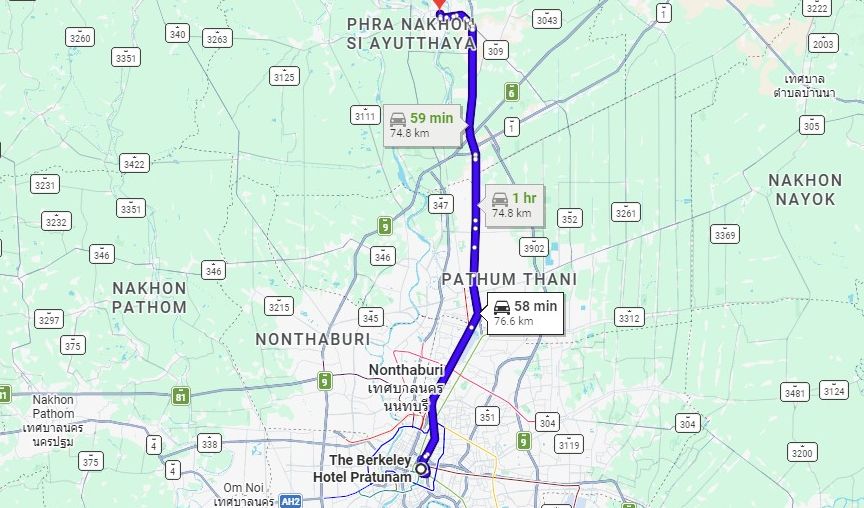
A bus picked us up at our hotel and the ride to Wat Mahathat takes about 1 hour.

Our bus dropped us off a the entrance of Wat Mahathat located in the center of Ayutthaya Historical Park.
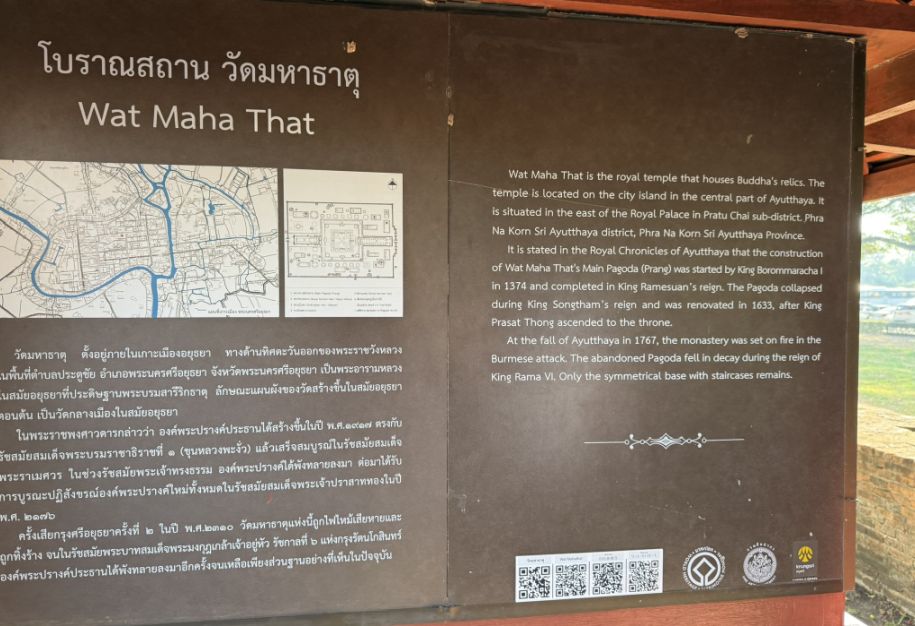
Our first stop in Ayutthaya was Wat Mahathat (Temple of the Great Relic), one of the most important and atmospheric temple ruins in the ancient capital. It was built in the late 14th century during the reign of Borommarachathirat I, the temple once served as a major religious center of the Ayutthaya Kingdom and housed sacred Buddhist relics.

Our guide giving us a brief history of Ayuttaya. The city was founded in 1350 by King Ramathibodi I, who established the Ayutthaya Kingdom. Because of its location between three rivers, the city became a major trading hub connecting Asia, the Middle East, and Europe. Merchants from China, Japan, Persia, Portugal, France, and the Netherlands all had trading posts there. At its peak in the 17th century, Ayutthaya was described by foreign visitors as one of the largest and most cosmopolitan cities in the world, with magnificent palaces, monasteries, and hundreds of temples. However, in 1767 the city was destroyed during the Burmese–Siamese War (1765–1767) when the Burmese army invaded, burned the city, and forced the Siamese kingdom to abandon it. Much of the city was left in ruins, which is why today visitors see scattered temples, broken towers, and damaged statues across the historical park.

Walking through Ayutthaya feels very different from visiting active temples in Bangkok. The area is vast and quiet, with brick ruins, crumbling stupas, and ancient trees scattered across the landscape. The red brick structures glow under the sun, and we can imagine the scale of the temples that once stood here.

Remains of monasteries, prayer halls, and towers that once formed an elaborate temple complex.

The walk through the property feels almost like wandering through an open-air archaeological site.
 |
 |
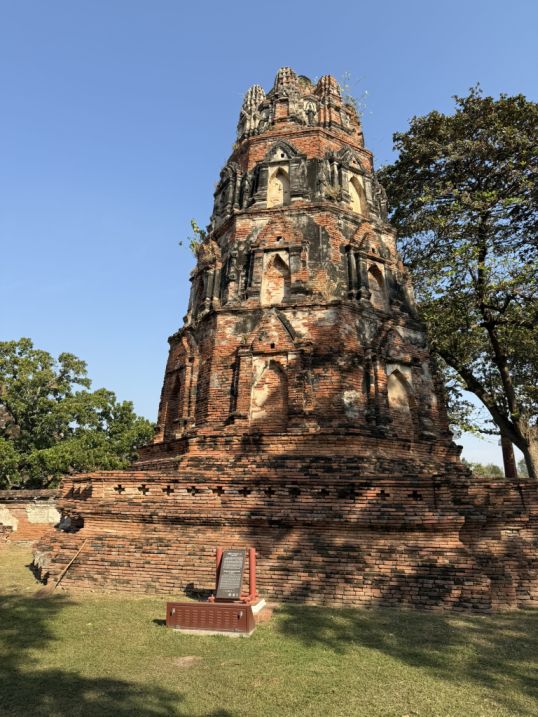
Crumbling brick walls outline former buildings, and partially collapsed chedis (stupa-like towers) rise above the grounds, giving a sense of the scale and grandeur the temple once had.

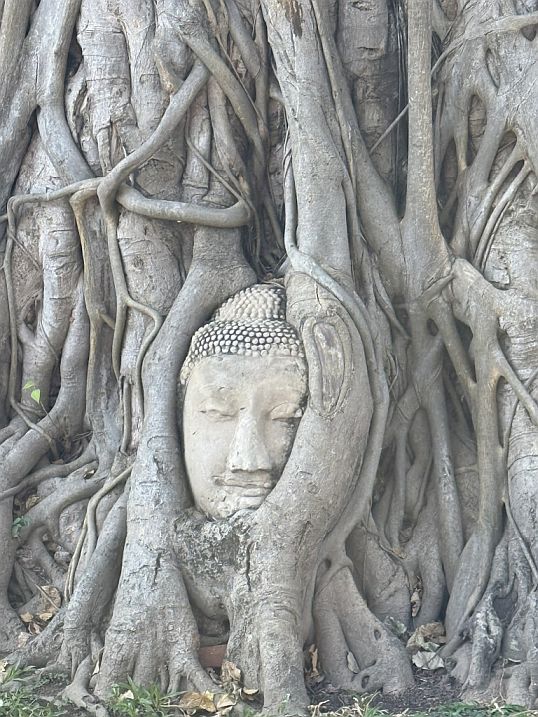
One of the most famous sights is the Buddha head embraced by tree roots, located near one of the temple walls.

The story behind it is both sad and fascinating.
In 1767, the Burmese invasion destroyed much of Ayutthaya and many Buddha
statues lost their heads. One head likely fell near a young bodhi tree.
Over time, the roots grew around it, lifting the head and creating a powerful
image of nature reclaiming sacred space.
 |
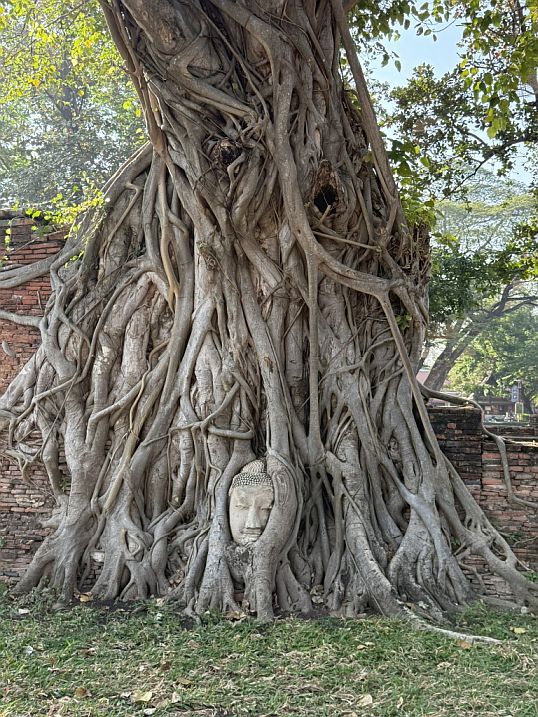 |
The result is a striking image of a serene stone Buddha face surrounded by living tree roots. Many visitors see this as a symbol of nature reclaiming the ruins and of the enduring spiritual presence of Buddhism even after the destruction of the city.
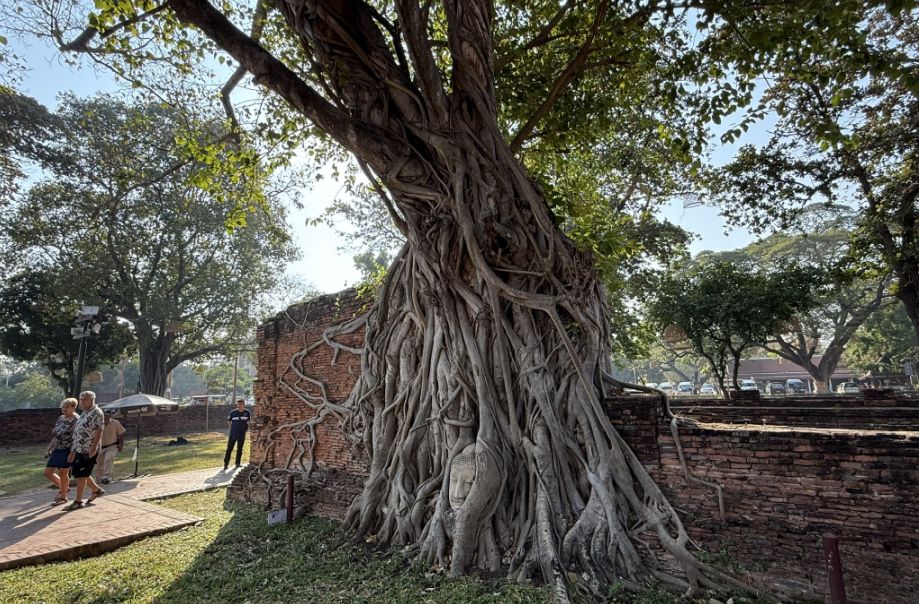
The Bodhi tree holds profound significance in Buddhism. It is believed to the tree under which Siddhartha Gautama, the historical Buddha, attained enlightenment around the 5th century BCE in Bodh Gaya, India. The Bodhi tree symbolizes awakening, wisdom, and the deep connection between nature and spiritual realization. It roots are deeply embedded in the earth, representing the need for grounding and stability in one's spiritual journey.
 |
 |
This sandstone Buddha head, mysteriously entwined within holy Bodhi tree roots, creates a powerful symbol of nature reclaiming ancient spirituality. Multiple legends surround its origin, including stories of thieves abandoning it only for growing tree roots to embrace the sacred image over centuries
 |
 |
Visitors are asked to show respect here by kneeling or lowering themselves when taking photos, since the Buddha head is considered sacred.

Walking further in the property.

As we walked around Wat Mahathat, it is very common to nose so many stupas scattered across the temple grounds. These structures, called chedis in Thai, are sacred Buddhist monuments. A stupa traditionally serves as a reliquary, meaning it holds relics such as sacred objects, ashes of monks or royalty, or symbolic relics connected to the Buddhism.
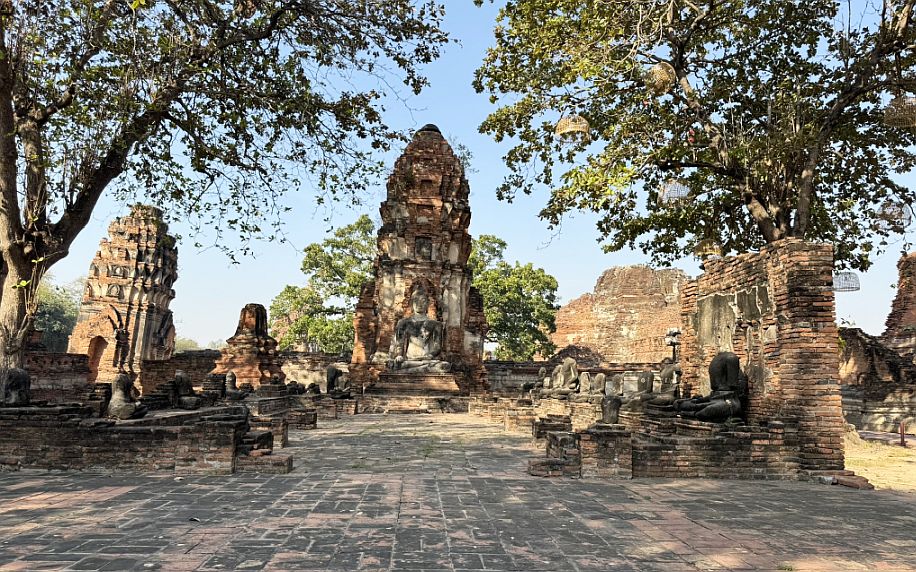
Courtyard where three stupas stand together, each slightly different in size and height. These groups of stupas were often built at different times, sometimes to hold relics or the remains of important monks associated with the temple.
 |
 |
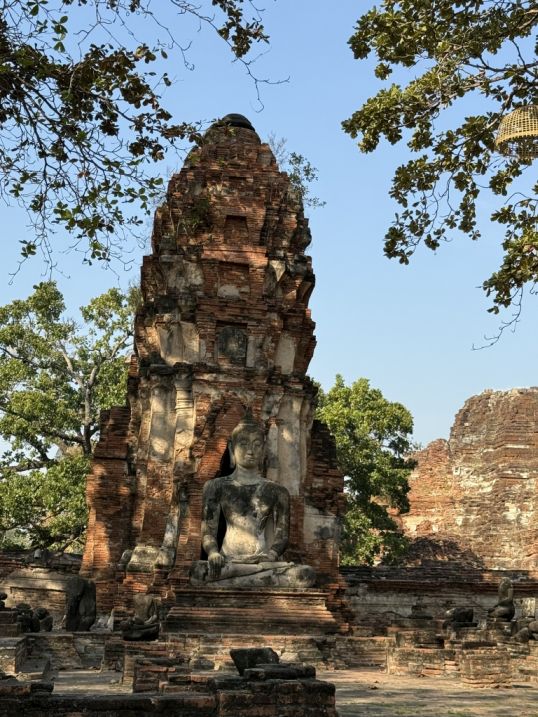
At the base of one of the stupas there is a large, intact Buddha statue seated in meditation, with legs crossed in the lotus position. This posture represents calmness, enlightenment, and spiritual balance. Seeing a complete statue here is striking because many others in the complex are damaged.
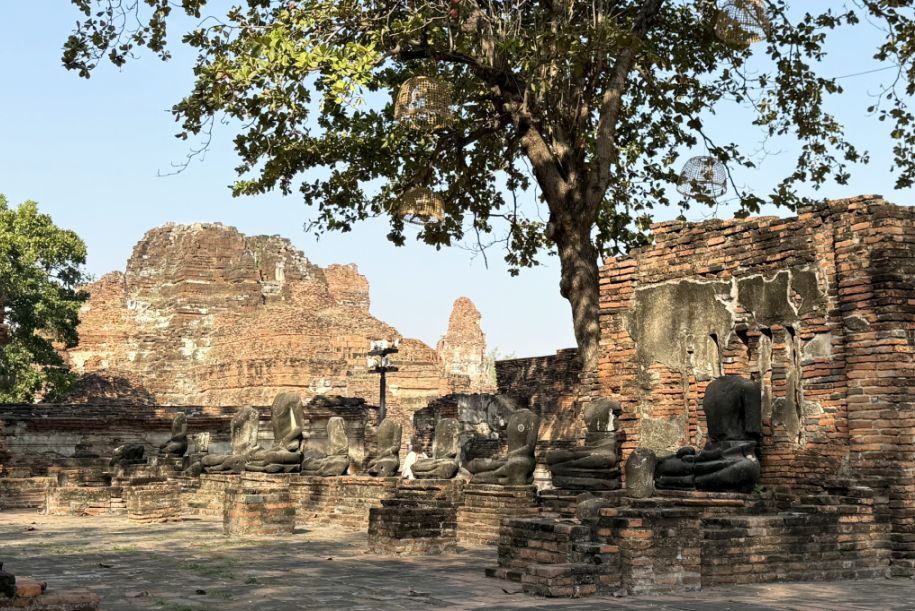
Around the courtyard we noticed a row of dark stone Buddha statues without heads lining part of a wall. These statues once formed a continuous row around the sacred area. Originally each figure had a serene Buddha face, but most of the heads were lost during the destruction of the city in 1767 or removed later by looters. Even without their heads, the statues still convey a powerful presence, silently guarding the ruins.
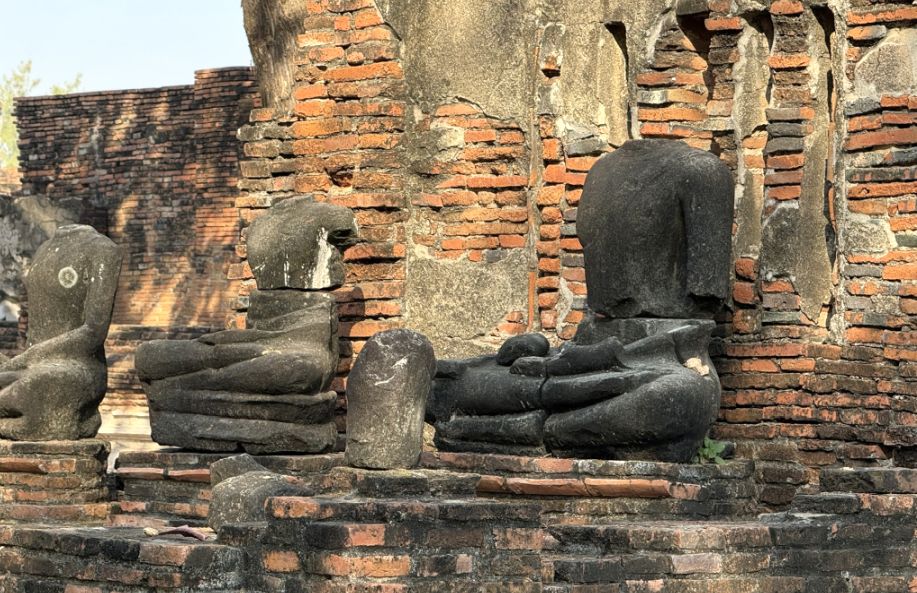
These statues once lined the galleries of the temple, creating a sacred walkway for monks and worshippers. Today their headless forms are among the most striking sights in Ayutthaya. The damage dates largely from the destruction of the city in 1767 during the Burmese–Siamese War (1765–1767), when invading armies burned temples and decapitated statues as symbols of conquest.
 |
 |
A stupa with a statue of Buddha that is still intact

This area used to be the Cloister and used to be a covered corridor surrounding the main sacred space of the temple. In Buddhist temple architecture, a cloister is a rectangular walkway lined with Buddha images, allowing monks and worshippers to walk around the sacred center while praying or meditating. In the past, this cloister would have been filled with dozens of complete Buddha statues, forming a serene gallery around the temple’s inner courtyard.

Today only the brick foundations, partial walls, and rows of headless statues remain, but these ruins help visitors imagine how grand the temple once was. Walking through these courtyards and cloisters gives a sense of the scale of the monastery and the spiritual life that once filled the ancient capital of Ayutthaya.

Our guide is leading us to the central and most sacred section of the temple complex.
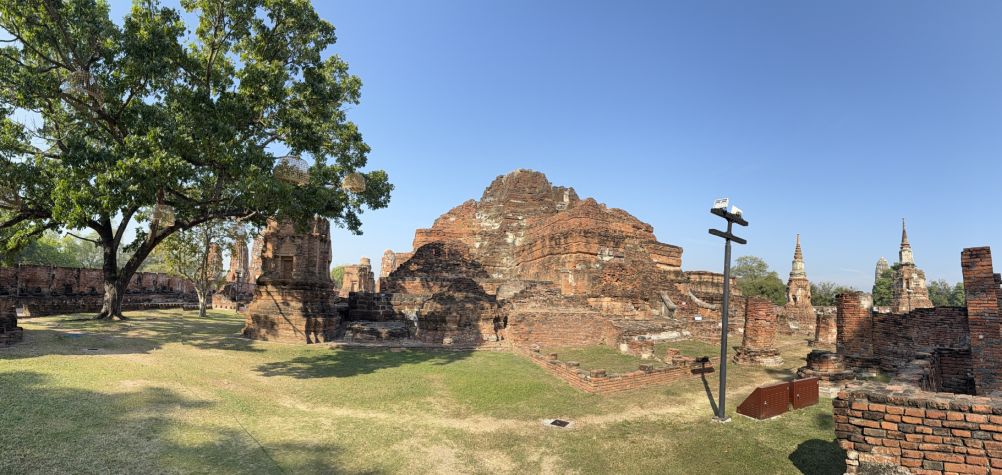
In the time of the Ayutthaya Kingdom, this area served as the spiritual heart of the monastery, where the most important ceremonies and religious activities took place.

In the center of this area stood the main prang, a tall tower built in the Khmer architectural style. Although much of it has collapsed today, it was originally a towering structure that could be seen from far across the city. The prang was built to enshrine sacred Buddhist relics, making it the holiest structure of the temple.
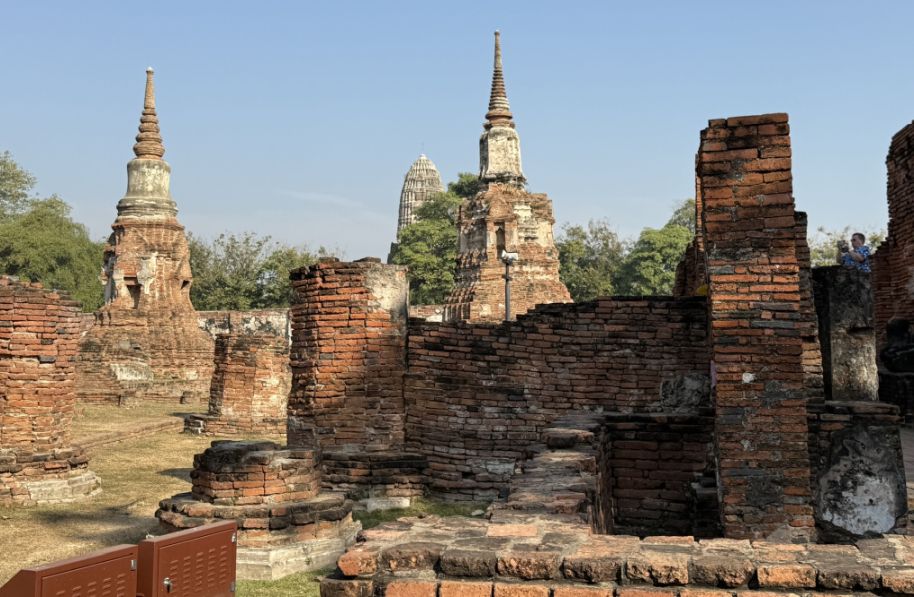
Around it were several smaller pointed stupas (chedis) with elegant, tapering tops. These structures often contained relics or commemorated important monks, members of the royal family, or donors who helped build the temple. As we walked through this central area today, you see rows of ruined pillars that once supported the roof of important buildings, such as the ordination hall or assembly hall where monks gathered for prayers, chanting, and religious instruction.

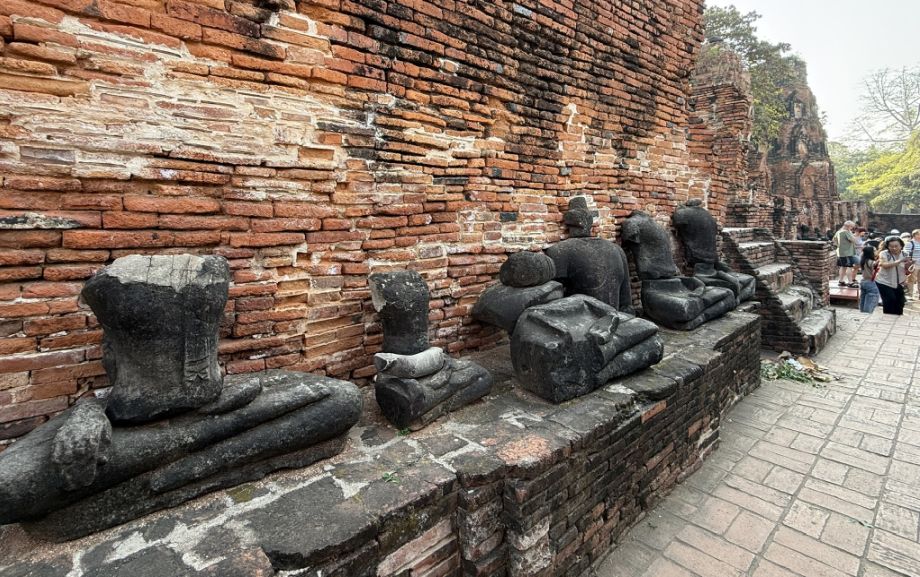
Surrounding the sacred center are many Buddha statues seated in meditation, positioned along platforms and walls.
 |
 |
As in other parts of the temple, most of them no longer have their heads. This damage largely dates back to the destruction of the city in 1767 during the Burmese–Siamese War (1765–1767), when invading armies burned temples and deliberately destroyed religious images.
 |
 |
Even in their damaged state, the statues still convey a powerful atmosphere.

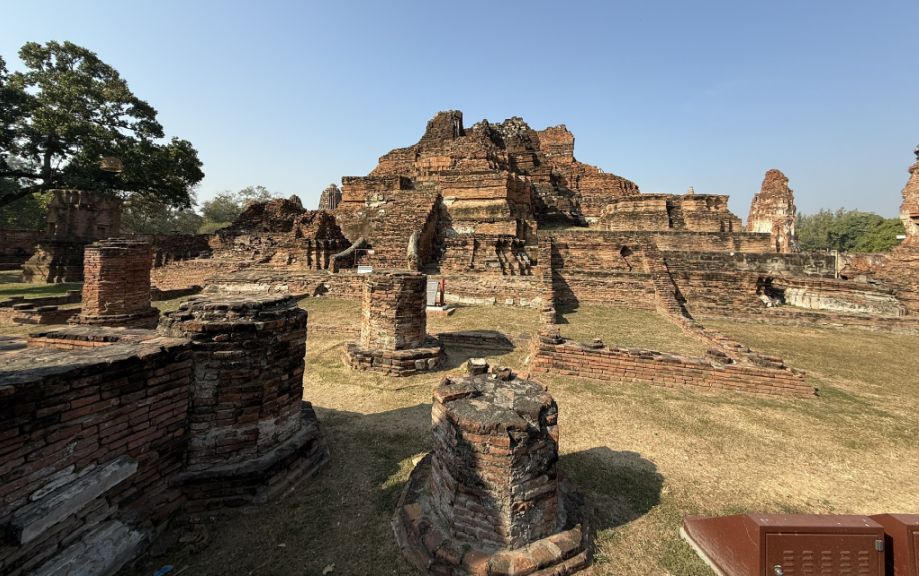
Ruined pillars that once supported the roof of important buildings, such as the ordination hall or assembly hall where monks gathered for prayers, chanting, and religious instruction. These buildings would have been covered with elaborate wooden roofs and decorated with carvings, murals, and gilded statues. Now only the brick bases and columns remain, giving visitors a sense of the scale of the original structures.

Today this central zone feels almost like a silent archaeological landscape, ancient brick structures rising among trees and open courtyards. Yet it was once a vibrant religious center where monks studied Buddhist teachings, ceremonies were held, and sacred relics were honored in one of the most important temples of the Ayutthaya kingdom.

I noticed one larger seated Buddha statue that is still intact. This larger statues was placed at important points along the cloister or near entrances to sacred buildings, serving as focal points for prayer and meditation.

So many stupas along the way.

The cloister walkway, sometimes referred to as the gallery of Buddha images. In many large temples of the Ayutthaya Kingdom, this cloister formed a rectangular corridor surrounding the sacred inner courtyard.

The long brick walkway you see today was once a covered corridor supported by wooden beams and pillars. Along both sides of the walkway were rows of seated Buddha statues placed on raised platforms. The long rows of headless figures sitting quietly among the ruins create a haunting reminder of the temple’s past.

During the destruction of the city in 1767, much of the temple was burned and the statues were deliberately damaged, which is why today you see so many headless Buddha statues sitting quietly along the brick wall. Even in this damaged state, the long line of statues gives a powerful impression of how grand the cloister once was.


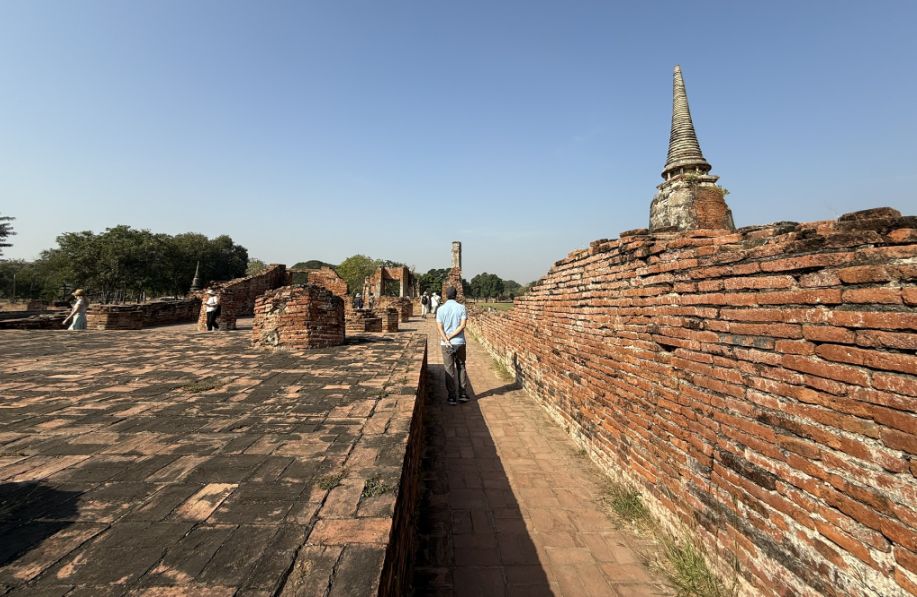
Beautiful brick walkway with the surrounding brick stupas, broken pillars, and towering prang remains help visitors imagine how magnificent this complex once was when it was filled with monks, pilgrims, incense, and chanting.

This is a combination of Chedi (stupa) and Prangs. These two structures together tell the story of the kingdom’s architecture. The Khmer influence appears in the prangs, while the Sri Lankan and traditional Buddhist influence appears in the chedis. Seeing both styles in the same temple complex shows how Ayutthaya was a crossroads of cultures, religion, and art during the height of the Ayutthaya Kingdom.
 |
 |
When walking through the ruins of Ayutthaya, it helps to know how to distinguish between the two main types of religious towers you will see: prangs and chedis (stupas). Both are sacred structures in Buddhism, but they have different shapes, meanings, and historical influences.
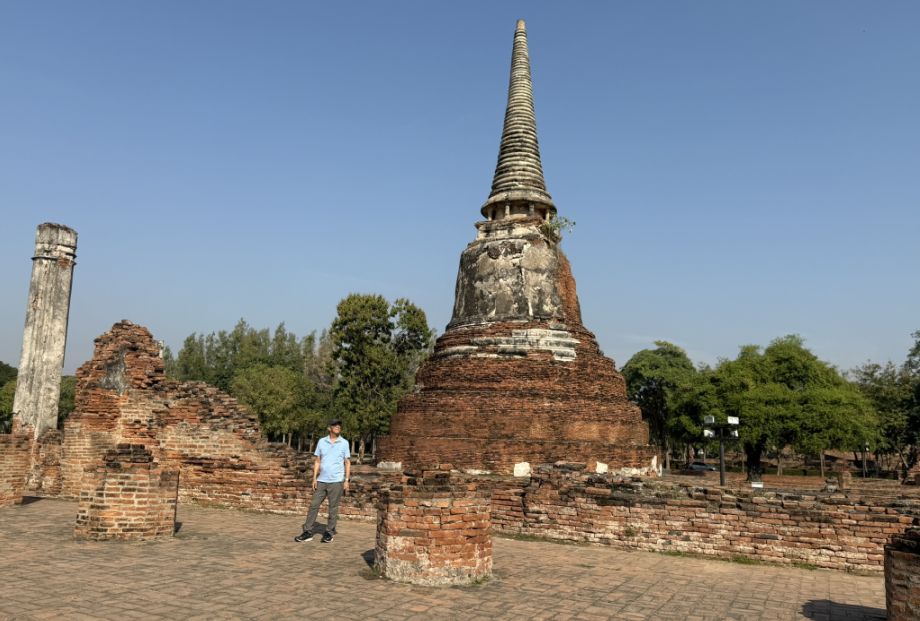
This one is a Chedi (Stupa) because it is bell-shaped , often look like a large bell sitting on a base, and usually shorter and wider than prang. Chedis are reliquary monuments. They were built to hold Buddha relics, ashes of kings or monks, and sacred objects or scriptures. They represent the enlightenment of the Buddha and are among the most sacred structures in Buddhist architecture.

Here you see a mixture of Chedi (on the left) and Prangs (Khmer-style tower) on the right. They are tall and corn-cob shaped, usually very tall and narrow, and sometimes have small niches where Buddha images were placed. The prang design comes from the architecture of the Khmer Empire. It symbolizes Mount Meru, the sacred mountain believed in Hindu and Buddhist cosmology to be the center of the universe.

We are now leaving the area.
 |
 |
Through an opening beyond the ruins we saw what looks like a body of water.

This is likely part of the moat or water channels that once surrounded sections of the ancient city of Ayutthaya.

The capital was originally built on an island formed by three rivers, and canals and ponds were an important part of the city’s design, helping with transportation, defense, and water management.

We are now going back to the parking lot.

These tall brick towers prangs are enormous and it is a distinctive temple structure found throughout the ancient capital of Ayutthaya.
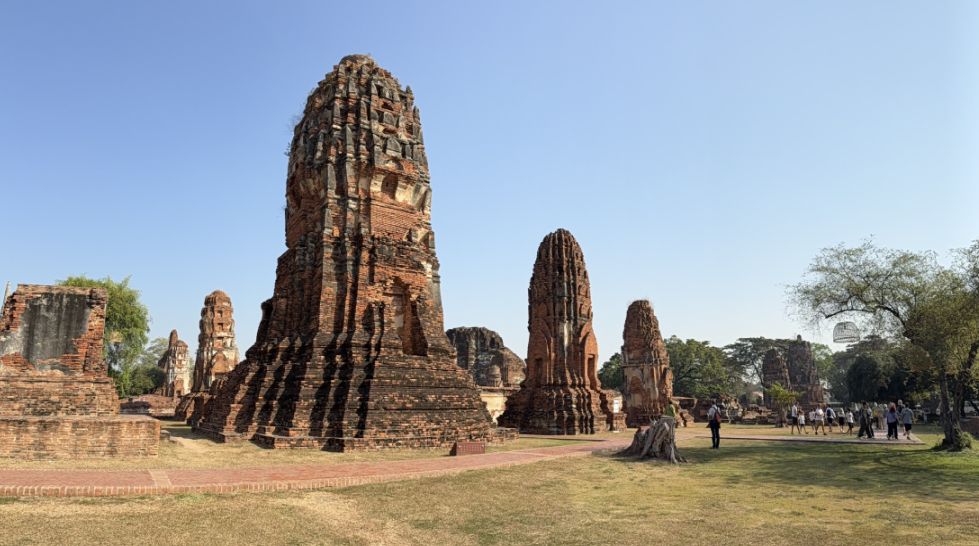
They are part of the ruins within Wat Mahathat, one of the central temples of the old city.

These structures are Khmer-style prangs, which are tall, corn-cob–shaped towers built of brick and laterite. This architectural style was influenced by the Khmer empire (the same cultural tradition that built Angkor Wat). When the Ayutthaya Kingdom flourished, its architects adopted and adapted this style.

A prang usually served as the central shrine of a temple. Inside the tower there was often a small chamber containing sacred relics, such as fragments of Buddha relics, sacred texts, or ritual objects. The vertical shape symbolized Mount Meru, the sacred cosmic mountain in Buddhist and Hindu cosmology, believed to be the center of the universe
 |
 |
We are having fun taking pictures with the Prangs (trying to push up the tilting prang).

When the city was destroyed in 1767 during the Burmese–Siamese War (1765–1767), many temple structures collapsed or burned. Over time the outer stucco decorations fell away, leaving the bare red brick skeletons that give Ayutthaya its dramatic archaeological appearance today.

Walking back to our meeting place.
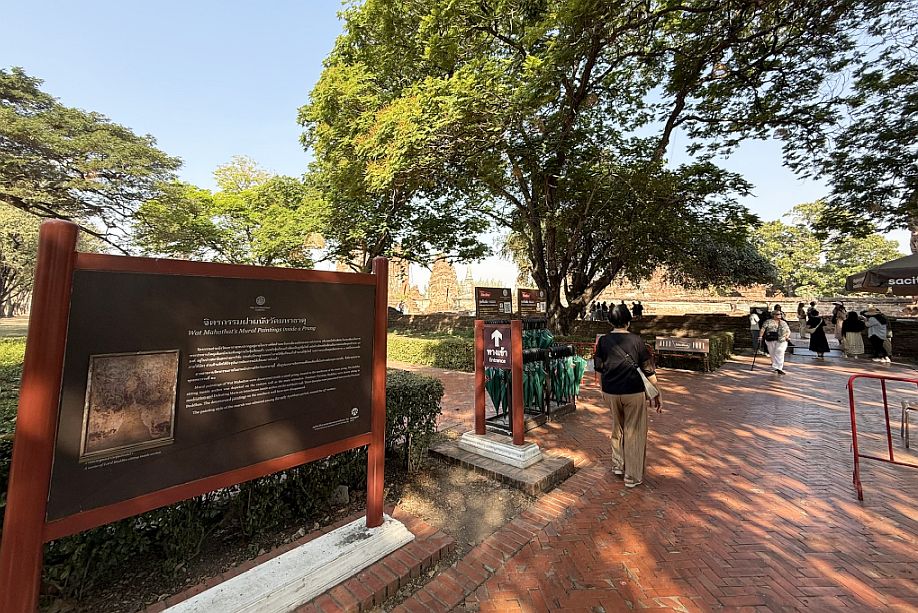
We are done with our visit here and we are headed to the next destination.
NEXT... Day 2-Wat Phrasisanpeth