

12 days in Thailand 1/7- 1/18/2025
Chinatown, Bangkok-1/7/2025
Today we are flying from SFO to Bangkok. The direct flight was a little over 16 hours and by the time we got there, it was late in the evening. The next morning we met up with Hoa's family.
|
|
Our first day in Bangkok began with a subway ride from hotel The Berkeley Hotel Pratunam to the city’s vibrant Chinatown, known locally as Yaowarat.
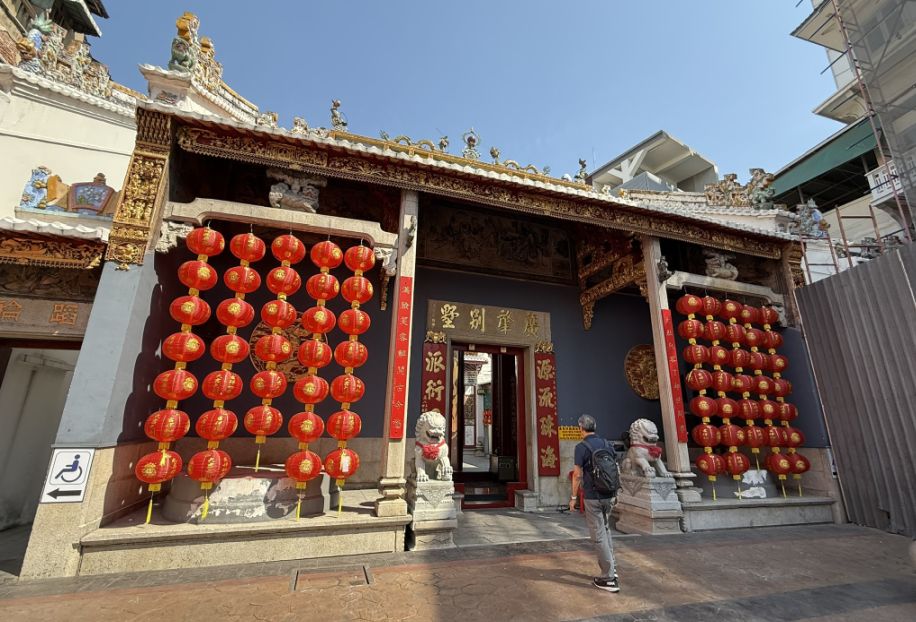
Our first stop was the Kwang Tung Shrine, a small but deeply revered Chinese temple tucked within the busy neighborhood.

Built by Cantonese immigrants more than a century ago, the shrine is dedicated to deities important to the Chinese community in Bangkok.

Inside, the scent of burning incense fills the air as visitors light joss sticks and bow before the altar, asking for blessings, prosperity, and good fortune for the coming year. The shrine reflects the long history of Chinese migration to Thailand, where generations of traders and merchants helped shape the culture and economy of Chinatown.

Walking further into Yaowarat, the streets became even more festive. Nearly every shop was decorated with red lanterns and auspicious symbols, transforming the entire district into a glowing corridor of color.

Red and gold decorations hung above storefronts selling gold jewelry, dried seafood, herbal medicines, and traditional sweets, items often purchased as gifts or offerings during the New Year season.

Eventually we arrived at the iconic Odeon Circle Chinatown Gate, the grand entrance to Chinatown.

The gate, with its ornate red pillars and elaborate golden roof, was built in 1999 to celebrate the 72nd birthday of Bhumibol Adulyadej (the late King). Known as the “Gate of the King’s Birthday Celebration,” it symbolizes the strong ties between Thailand and its Chinese community. The design follows traditional Chinese architectural styles, with guardian lions and intricate carvings representing prosperity, longevity, and protection.
 |
 |
Thierry, Hoa, and George.
Mai, Cang, me, and Chi Be in front of the iconic Odeon Circle Chinatown Gate

After walking through Chinatown, you arrived at Wat Traimit Witthayaram Worawihan, one of the most famous temples in Bangkok. Located at the edge of Chinatown, the temple is best known for housing the Golden Buddha, the largest solid gold Buddha statue in the world.
 |
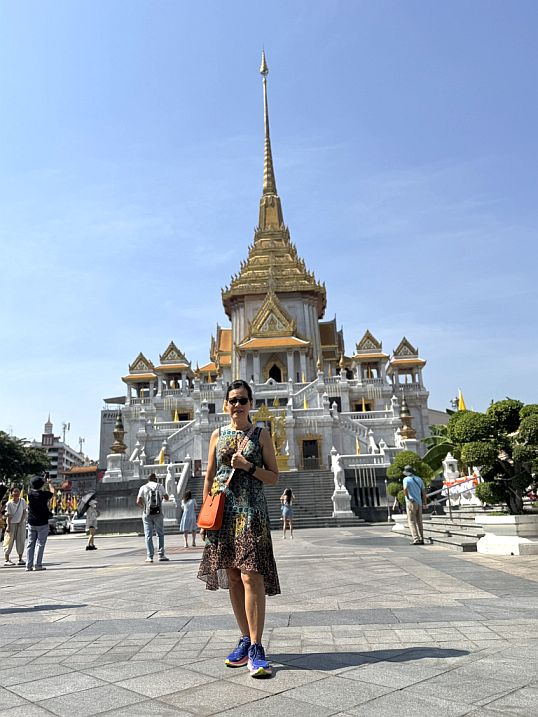 |

Visitors pay an entrance fee to go up to the top level of the temple, where the magnificent Golden Buddha (Phra Phuttha Maha Suwana Patimakon) is enshrined.

Before climbing to the upper level, we noticed the large portrait of Bhumibol Adulyadej, the late king who is deeply revered throughout Thailand. Images of him appear in many public places and temples as a sign of respect and gratitude for his long reign (1946–2016) and his role in modern Thai history

I am now going up to the upper level of the temple

Inside is the famous Golden Buddha (Phra Phuttha Maha Suwana Patimakon). The statue weighs about over 11,000 pounds and is made almost entirely of solid gold.

It dates from the Sukhothai period (13th–14th century), one of the golden ages of Thai Buddhist art.
One of the most fascinating parts of its history is that for centuries the statue’s true value was hidden. To protect it from invading armies, the gold Buddha was completely covered in plaster and stucco so that it looked like an ordinary statue. Its secret was only discovered in 1955, when the statue was accidentally dropped during a move and some of the plaster chipped off, revealing the gold underneath.
 |
 |
The Buddha is depicted in a graceful seated posture, with the elegant flame-like shape on the head that is characteristic of Sukhothai style sculptures.

View of the Buddha statue from the back.

We are now on the ground level of the temple and there are many Buddha statues.

We are now entering this temple of the ground level. The temple complex itself has several levels, including a museum that explains the history of the Golden Buddha and the development of Bangkok’s Chinatown community.

Inside there is another large Buddha statue. This hall is quieter and serves as a place where visitors and local worshippers can pray, light incense, and make offerings.

Our family praying..
 |
 |
We are now done with our visit. Cang, and Chi be drinking fresh coconut while waiting for everyone to done with the visit. As we are leaving the temple, the ladies saw a lady selling bracelets and we are checking out her merchandise.

Our next stop was the Thian Fah Foundation, another important cultural and religious site in Yaowarat. At the entrance there is a beautiful Chinese-style ceremonial gate, richly decorated in red and gold. Like many structures in Chinatown, the gate reflects traditional Chinese architectural design, with curved rooflines, decorative carvings, and bright colors symbolizing good fortune and protection

Passing through the gate leads into a courtyard where the temple building stands quietly behind the busy street.

The foundation is one of the oldest Chinese charitable organizations in Bangkok, established in 1902 by members of the Chinese immigrant community. Its mission has long been to help people in need, providing medical care, emergency services, and social assistance. In fact, the foundation operates a hospital and is well known in the city for its volunteer rescue and ambulance services.

Inside the temple is the Guanyin statue at Thian Fah Foundation, a large and elegant statue of Guanyin, the bodhisattva associated with mercy and compassion in Chinese Buddhism. The statue is particularly revered because it dates back several centuries and was brought to Thailand by Chinese immigrants. Many visitors come here to pray to Guanyin for health, protection, and guidance.
 |
 |
Guanyin is short for Guanshiyin, which means "[The One Who] Perceives the Sounds of the World". Originally regarded as male in Indian Buddhism, Guanyin has been more commonly depicted as female in China and most of East Asia since about the 12th century. Due to sociogeographical factors, Guanyin may also be historically depicted as genderless or androgynous. On the 19th day of the sixth lunar month, Guanyin's attainment of Buddhahood is celebrated. Guanyin has been incorporated in other religions, including Taoism and Chinese folk religion.

The temple provides a peaceful contrast to the busy streets of Chinatown outside.
 |
 |
While Yaowarat is filled with shops, food stalls, and traffic, the courtyard of the Thian Fah Foundation feels calm and reflective, with worshippers lighting incense and quietly offering prayers.
 |
 |
The combination of charity work, community service, and religious devotion makes this place a meaningful landmark for Bangkok’s Chinese-Thai community.

We are now leaving the temple and heading to lunch.

We met up with Thuan who flew from Saigon just to spend some time with all of us.

We are so happy to meet up with Hoa's sisters, brother, and the in-laws.

Quick selfie before having lunch.

We had traditional Thai noodle soup in a casual restaurant in Chinatown.

So nice to see everyone in Bangkok.
 |
 |
We passed by a small open air market. This vendor is displaying so many delicious pre-cooked dishes.
 |
 |
Fish and vegetable market.
 |
 |
A simple stall selling soup. Mai and Thierry buying decoration for Chinese New Year.

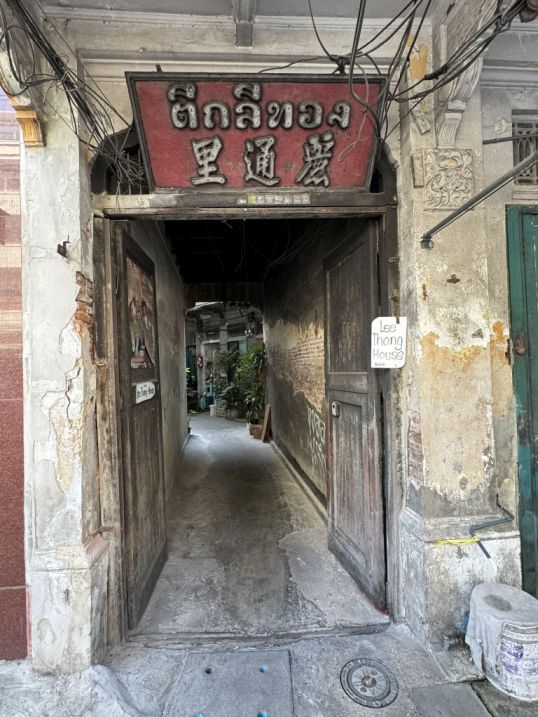
Before reaching Wat Mangkon Kamalawat, we walked through an alley.

Inside the alley there is a display of a visual timeline of the monastery, filled with photographs and historical panels.

These images trace the history of the temple and the Chinese Buddhist community in Bangkok. Among the pictures you likely noticed portraits of Bhumibol Adulyadej, the late Thai king who was widely respected and often supported religious and charitable institutions across the country.

Other photos showed generations of monks connected with the temple, documenting its long spiritual lineage. A few striking image showing Pope Francis shaking hands with a Buddhist monk during his 2019 visit to Thailand, a moment that symbolized interfaith respect and dialogue between Buddhism and Catholicism.
 .
.
At the end of the alley we arrived at Wat Mangkon Kamalawat, the largest and most important Chinese Buddhist temple in Yaowarat. Built in the late 19th century, the temple follows traditional Chinese architectural styles rather than the typical Thai temple design.

In the courtyard stands a large incense burner, where worshippers place bundles of burning incense as offerings.

Inside the main hall, the temple feels warm and glowing with rows of red lanterns hanging from the ceiling, symbols of prosperity and good fortune, especially meaningful with Chinese New Year approaching.
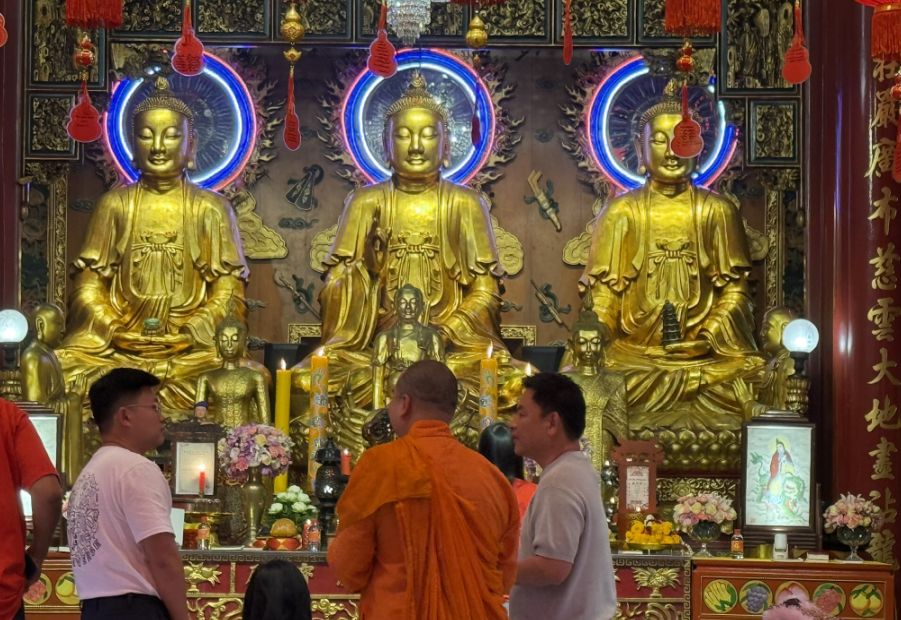
At the center of the shrine are three large golden Buddha statues,

Surrounded the room are figures of bodhisattvas and guardians.

The hall was crowded with worshippers lighting incense, bowing, and making offerings for blessings in the coming year. The atmosphere is lively but reverent, with the sounds of prayer, flickering candles, and the soft light reflecting off the golden statues.
 |
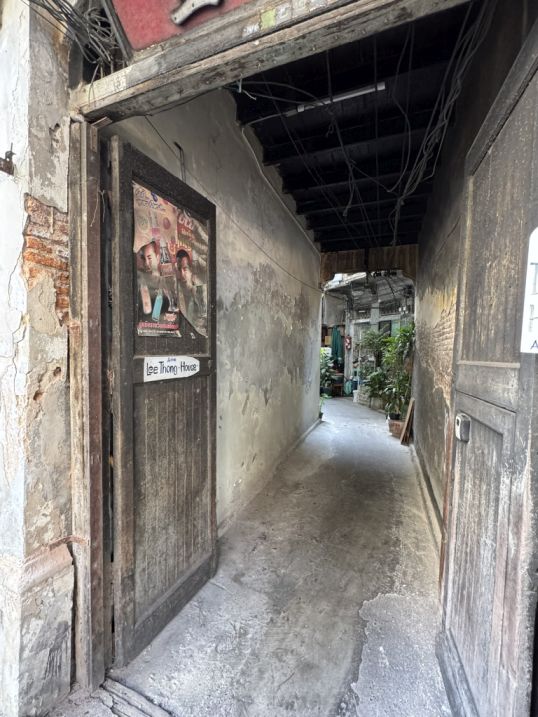 |
We are heading for some refreshment at Vanish Café & Bar, and on the way we passed by a and cute small alley.

Vanish Café & Bar is a quiet and modern contrast to the busy streets of Chinatown. Tucked into a side street, it offers a relaxed space where visitors can cool down and enjoy coffee, tea, or refreshing drinks.
Take at the silver Elephant on the right, I'll tell you a about it in a bit.

The design blends contemporary café style with touches of Thai and Chinese influence, making it a pleasant resting spot after exploring the temples and crowded markets of Yaowarat.

Sitting there with a cold drink, it was a perfect moment to pause and take in the vibrant experiences of our first day in Bangkok before heading back to our hotel.

We called for Grab to pick us up but they told us to go to a main street. On our way there we encountered this shop with a large elephant statue on display.
 |
 |
After talking to the owner he told us that the Elephant Parade is an open-air exhibition dedicated to saving the Asian elephant from extinction. For one or more months, hundreds of painted elephant sculptures specially created by artists are placed in the streets of one or more host cities to increase public awareness of the plight of the elephant and gain support for Asian elephant conservation. They are then auctioned off, with the proceeds going to the Elephant Family organisation.
 |
 |
For Dinner we are meeting up with my aunt Kim, and her husband Larry in the lobby of our hotel. We made arrangement so everybody is staying in the same hotel.

Group picture!

Since this is our first evening in Bangkok, we all voted for Thai Food. Burn Busaba in located inside the CentralWorld shopping mall. It is actually quite common in Bangkok for many excellent restaurants to be located inside shopping malls. Modern malls such as CentralWorld, Siam Paragon, and ICONSIAM have become major dining destinations. It is Air-conditionning and comfortable as the heat adn humidity in Bangkok make malls a pleasant place to dine.

After a long day exploring the temples and streets of Chinatown, the restaurant was a comfortable place to relax and enjoy dinner. Burn Busaba is known for serving refined versions of classic Thai dishes, focusing on bold flavors, balanced between spicy, sour, sweet, and salty, which define traditional Thai cuisine. The dishes are often beautifully presented while still keeping the authentic taste that locals expect.

Cheers to the good time. Such a rare adn special occasion to see everyone in Bangkok.
 |
 |
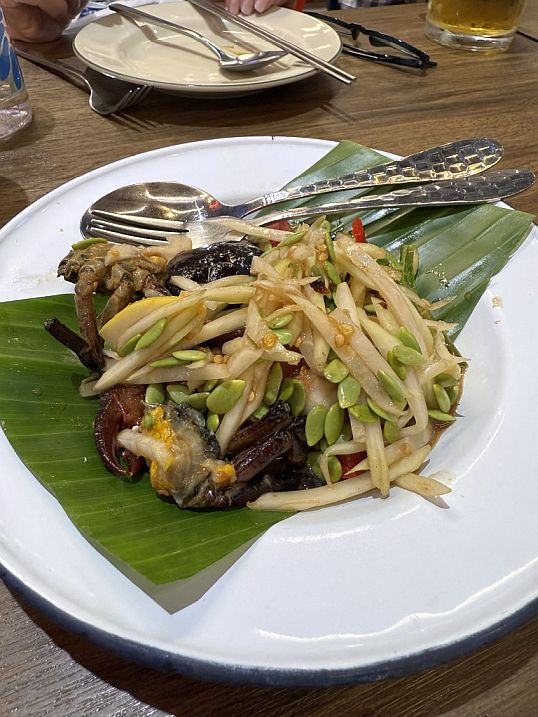
Papaya salad with crab.

Stir fried glass noodle with shrimps, and morning glory.
 |
 |
Fried crispy pork belly with tomato dipping sauce.
 |
 |
Pad Thai
 |
 |
Grilled beef with tomato dipping sauce.

Tom yum goog soup
 |
 |
Tom yum gogo soup with crispy fried chicken wings with cripsy shallot.
 |
 |
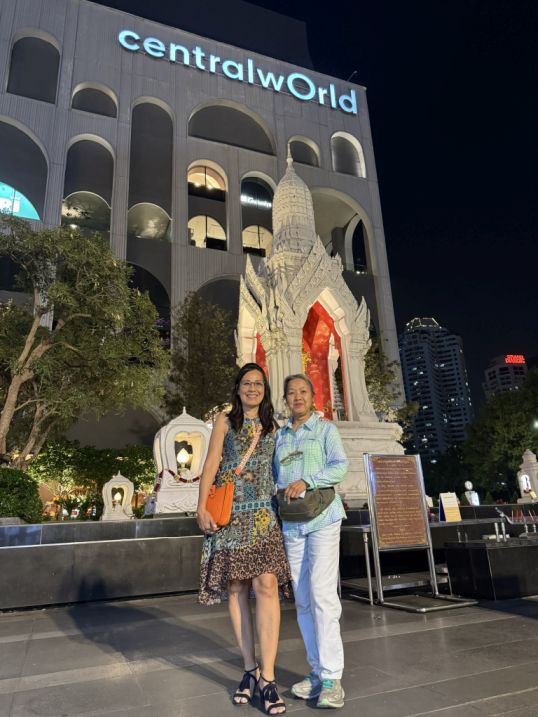
My aunt Kim and me in front of CentralWorld.
Our first day in Bangkok began with a subway ride from Pratunam to the vibrant streets of Yaowarat, where the neighborhood was already glowing with red lanterns in preparation for Chinese New Year. After visiting shrines and walking through the bustling markets, we stopped at the impressive Odeon Circle Chinatown Gate, the symbolic entrance to Chinatown. The afternoon continued with visits to several important temples, including Wat Traimit Witthayaram Worawihan, home to the famous Golden Buddha, and Wat Mangkon Kamalawat, where worshippers filled the courtyard with incense and prayers beneath rows of red lanterns. Along the way, we also stopped at the Thian Fah Foundation, a historic Chinese charitable temple dedicated to compassion. After a refreshing break at Vanish Café & Bar, the evening ended with a delicious Thai dinner at Burn Busaba in CentralWorld, a perfect close to a day filled with culture, history, and the lively atmosphere of Bangkok.
NEXT... Day 2- Guided tour -Wat Mahathat, Ayuttaya