5 days in Laos-1/31- 2/3/2025
|
Day 1 Vientiane |
Day 2-Vientiane Patuxai That Luong Buddha Park Tamnak restaurant |
Day 3-Vientiane Cope Museum Wat Si Muang |
Day 4-Luang Prabang Mekong River cruise Pak Ou Caves Lunch at Manifa Kuang Si waterfall Main Waterfall Manda de Laos |
Day 5-Luang Prabang Mount Phousi |
Day 2-Buddha Park, Vientiane -1/31/2025
After resting for a while, we hired a driver and headed out of Vientiane to Buddha Park, also known as Xieng Khuan, meaning “Spirit City.” Located about 16 miles southeast of the city near the Mekong River, the park is unlike anything else we had seen that day.
Buddha Park was created beginning in 1958 by Luang Pu Bunleua Sulilat, a spiritual teacher and sculptor who combined ideas from Buddhism and Hinduism into his own distinctive vision. Unlike That Luang or the old temples of Vientiane, these are not ancient statues. Most are enormous reinforced-concrete sculptures created in the 20th century, but their forms are inspired by centuries-old religious stories, gods, demons, animals, and Buddhist imagery. There are more than 200 sculptures spread throughout the park.

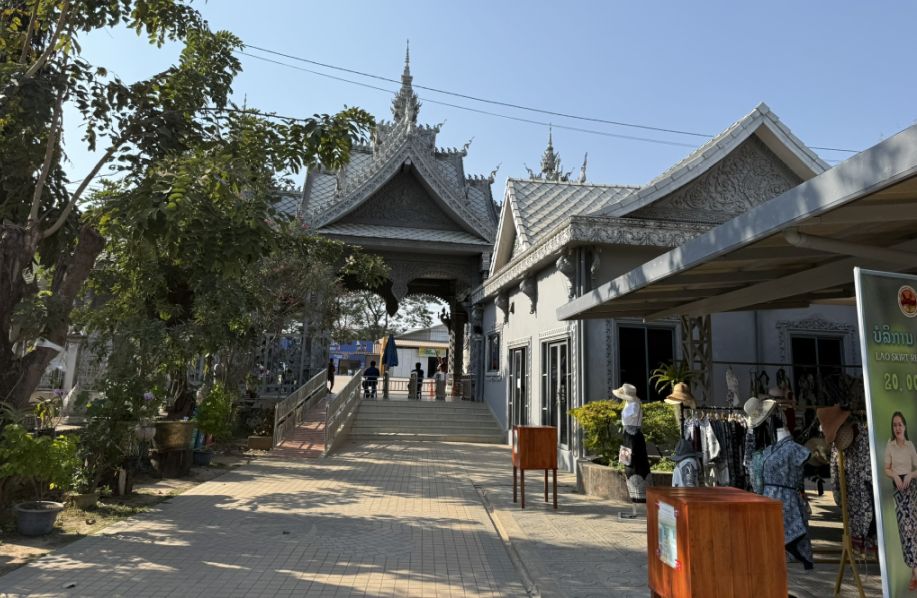
We are waiting at the entrance lobby while Hoa is buying tickets for us to get in the park.

After buying our tickets, we entered Buddha Park along a lovely walkway shaded by trees, with bougainvillea climbing over metal archways and adding bright splashes of color.
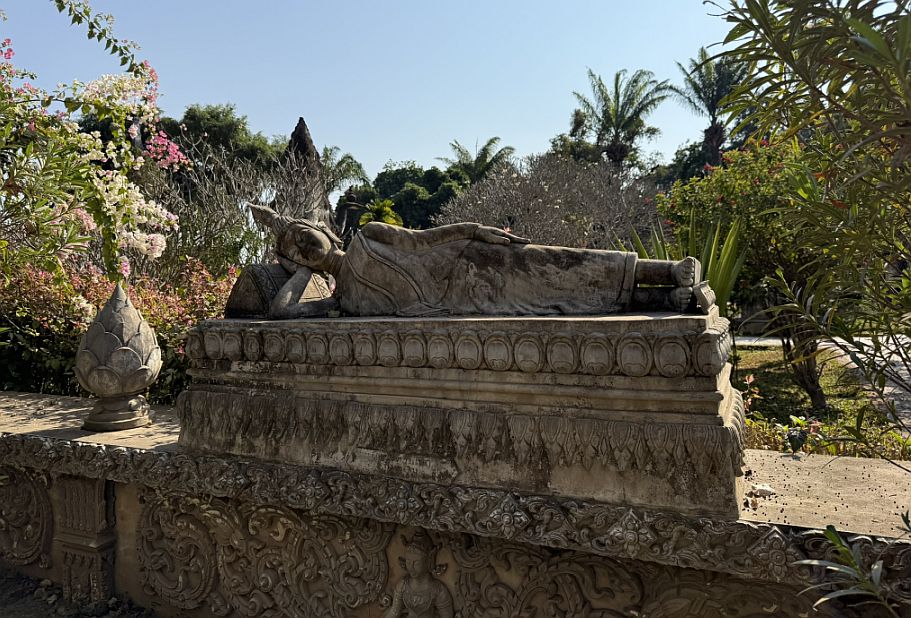
Almost immediately, we came across a reclining Buddha, lying peacefully with one hand supporting his head.

A little farther into the park, we came upon the enormous reclining Buddha, one of the most impressive sculptures in Buddha Park. Stretching roughly 131 ft. in length, the figure dominates the landscape. The Buddha is lying on his right side in the traditional posture associated with parinirvana, the final passing of the Buddha after he had completed his earthly life and teachings.

His peaceful expression and relaxed posture give the enormous sculpture a surprisingly calm presence despite its massive size. Standing beside something this enormous really gives you a sense of scale. It was one of those sculptures that photographs don't quite capture, you have to stand there and look up at it to appreciate just how large it really is.
 |
 |
Unlike the polished golden Buddha images we had seen at the temples earlier in the day, this one is made of concrete and has a much more monumental, almost surreal quality. Around it are other sculptures and religious figures, making the reclining Buddha feel like one part of a much larger spiritual landscape.

Walkway inside the park with sculptures along the way.
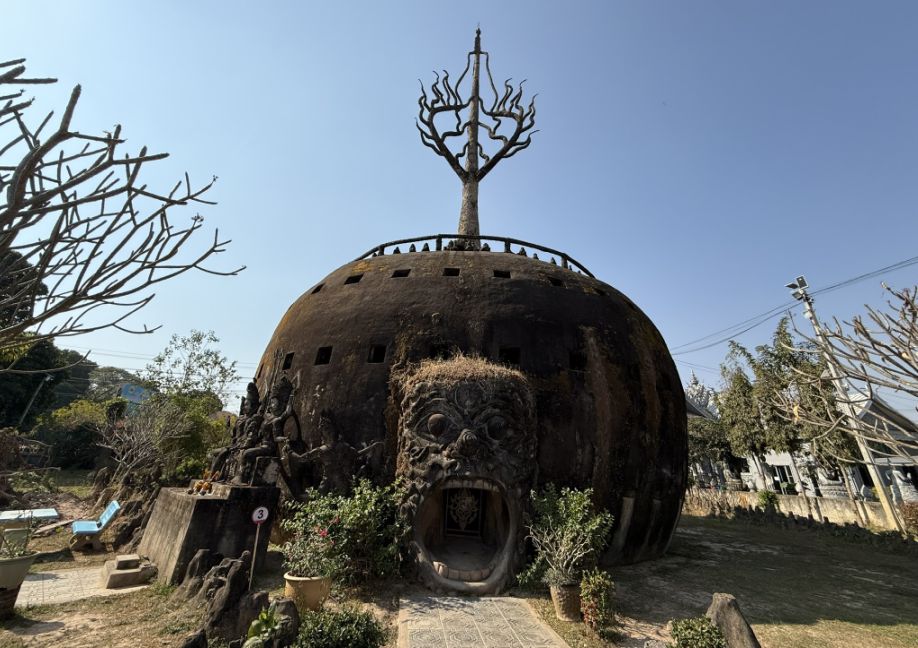
As we continued along the walkway, we came to one of the strangest and most impressive structures in the entire park, a huge, rounded concrete structure that looks almost like a giant pumpkin or dome. At the front was a massive, frightening face with its mouth wide open, almost as if it were screaming. This enormous mouth is actually the entrance into the structure. Rising from the top was an unusual tree-like sculpture, with twisting, curling branches reaching toward the sky. The whole structure looked almost otherworldly, which seemed perfectly fitting for a place as unusual as Buddha Park.
 |
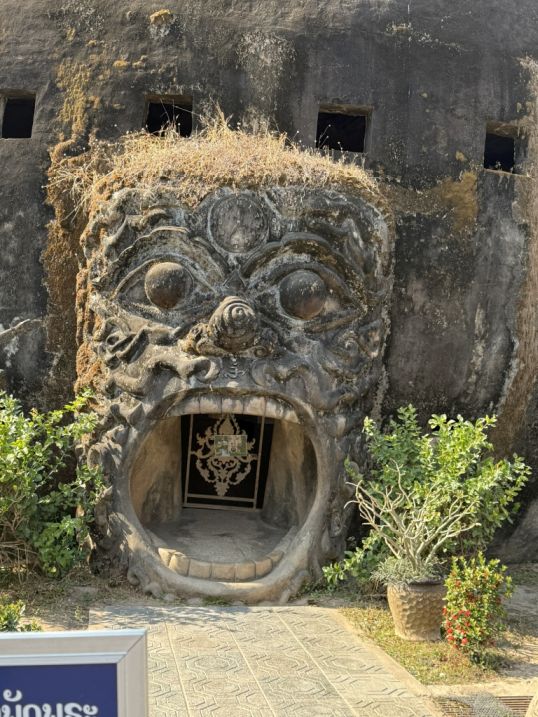 |
This is the park's famous three-level "pumpkin", representing Hell, Earth, and Heaven. The demon's open mouth at the bottom represents the entrance into Hell. Inside, visitors can climb through the different levels, where sculptures illustrate the various realms of existence. Eventually, you can climb all the way to the top, where the circular platform gives you a wonderful view over the entire park.
Looking at it from the outside, with the enormous face staring back at us and that strange twisting tree rising from the top, it was hard to imagine that this was created in the late 1950s rather than being some ancient religious monument. It was one of the many surprises of Buddha Park.

These 2 sculptures is combining Buddhist and Hindu imagery. The tall figure on the right appears to be a Hindu deity, probably Vishnu or a Vishnu-related divine figure. The circular object in the raised hand looks like the chakra (discus), one of Vishnu's principal attributes. The elaborate pointed crown is also typical of Hindu divine imagery in Laos and neighboring Thailand.
 |
 |
The smaller figure on the right is harder to identify confidently from this angle. Its dramatic posture and serpent-like/arched element suggest it may represent another figure from Hindu mythology—possibly a deity, demon (asura), or attendant associated with the scene.
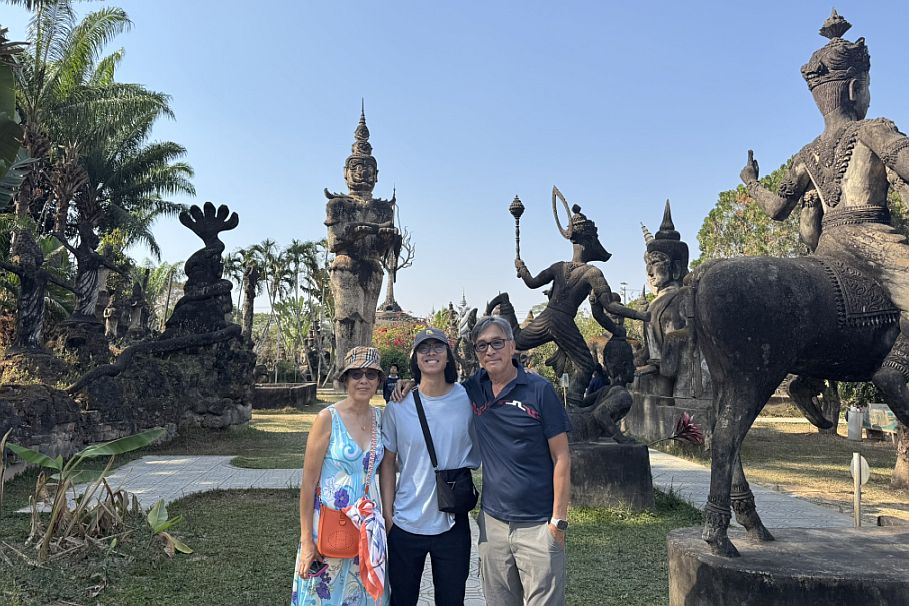
There are more than 200 sculptures, and you'll notice that some are obviously Buddha's, while others have many arms, animal heads, snakes, frightening faces, or look like monsters. That's intentional. The park combines Buddhist and Hindu mythology, especially ideas about karma, rebirth, gods, demons, heaven, hell, and the different realms of existence.

AS we walked along there are many Buddha's sculptures in different positions.

Through the bougainvillea's I noticed an interesting sculpture. It appears to be a representation of Avalokiteshvara, the bodhisattva of compassion, although Sulilat's sculpture mixes iconography enough that I wouldn't treat the identification as certain.

The small figure at the front: This is a particularly nice detail. The enormous supernatural figure towers behind a comparatively human-scale figure, emphasizing the relationship between the cosmic/divine realm and ordinary beings.

The increasingly elaborate tower of heads: In traditional eleven-headed Avalokiteshvara imagery, the heads are stacked vertically, sometimes culminating in a fierce face and a Buddha at the top. Sulilat seems to be taking that basic visual idea and making it much more surreal.
In Buddhist imagery, Avalokiteshvara can appear with numerous arms. They symbolize the ability of compassion to reach beings everywhere, many hands available to help many beings.
Look upward and you'll see faces arranged in tiers. In multi-headed forms of Avalokiteshvara, these represent the ability to look in every direction and perceive the suffering of all beings.

Walking around the park.

Following the walkway inside the park...

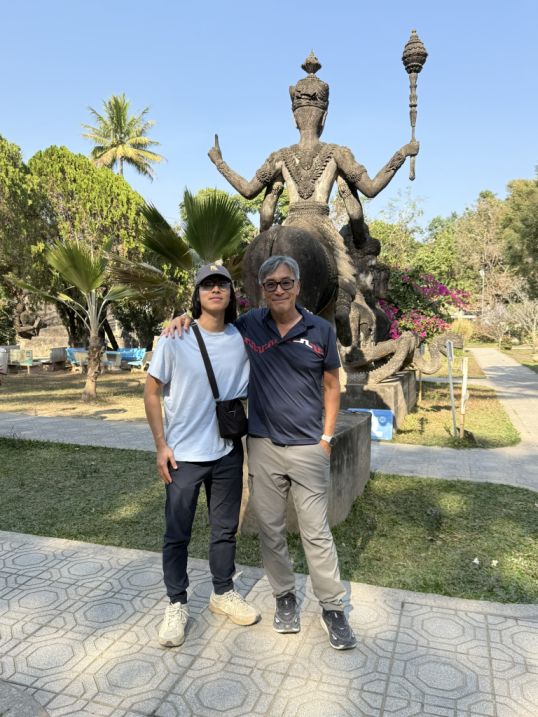
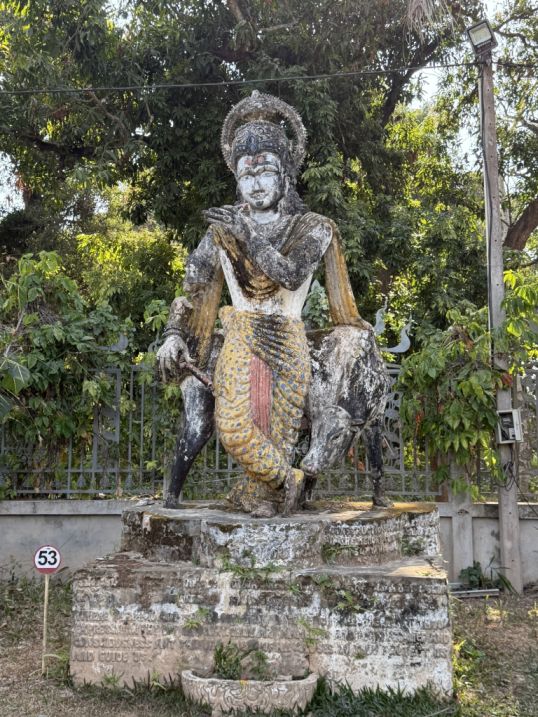
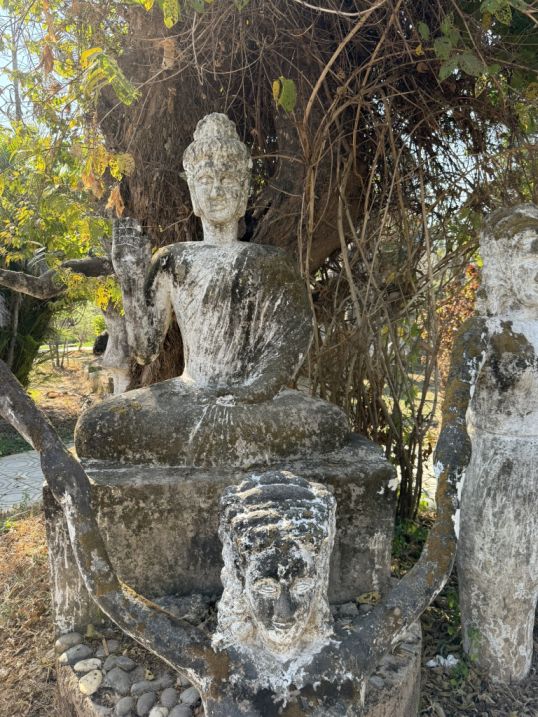
A sitting Buddha most often represents the Buddha during meditation or teaching. If he's sitting cross-legged with his hands resting in his lap, that's usually meditation, calm, concentration, and the path toward enlightenment. If one hand touches the ground, that's the famous "calling the Earth to witness" gesture: the moment just before enlightenment when the Buddha resisted Mara's temptations and called the Earth as witness to his worthiness.
 |
 |

More Buddha sculpture along the way

The two figures seem to depict a religious encounter or act of reverence..
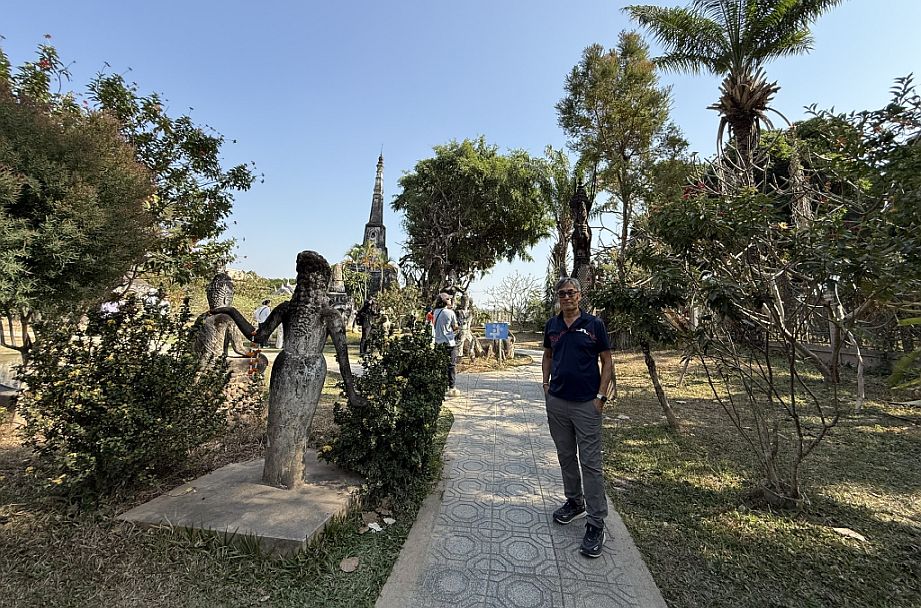

A monk praying in the park.
 |
 |
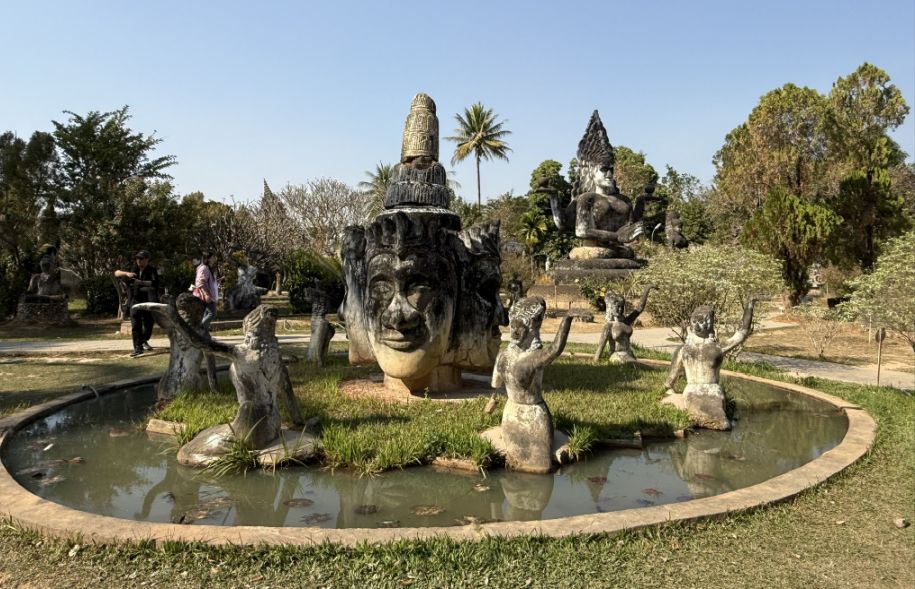
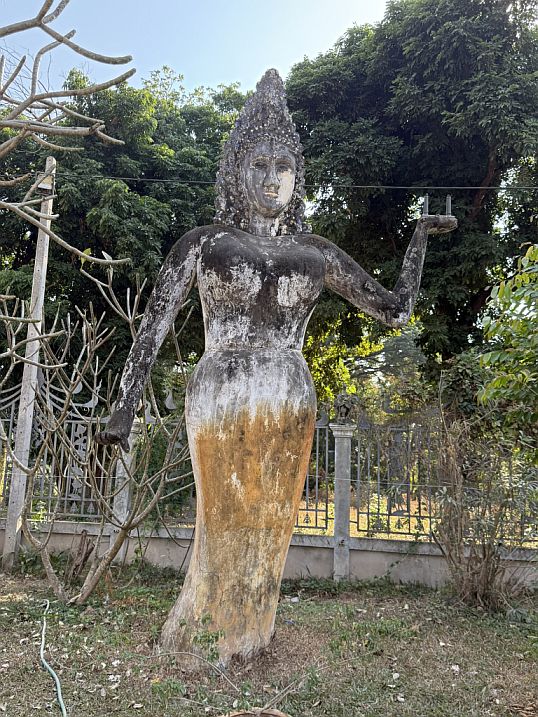
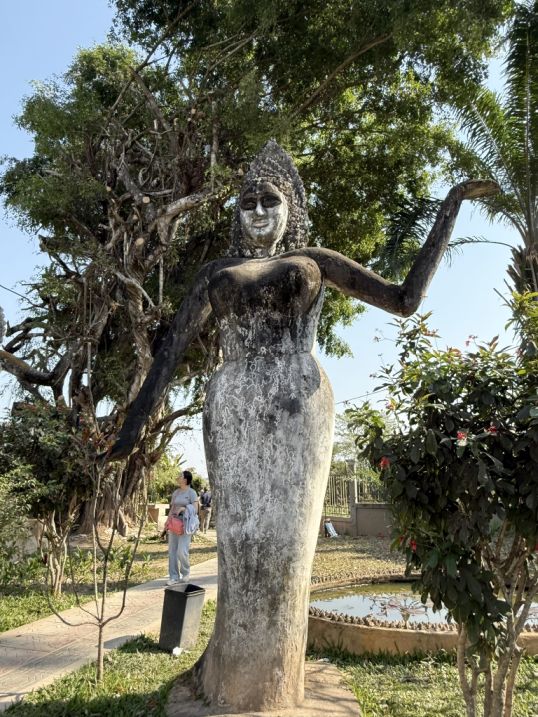
Fountain with enormous crowd head in the center and the women arranged around the water appear to be celestial dancers, often called apsaras in Hindu-Buddhist art. Apsaras are beautiful supernatural female beings associated with the heavenly realms. They dance, perform music, and accompany gods and other celestial beings.
 |
 |
 |
 |
This one has an unusual steep, almost pyramidal lower body with a tall spire. That's why it looks different from the more rounded stupas you may have seen elsewhere in Laos. Buddha Park's creator, Bunleua Sulilat, freely combined architectural and religious forms, so not everything follows standard Lao temple design.
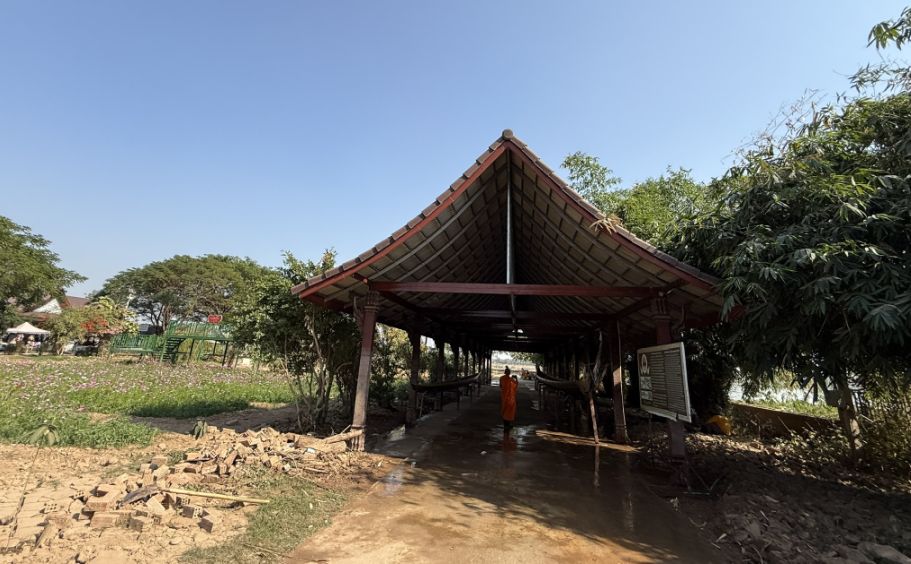
We are now walking toward the far end of the park and in front of us is a pavilion.

Inside is a boat is called Khonsavanh 999. According to the sign, its story begins in 1960, when residents of Thapha Village traveled to Na Ngom Village in Thoulakhom District, Vientiane Province, to cut the tree trunk from which the racing boat would be made. A boat builder came from Nongkoung Village in Thailand to construct it. And apparently it was a very successful racing boat. From 1960–1985, the sign says Khonsavanh accumulated 32 silver bowls as prizes: 10 first places, 14 second places, and 8 third places.
There's also an interesting second life to the boat. By 2017, it was considered too small for racing because it carried only 39 paddlers. Monk Bounlumh Siripanhyo, associated with Khonsavanh 999 and Southern Thapha temples, had it renovated and enlarged to carry 55 paddlers. It then went racing again and won or placed in several local competitions—including a first-place finish at Chaeng Village and prizes in both men's and women's traditional boat races.
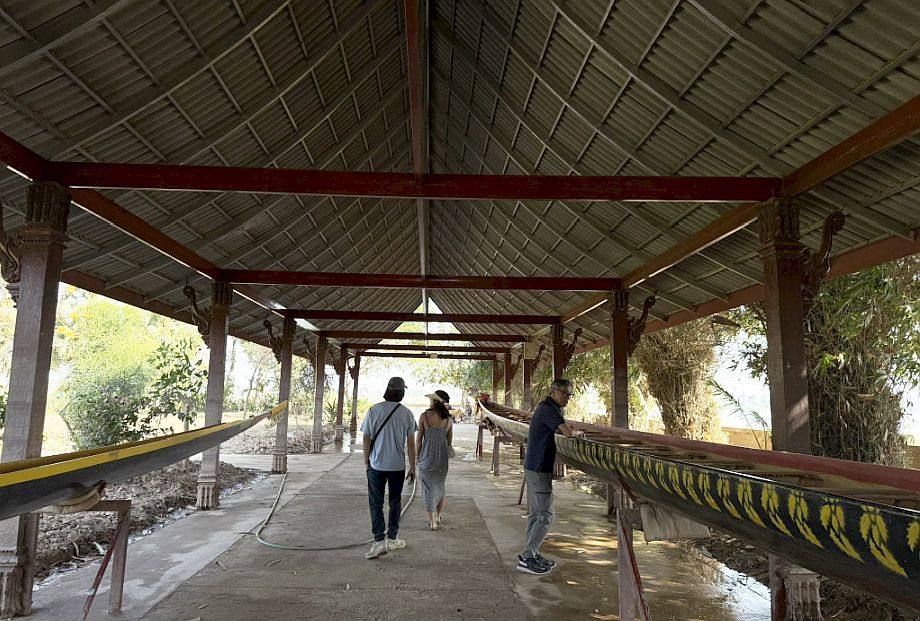
Then COVID changed things. During the pandemic the boat stopped being used. Because there was no suitable place to preserve it, Xiengkhouan Cultural Park acquired it from Monk Bounlumh and put it here permanently as an example of a traditional Lao racing boat. So the boat you're looking at is not a replica or simply a decorative object. According to this sign, it's an actual racing boat with a history stretching back more than 60 years.

We are now at the end of the park at the southern edge of Buddha Park, and the river here forms the international border between Laos and Thailand. When you're standing on that walkway looking across the Mekong, the opposite bank is Thailand.
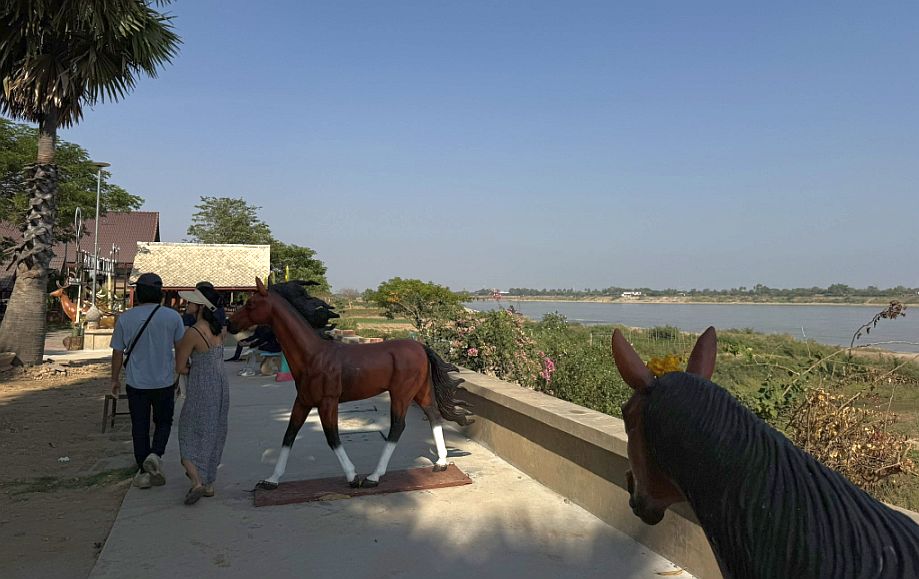
That makes this part of the park feel quite different from the dense collection of sculptures we just walked through. After all the Buddhas, Hindu gods, demons and fantastic creatures, suddenly the landscape opens onto the Mekong, which has shaped Lao life, agriculture, transportation, religion and mythology for centuries.
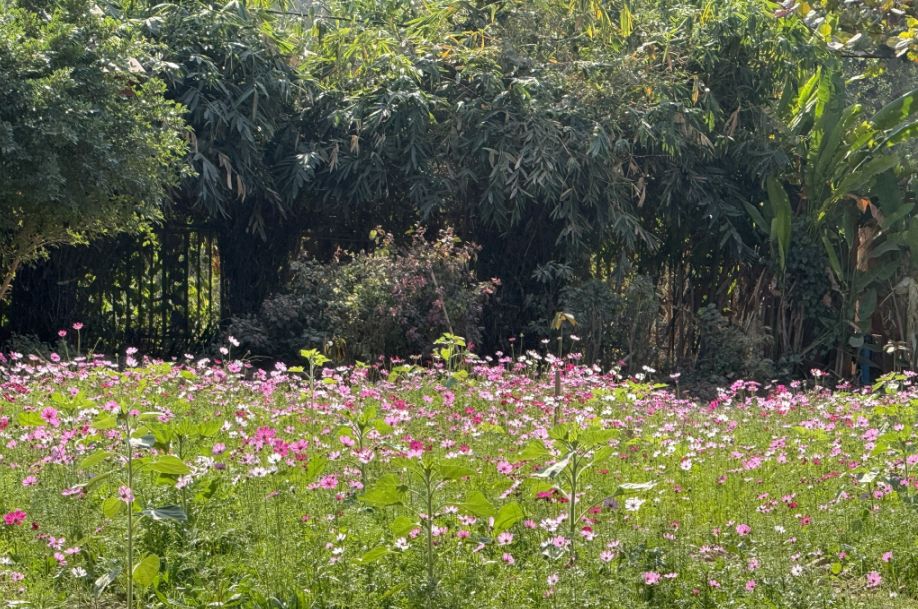
Then we walked pass an open field filled with purple and white flowers, bamboo and banana plants, which is a very Southeast Asian garden setting.
 |
 |
We are now retracing our steps back to the entrance.

Along the way we passed by a pavilion with 3 figures that do look much more Chinese/Central Asian than Lao or Thai, and that's probably intentional.
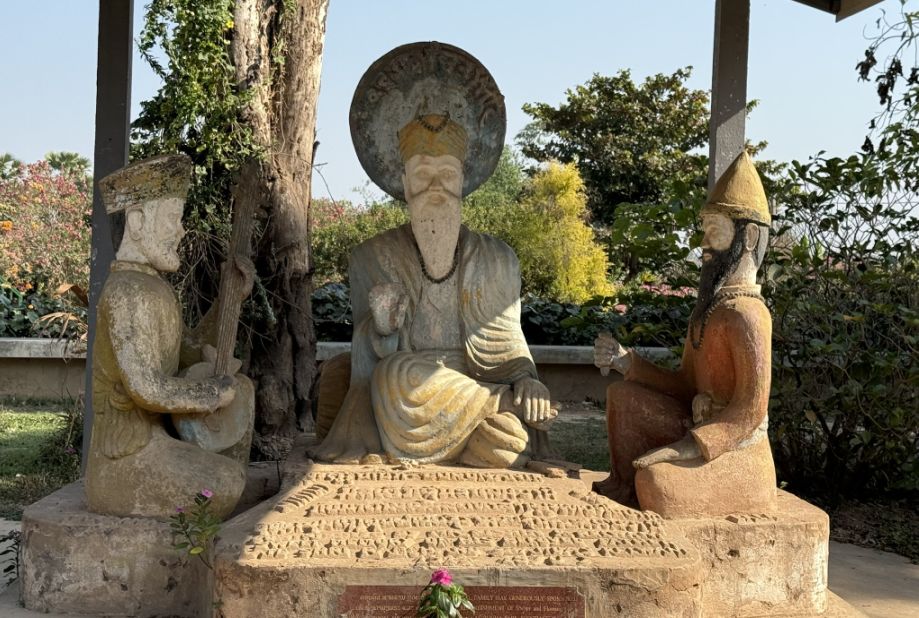
The central figure has a long beard, turban-like headdress, halo, robes, and a teaching gesture. The two attendants also have distinctly non-Lao clothing; the one on the left even appears to be holding a stringed instrument. This suggests a scene connected with a religious teacher or sage from outside the usual Theravada Buddhist imagery.
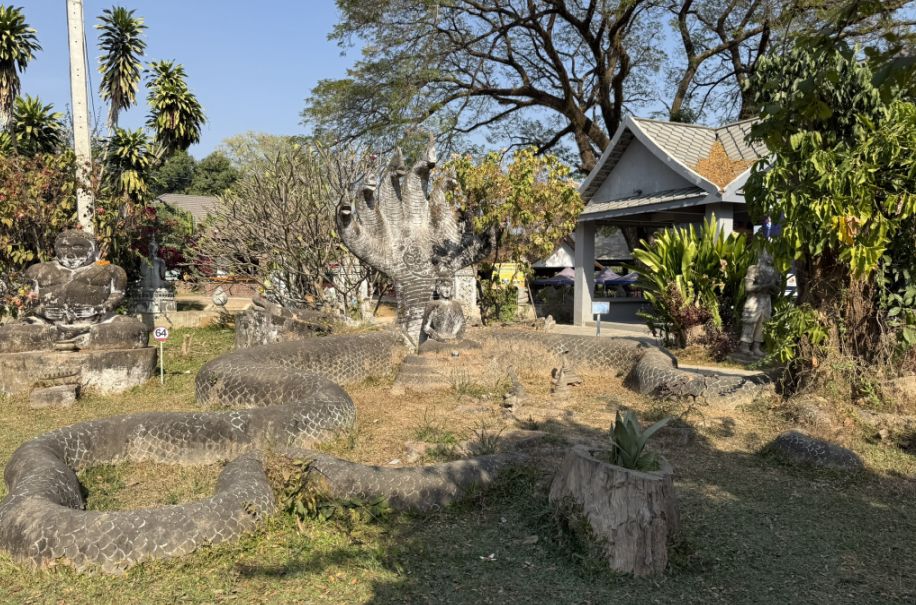
Statue of Buddha protected by Mucalinda (Muchalinda), the Nāga King. The huge serpent body on the ground is Mucalinda's coiled body. It effectively becomes the Buddha's protected seat. The seven heads rising above him form a great canopy. Seven-headed Mucalinda images are particularly characteristic of Southeast Asian Buddhist art, including the old Khmer tradition that strongly influenced Laos.

The seven enormous cobra heads are the key. it represents an episode shortly after the Buddha attained enlightenment. While the Buddha was sitting in deep meditation, a tremendous storm arose, with heavy rain and rising water. The nāga king Mucalinda emerged and wrapped his enormous coils beneath/around the Buddha, then spread his multiple cobra hoods above him like an umbrella, protecting the meditating Buddha from the storm.
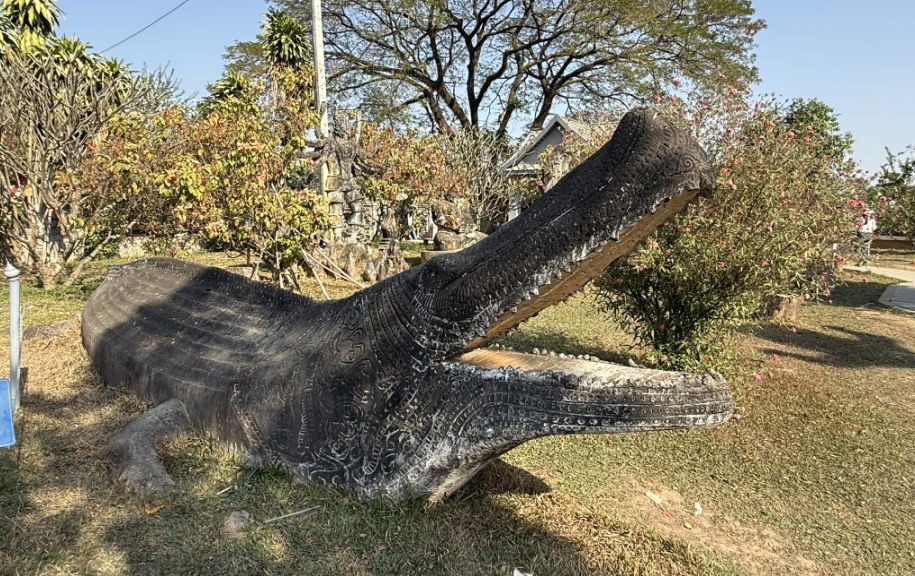
A large statue of a crocodile with its mouth wide open may represent another mythological creature or danger associated with the watery realm. Interestingly, a published guide to Xieng Khuan specifically mentions that the park contains scenes of holy men interacting or battling with crocodiles, so crocodiles are indeed part of Sulilat's strange visual vocabulary.
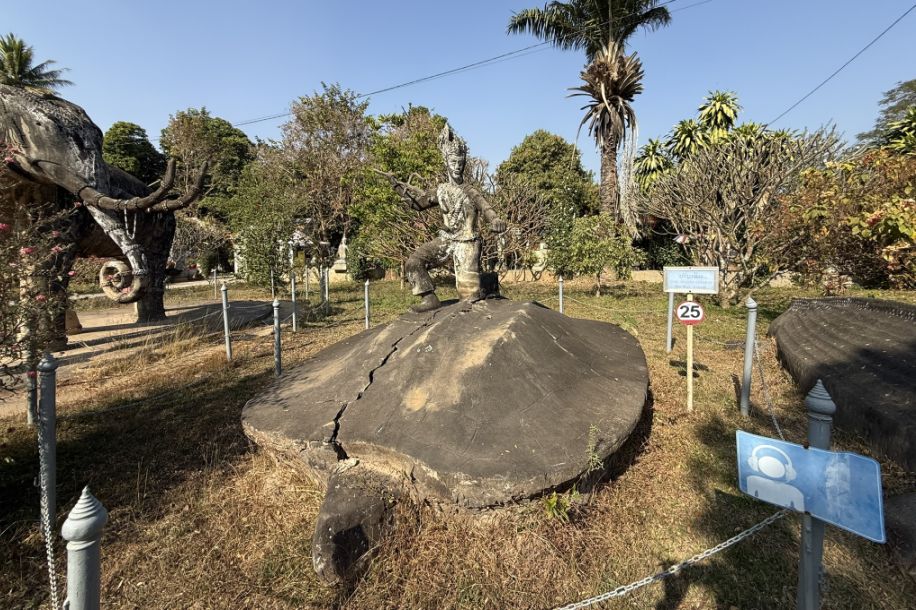
In Hindu cosmology, the turtle/tortoise can represent Kurma, the great tortoise incarnation of Vishnu who supports an enormous weight during the famous Churning of the Ocean of Milk. More generally, a giant tortoise is an image of stability and cosmic support.

We are now almost on our way out of the park.
 |
 |
On the ground are statues that are damages and are in need of repair.

We began among Sulilat's strange mixture of Buddhas, Hindu deities, multi-headed and multi-armed beings, nagas, celestial dancers, mythical animals and scenes that aren't always easy to decode. Then we reached the historic Khonsavanh 999 racing boat, walked out to the Mekong, wandered through the flower and tropical gardens, and came back through some of the quieter sculptures. The main idea we will take away is that Buddha Park isn't really a collection of “Buddha statues.” It's Bunleua Sulilat's imagined spiritual universe. Buddhism sits at its center, but Hindu mythology, Lao beliefs about nagas and spirits, and Sulilat's own unusual ideas all coexist there.
NEXT... Day 2-Dinner at Tamnak Lao Restaurant