5 days in Laos-1/31- 2/3/2025
|
Day 1 Vientiane |
Day 2-Vientiane Patuxai That Luong Buddha Park Tamnak restaurant |
Day 3-Vientiane Cope Museum Wat Si Muang |
Day 4-Luang Prabang Mekong River cruise Pak Ou Caves Lunch at Manifa Kuang Si waterfall Main Waterfall Manda de Laos |
Day 5-Luang Prabang Mount Phousi |
Day 2-Patuxai, Vientiane -1/31/2025
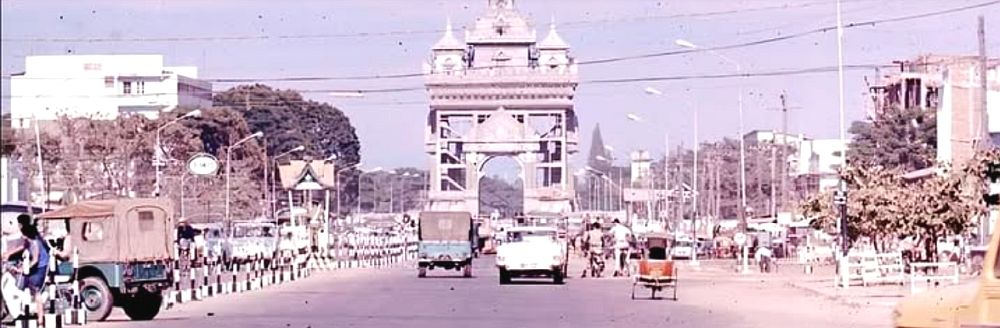
The next morning we headed to Patuxai, one of Vientiane's most recognizable landmarks.
This picture was taken around 1973-1975.
Walking toward it brought back memories from my childhood in the early 1970s, when my cousin and I would often walk here and climb all the way to the top. Back then it was known as Anousavari, the Monument of the Unknown Soldier. Although people said it had been completed, I remember the inside still feeling unfinished, with bare concrete walls and simple stairways.
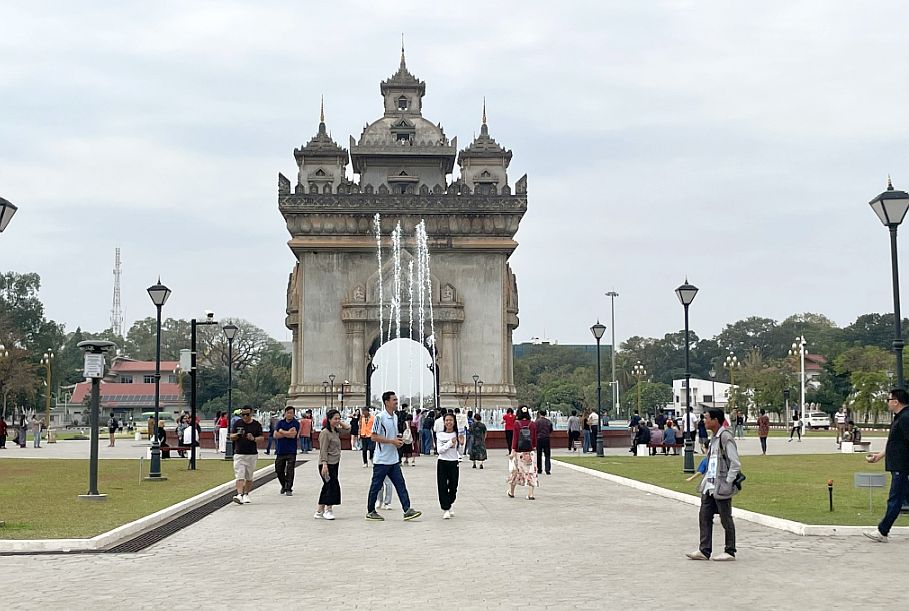
Today the shape is still the same but it is also different from what I remembered.
Patuxai, which means "Victory Gate," was built between 1957 and 1968 to honor the Lao people who fought for independence from France. Its design was inspired by Paris' Arc de Triomphe, but with a distinctly Lao character. Instead of classical European decorations, the monument is adorned with Buddhist-inspired carvings, mythical kinnari (half-woman, half-bird figures), naga serpents, and graceful lotus motifs. A famous local joke calls it the "vertical runway" because some of the cement used to build it came from American aid that was originally intended for a new airport runway.
 |
 |
Standing there again after more than 50 years was a special moment.

The monument has been beautifully restored, the surrounding park is now filled with fountains and gardens, and the climb to the top still rewards visitors with one of the best panoramic views of Vientiane. It was amazing to revisit a place that had been such a vivid part of my childhood and see how much it had changed while still feeling so familiar.
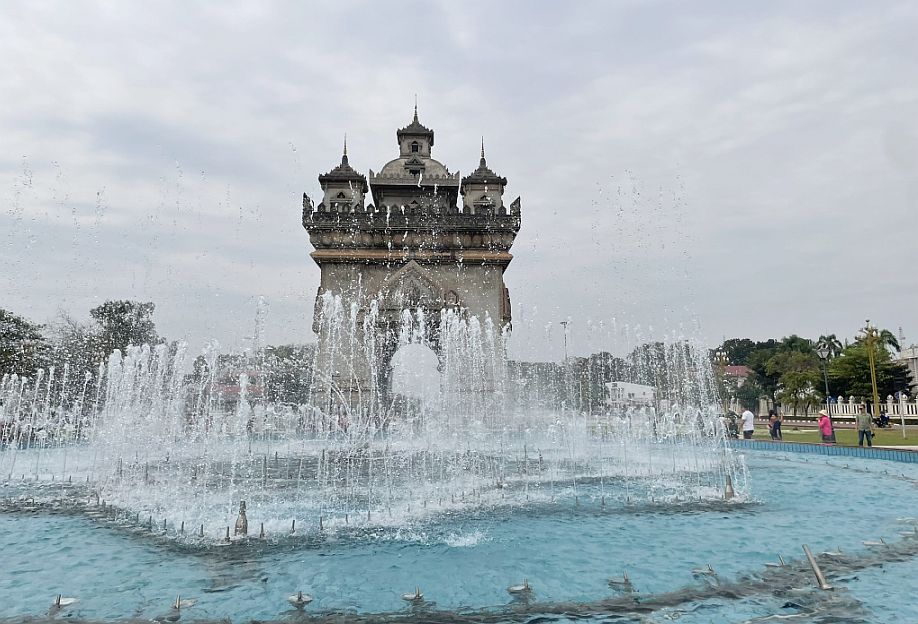
We left Laos in 1975, and I don't remember there being a fountain in front of Patuxai. Seeing it now was a surprise. The enormous fountain stretches across the park, with dozens of water jets dancing in the air, giving the entire approach to the monument a grand and elegant feel. It has transformed the entrance into a beautiful public gathering place.
 |
 |
The changes continued once we stepped inside Patuxai.
 |
 |
I clearly remembered the bare concrete interior from my childhood, but today it is completely different. Looking up, the ceiling was beautifully decorated in shades of orange, blue, and gold with intricate Lao designs, while statues of Buddha stood around the interior, giving the monument a much more refined and spiritual atmosphere than I remembered.

As we climbed the stairs toward the upper levels, we stopped to explore a small exhibition that tells the story of Patuxai.
 |
 |
View from the second floor looking down.

The exhibit floor.

The displays explain why the monument was built, the years of construction, its unique blend of Lao and French architecture, and the famous story that some of the cement came from American aid originally intended for an airport runway. Reading about its history while standing inside a place I had visited so often as a child made the experience especially meaningful. It was fascinating to see how Patuxai had evolved from the unfinished monument I remembered into the beautiful national symbol it is today.
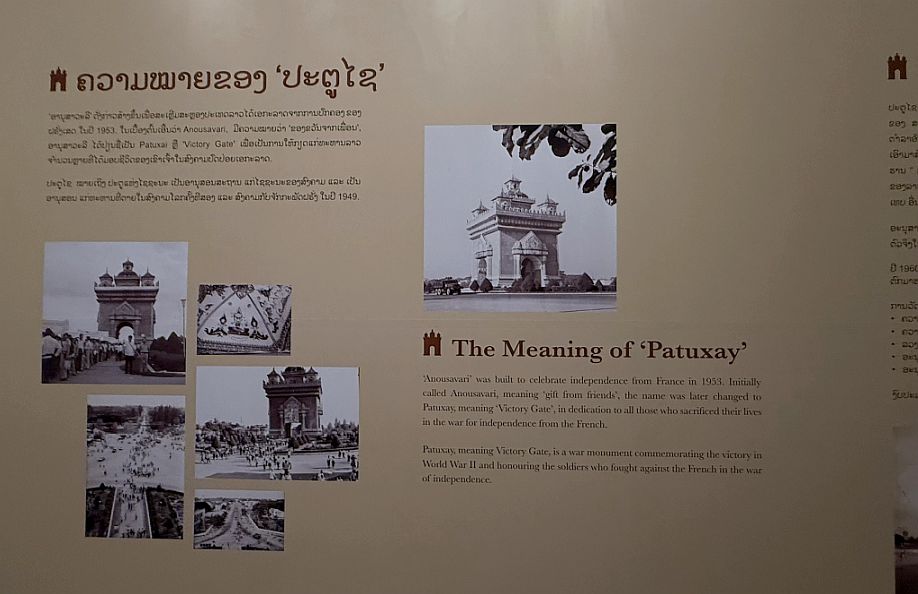
Patuxai means Victory gate in Lao.

Beautiful picture of the beginning of the construction of the gate.

Walking around the exhibit floor

Kevin and Kristie on the exhibit floor.

After climbing a few more flights of stairs, we reached the upper level, where we could step outside onto the observation deck.

Stepping out into the observation deck.

Sanding between the triangular openings in the walls, we were treated to sweeping views in every direction.
 |
 |
Looking east, the broad Lane Xang Avenue stretched straight toward the former Royal Palace, creating a grand boulevard reminiscent of the Champs-Élysées in Paris.
 |
 |
Looking back the other way, the large fountain spread out below us,

By the time we got up to the observation deck, the fountain was turned off but you can see the pattern of the water jets.

From this vantage point, it was easy to appreciate why Patuxai was built where it was. The monument stands at the center of one of Vientiane's most important boulevards, offering a panoramic view of the capital.
 |
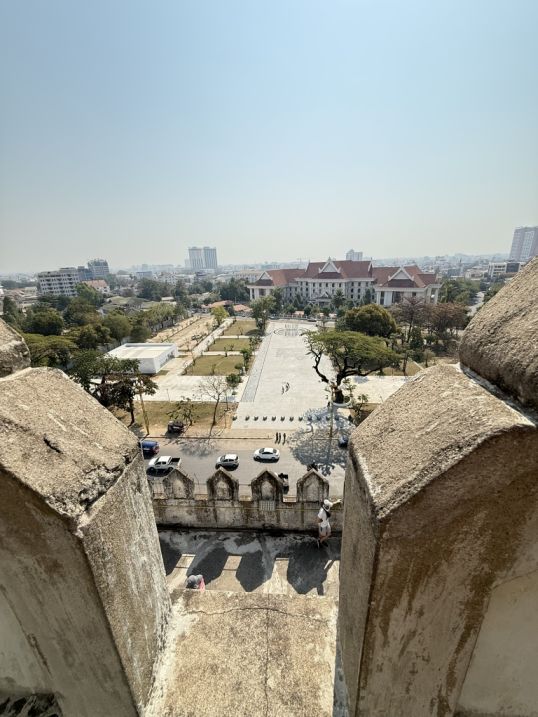 |
From the very top of Patuxai, one of the most prominent white buildings with a red tile roof and a long row of columns is the Prime Minister's Office. It sits not far from Patuxai and is one of the most recognizable government buildings visible from the observation deck. Its French colonial-inspired architecture, white façade, red roof, and stately columns make it stand out against the rest of the city.

Lycee de Vientiane

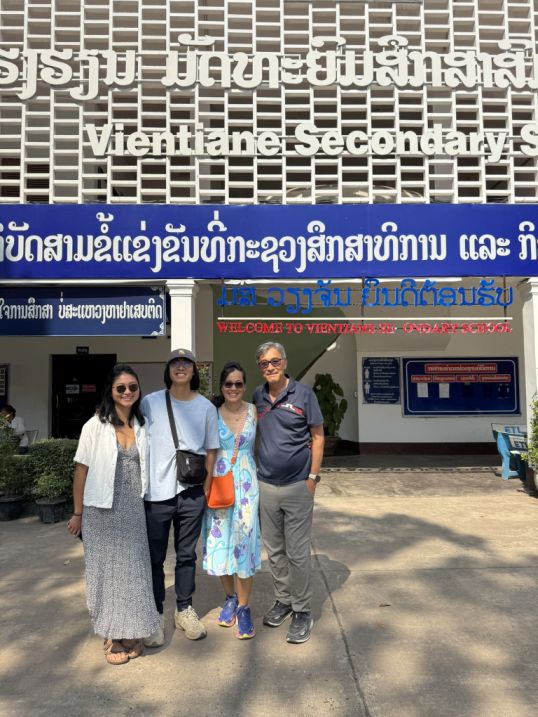
We walked to my old school, Lycée de Vientiane which is located less than five minute away from Patuxai.

As soon as I saw the front gate, I was amazed that it looked almost exactly as I remembered from the early 1970s. Instantly, memories of my school days came rushing back.

Back then, the Lycée de Vientiane was one of the country's most prestigious public French-language schools. Established during the French colonial period, it followed the French education system and attracted students from many backgrounds, including Lao, French, and other international families. For many students, it was a gateway to higher education in France and other French-speaking countries. In the 1970s, the school was a lively place where French was the primary language of instruction, reflecting the strong cultural ties that remained after Laos gained independence.
 |
 |
After the political changes of 1975, the French public school no longer operated in the same way. Today, the campus is home to the Lycée de Vientiane Josué Hoffet, a French international school run in partnership with the French government. While the curriculum and facilities have been modernized, it continues the tradition of providing a French education to both Lao and international students.

Walking toward the main entrance, I was amazed to see the familiar circular gateway with its metal gates. It looked almost exactly as I remembered. For so many years, I had stood at this very spot with my classmates every morning before the gates opened, talking and laughing as we waited to go inside. Seeing it again after more than fifty years felt like stepping back in time.
 |
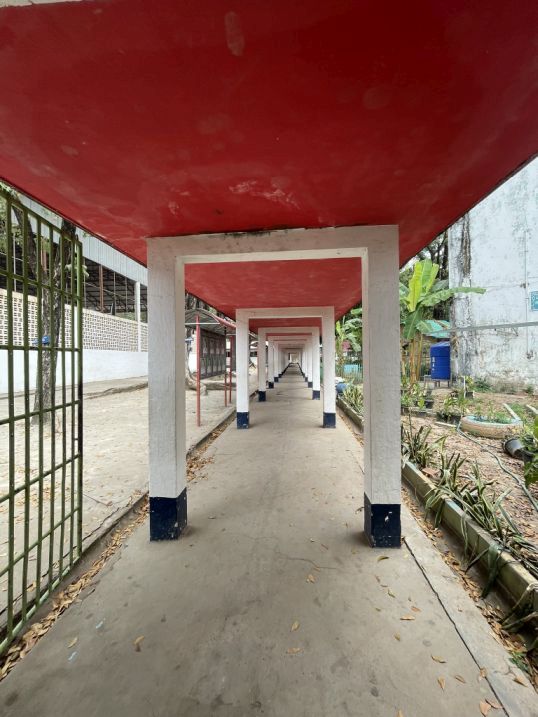 |
The long corridor was still there, connecting the different classroom buildings just as it had in the past. This corridor was more than just a walkway, it was where generations of students moved between classes, gathered with friends, and rushed to their next lessons when the bell rang. Its covered design was especially important in Vientiane’s climate, providing shade from the intense tropical sun and shelter during the heavy monsoon rains. Walking beneath it again, I could almost picture my younger self and my classmates moving from one classroom to another.
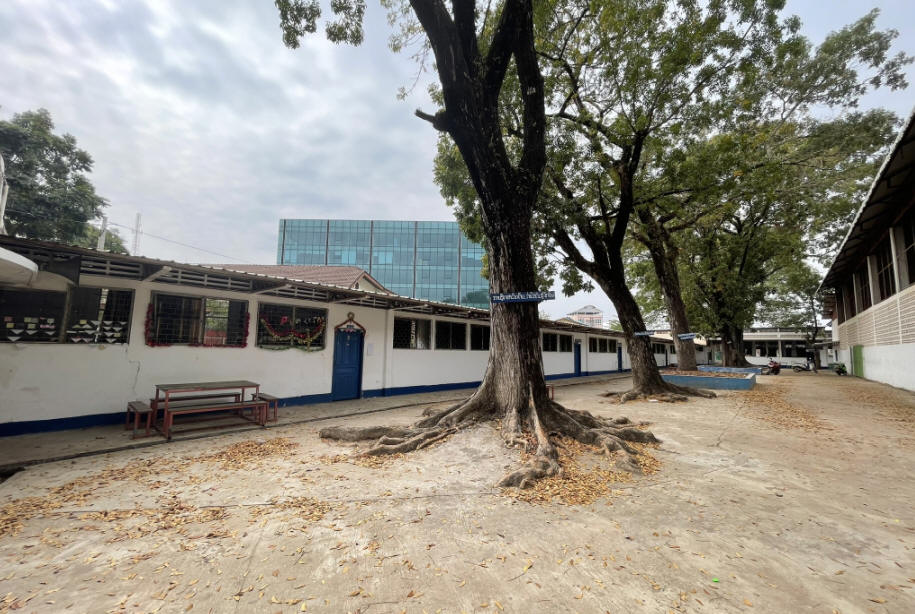
Then I saw the classroom where I used to study. Beyond it was the familiar schoolyard, shaded by tall trees that had grown alongside generations of students. The dirt paths between the classroom buildings were still there, just as I remembered them. These simple surroundings, corridors, trees, dirt roads, and classrooms held so many memories of friendships, laughter, and everyday moments from my childhood.
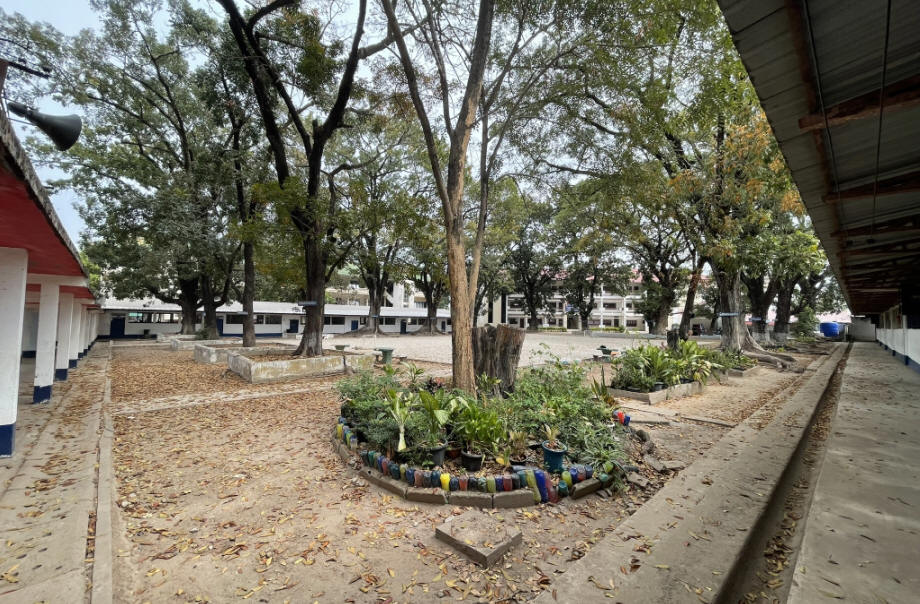
Standing there, I could almost hear the voices of my classmates, the ringing of the school bell, and the excitement of recess. So much of my childhood was shaped within these grounds. Of all the places I visited on this trip, this was perhaps the most emotional. It wasn't just a visit to an old school, it was a return to the place where so many of my happiest childhood memories were made.
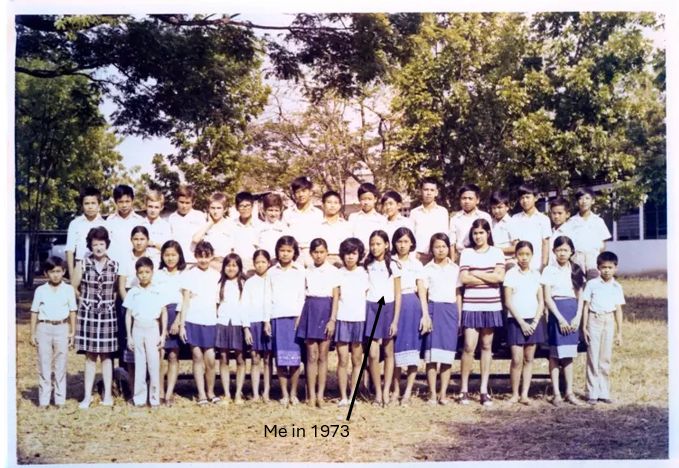
Found my picture on the internet- Class of 1972-1973-6e A2 (I was 13 years old).
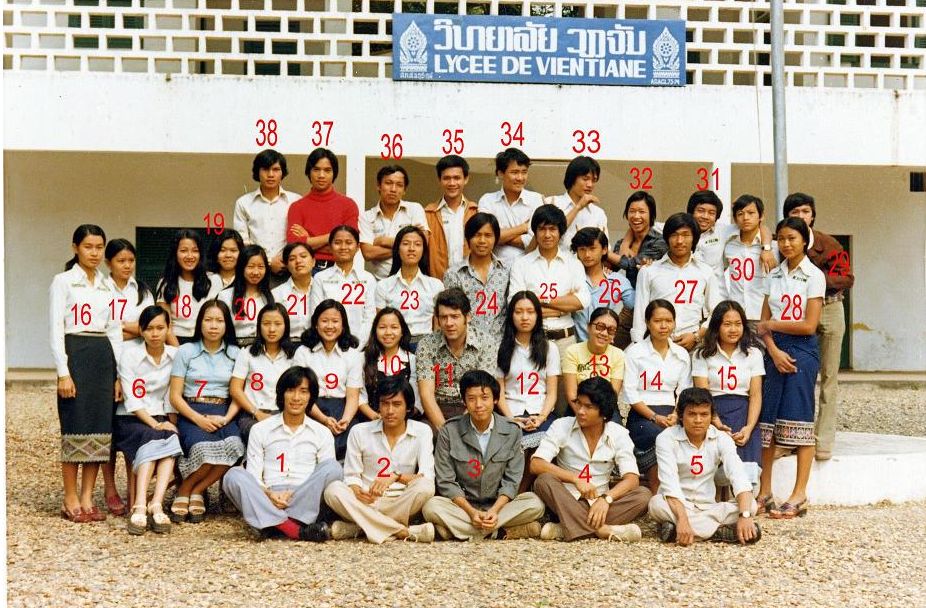
Hoa is #1-Class of 1973-1974-2eB1- click on LINK to see details
NEXT... Day 2- That Luang