6 days in Washington DC- 10/18- 10/23/2024
Day 2- City tour-10/19/2024
Korean War and Lincoln Memorial
We are now heading to the Korean War Memorial. It is a profound site designed to convey the intensity and the "forgotten" nature of the Korean War. Its two most iconic features, the field of statues and the mural wall work that together to tell a story of service and sacrifice. For a long time, the Korean War was dubbed the Forgotten war" sat in the shadow of the "Big One" (WWII) and the controversial one (Vietnam). Having the name and dates etched so boldly at the entrance was a way for veterans to say, "We were here, and this happened." It demands that the visitor acknowledge those specific three years of intense, frozen, and often brutal combat.
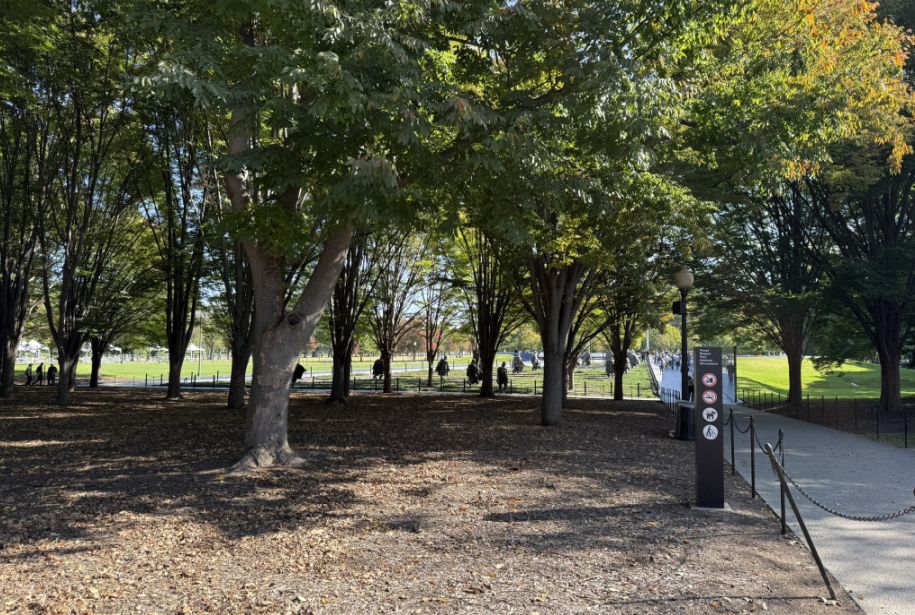
The walk toward the memorial feels almost deceptively calm at first. We are moving through open green space, and ahead, far off, there’s just shape and shadow. At that distance the soldiers aren’t yet people. They read as silhouettes pressed low against the horizon, dark forms rising from the ground, as if the land itself has grown figures.
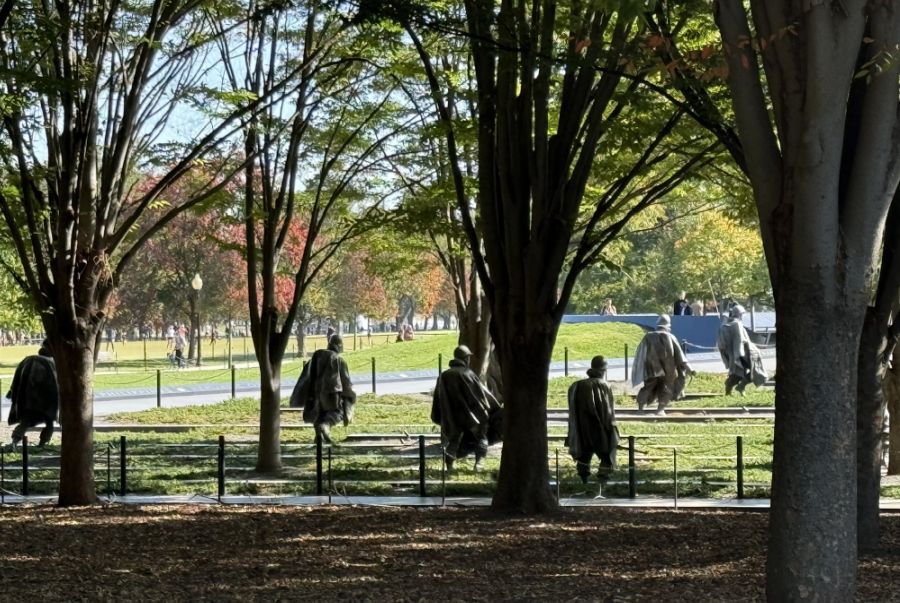
As we got closer, the shapes sharpen, and then we approached them from behind, and that matters. You’re not facing heroes on display, we are falling in step with them.
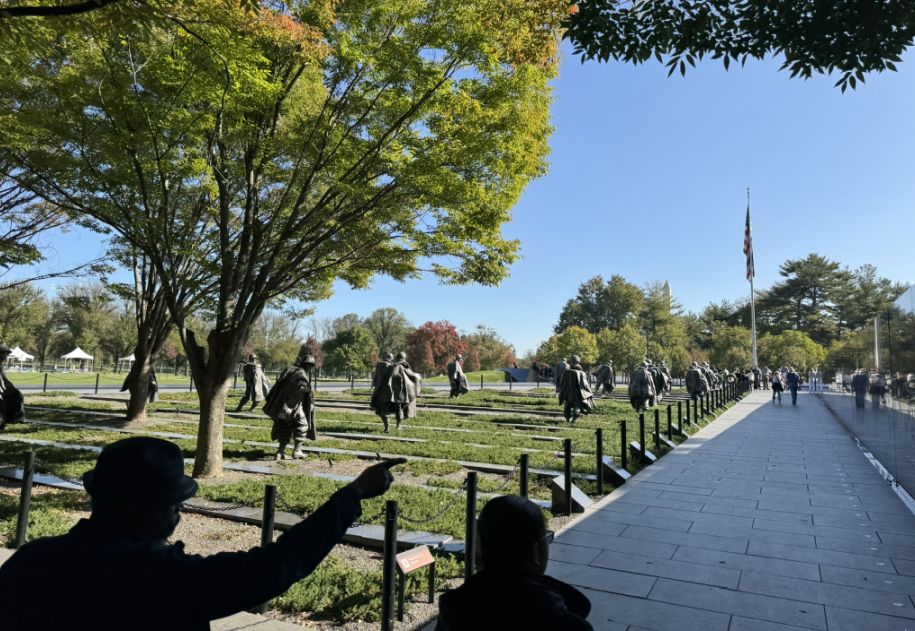
Our tour guide pointing to the wall and telling us the history.
 |
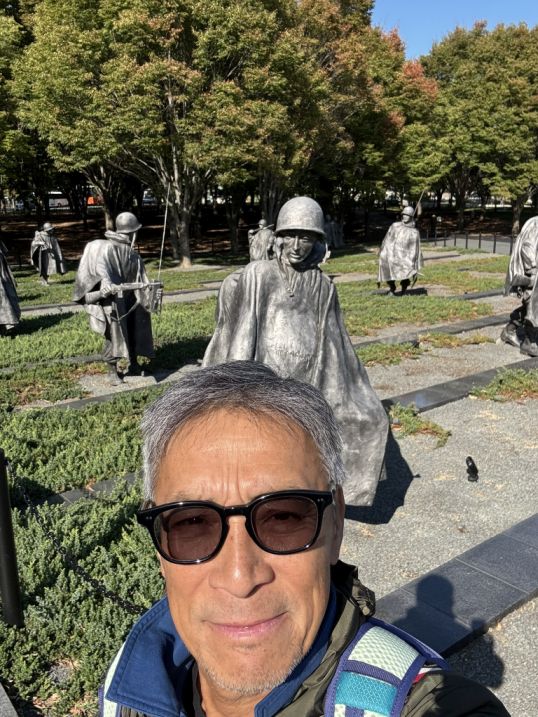 |
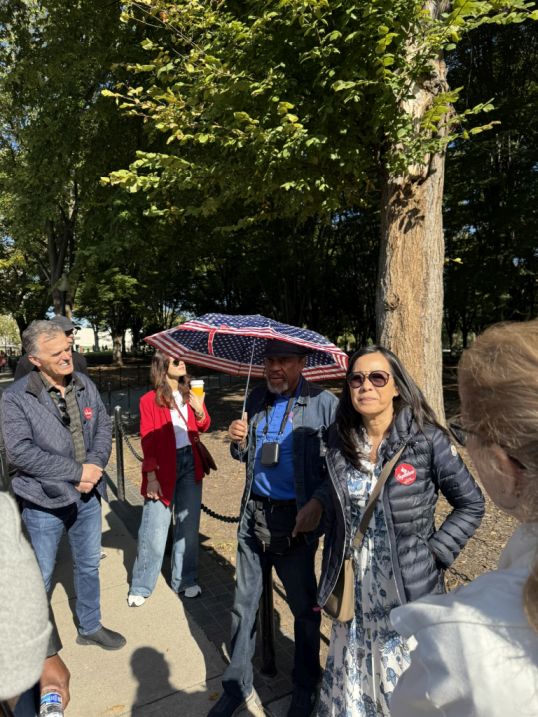
We gathered next to our guide to hear the history of the war and the memorial.
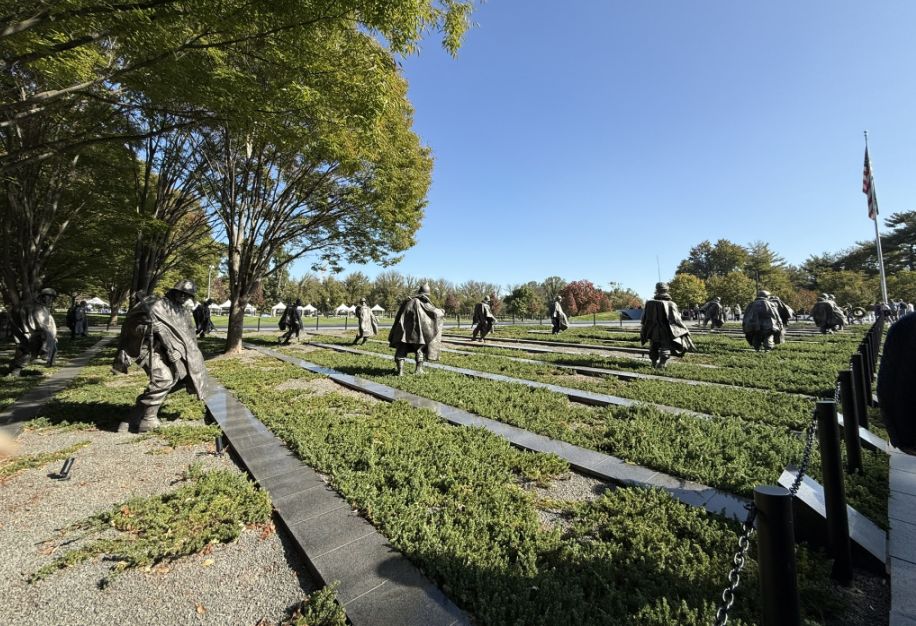
There are 19 stainless steel statues, sculpted by Frank Gaylord, represent a platoon on patrol. They are positioned in a "Field of Service" that is meant to evoke the physical and psychological reality of the conflict. From the back, you see the tension in their posture: shoulders hunched, heads angled forward, rifles held ready.
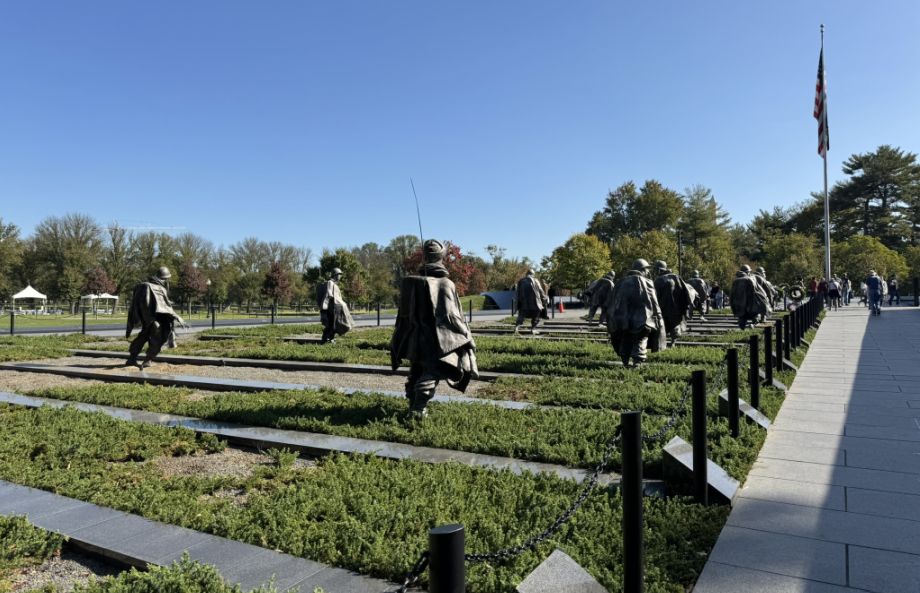
They look like they’re moving into uncertainty, and for a moment you’re walking where they walked, sharing their direction but not their fate.
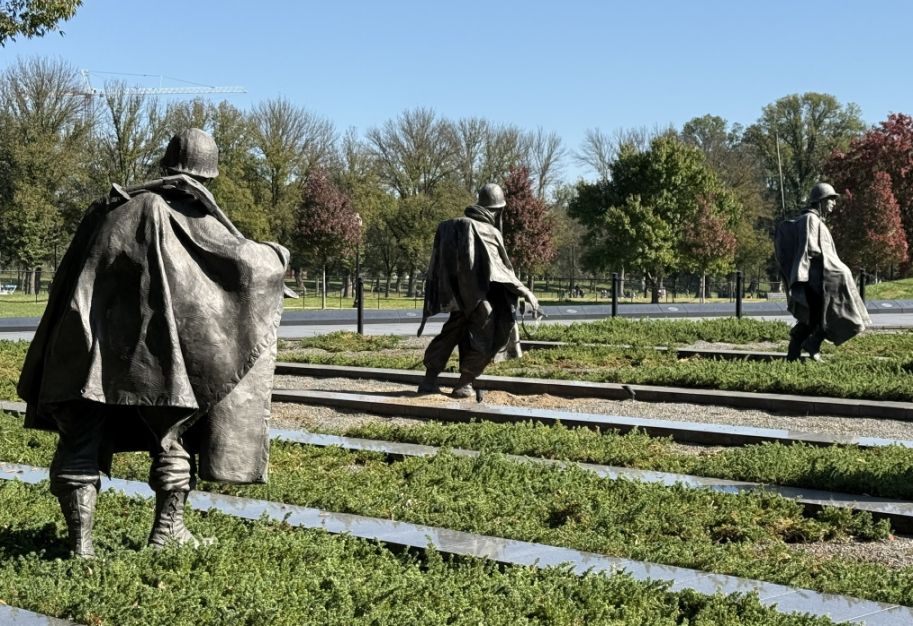
The statues represent an ethnic cross-section of America and include members from four branches of the military: 14 from the Army, 3 from the Marine Corps, 1 Navy Corpsman, and 1 Air Force Forward Air Observer.
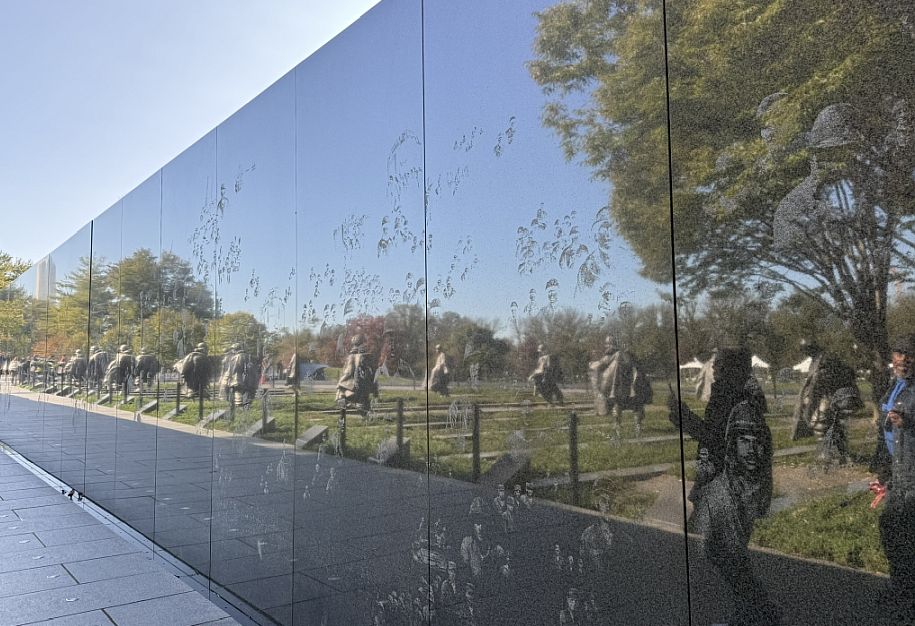
Running alongside the statues is a 164-foot-long wall made of highly polished Academy Black granite. It serves as a tribute to the millions of support troops who enabled the front-line soldiers to fight. While there are 19 physical statues, their reflection in the polished granite mural wall creates the image of 38 soldiers. This symbolizes the 38th Parallel (the border between North and South Korea) and the 38 months the war lasted. From a distance, the arrangement of the etched images and the shadows they create mimic the silhouette of the Korean mountain ranges.
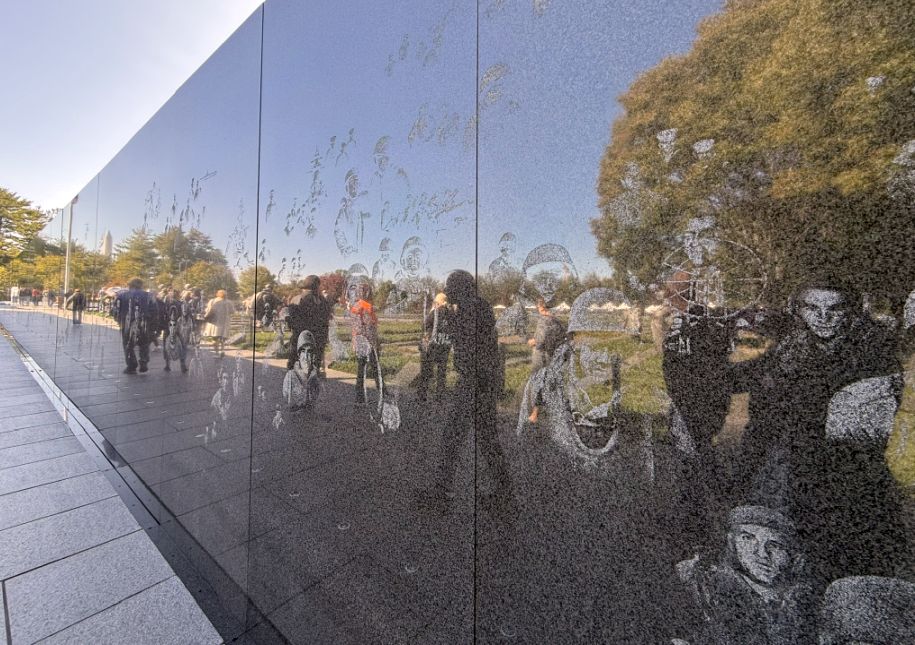
At first it feels abstract, but then the faces appear. The wall features over 2,400 photographic images of real service members, including nurses, chaplains, mechanics, and pilots, sandblasted into the stone. These faces were sourced from National Archives photos.
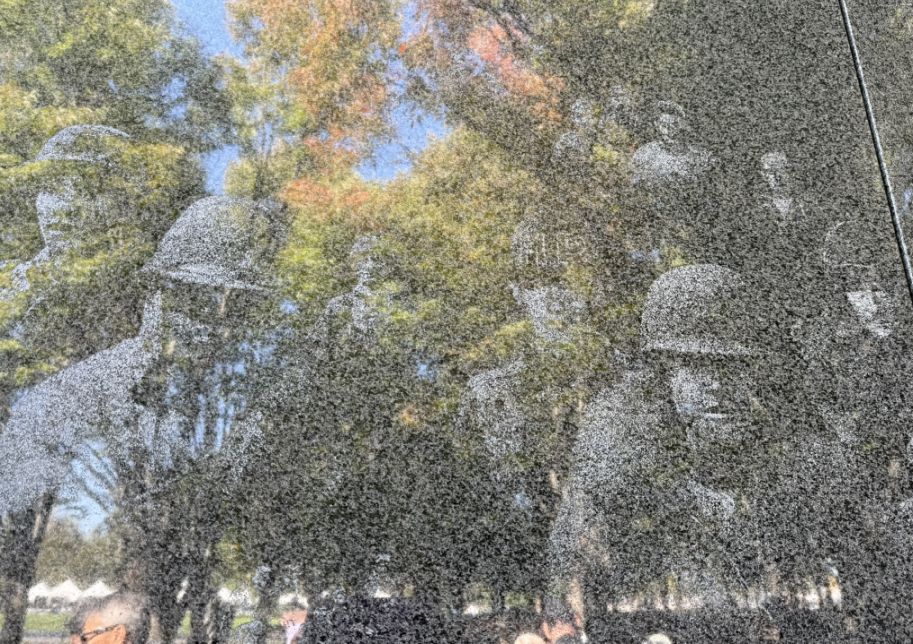
Faces etched on the wall.
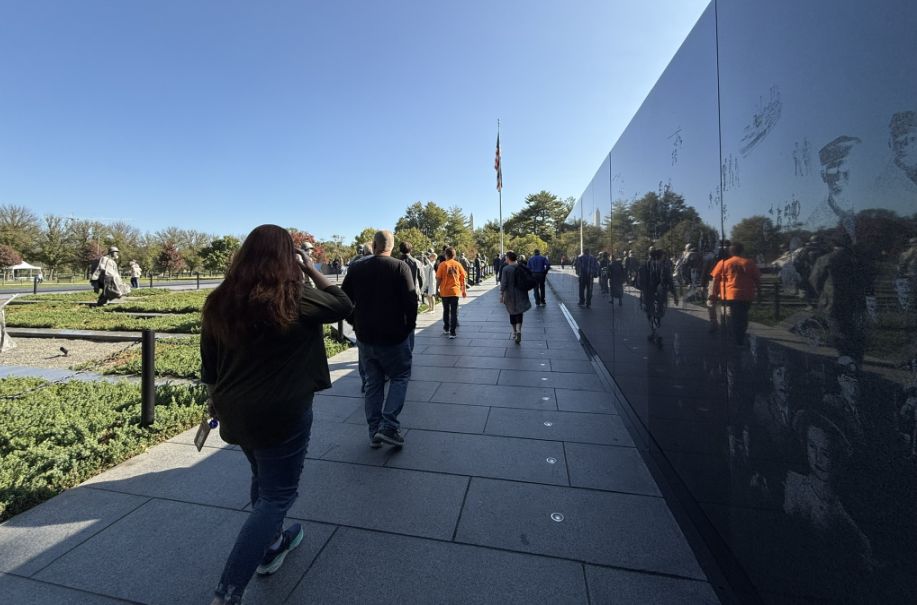
It’s unsettling and beautiful at the same time, past and present occupying the same breath.
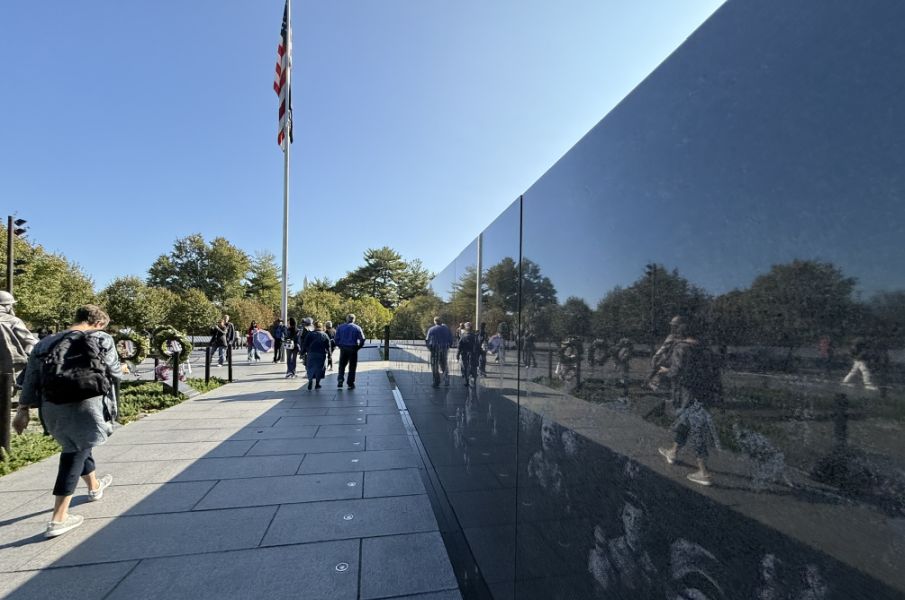
Wakking along the wall.
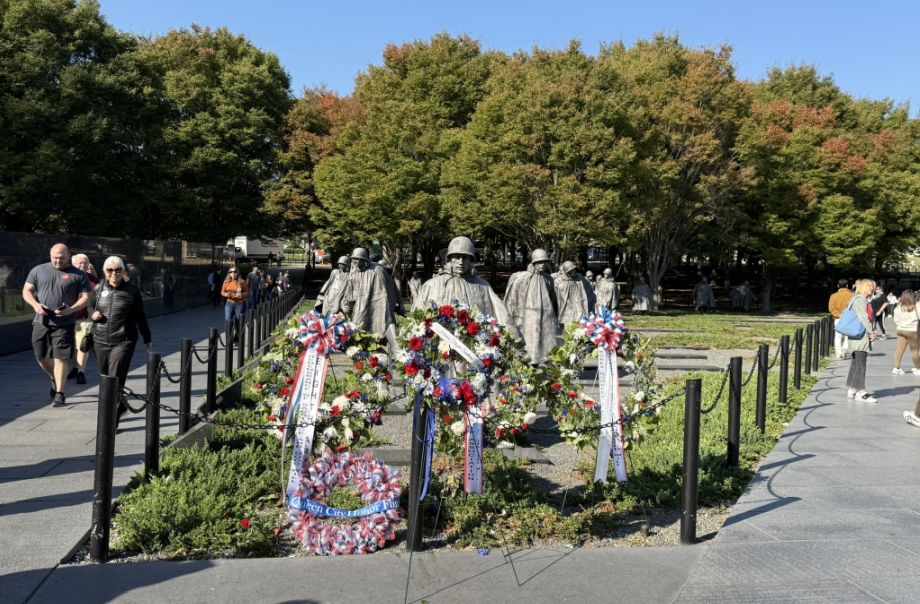
When you step in front of the soldiers, the mood shifts again. Now we are face-to-face. Their expressions are worn, alert, human. And at their feet, the flowers change everything. Bright against the gray and steel, they feel like quiet conversations left behind thank-yous, grief, remembrance, love. Some are fresh, some weathered, but all of them say the same thing: you are not forgotten.
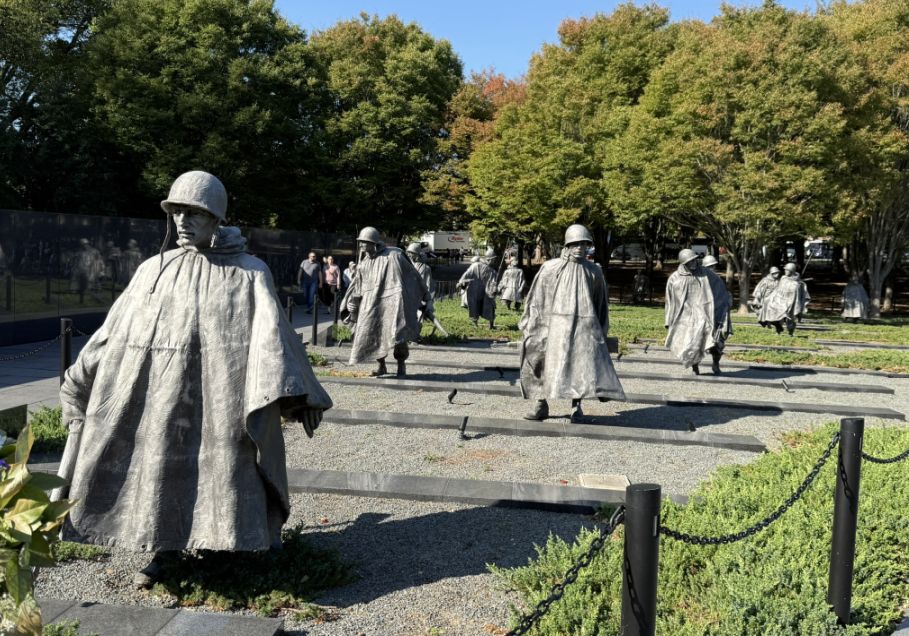
These 19 stainless steel figures represent a platoon on patrol, moving through a rugged landscape that mimics the terrain of the Korean Peninsula. Each soldier is draped in a heavy, wind-blown poncho. This specific choice of attire is meant to evoke the harsh, miserable weather conditions, monsoon rains and freezing winters, that defined much of the conflict. The way the ponchos are sculpted, appearing to flap in the wind, adds a sense of constant movement and cold to the scene
 |
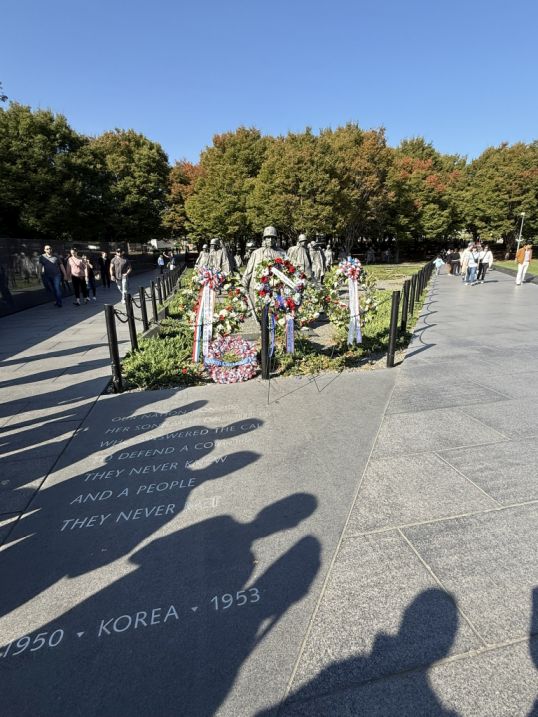 |
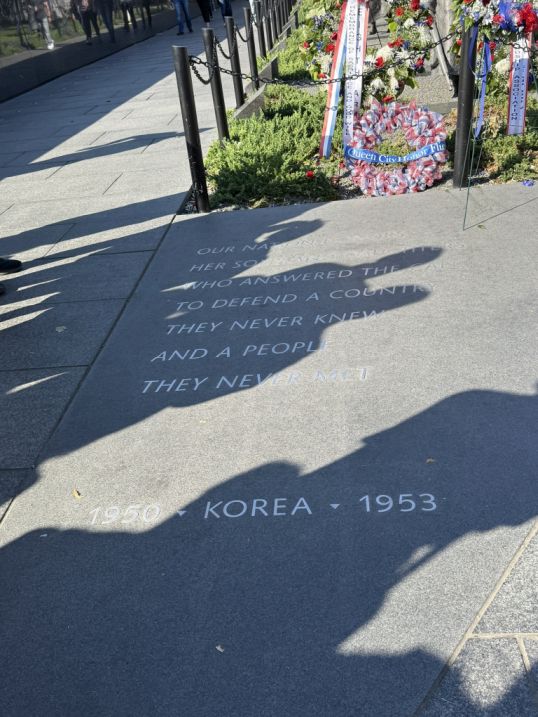
The Timeline of the Conflict: 1950, the war began on June 25, 1950, when North Korean forces crossed the 38th Parallel. The U.S. entered almost immediately to support the South.
1953: The fighting "ended" with an armistice signed on July 27, 1953. It’s important to note that a formal peace treaty was never signed, meaning the two countries are technically still at war, which makes the memorial's presence feel very "present-tense."
By placing these dates right at the feet of the lead statues, the designer (Frank Gaylord) and the architects created a start line for people to experience.
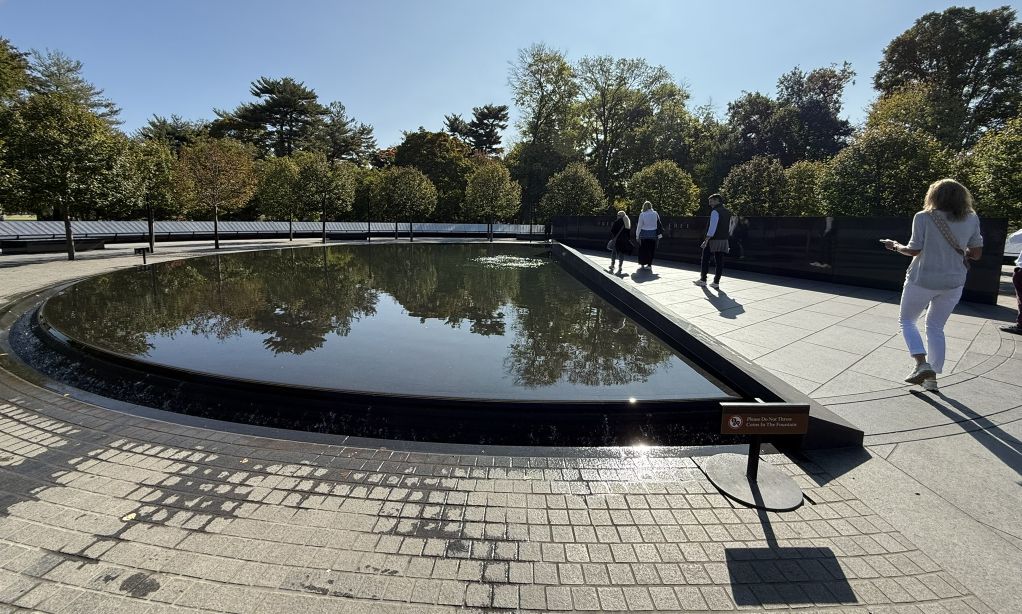
After the intensity of the soldiers, the space softens again. We come to the semi-circular Pool of Remembrance, its surface calm and reflective, almost deliberately still.
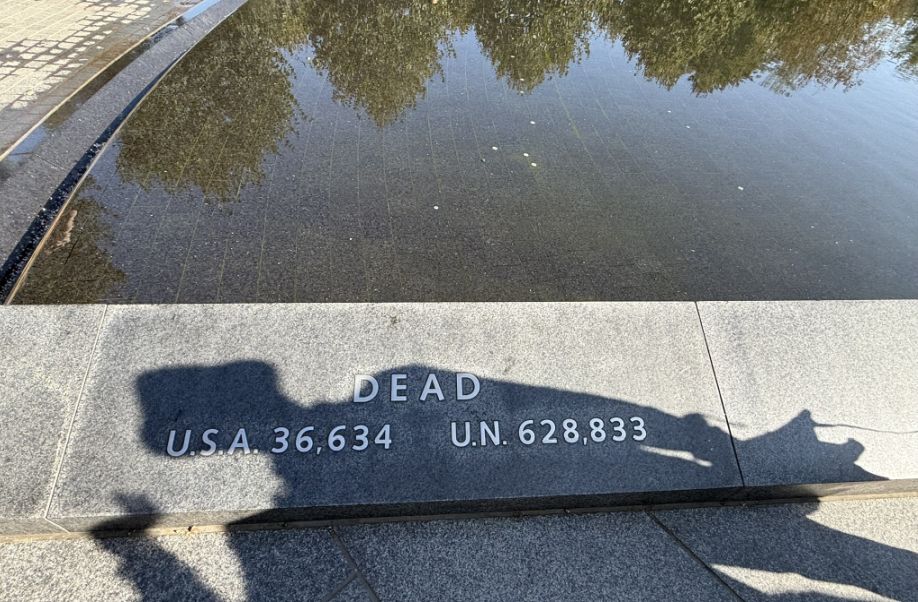
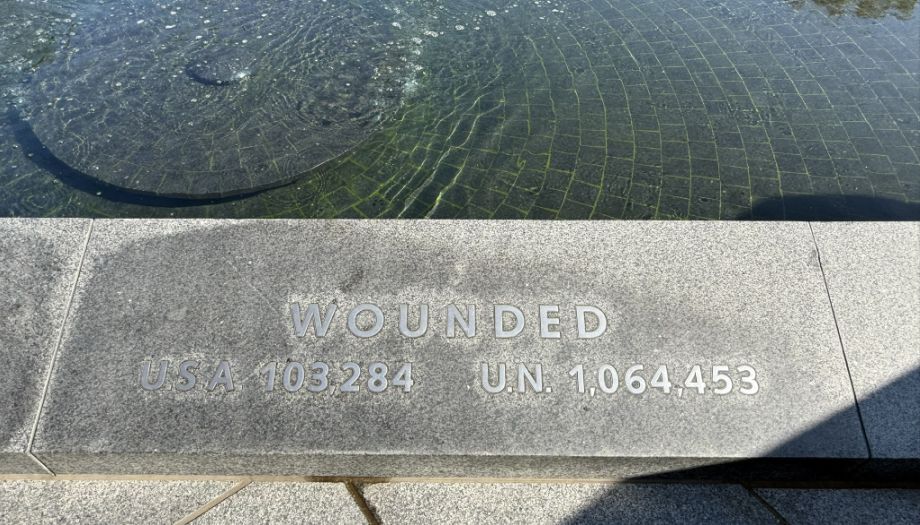
Around its edge are the numbers, dead, wounded, captured, missing, not as abstractions, but as a reckoning.
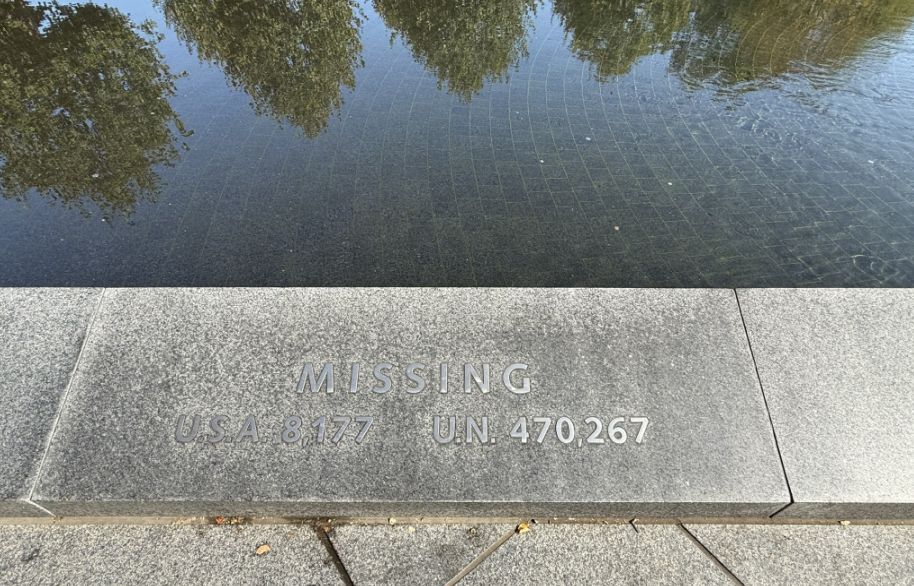
Seeing them written out forces the scale of the war into view. Each category is separate, precise, and heavy, reminding you that loss takes many forms, not just death.
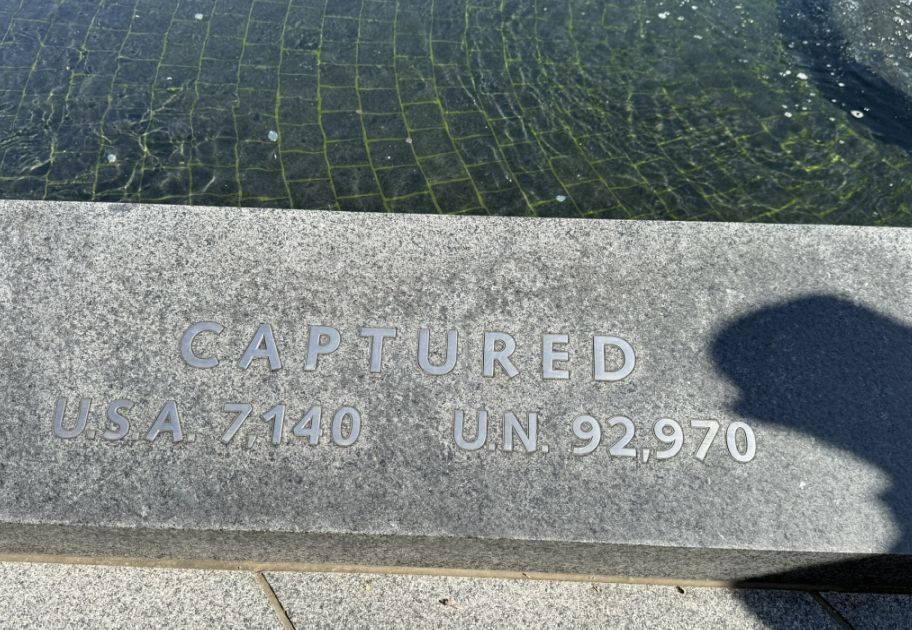
They’re carved plainly, without ornament, and reading them feels heavy. Numbers replace faces, and yet they make the loss feel even larger.
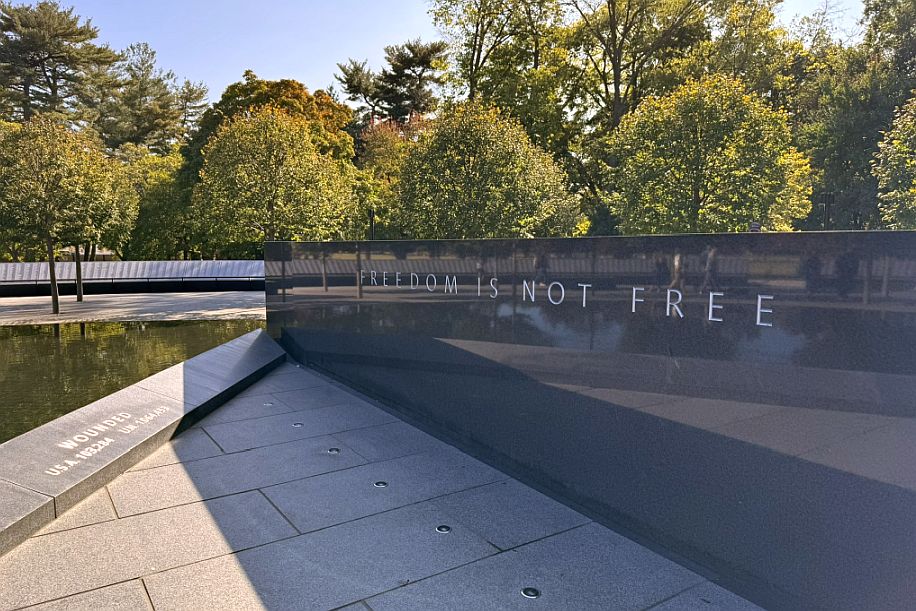
Near the end of the wall, you will find the iconic silver-inlaid inscription: "Freedom Is Not Free." This serves as the memorial's central takeaway, reflecting the high cost of defending democracy.
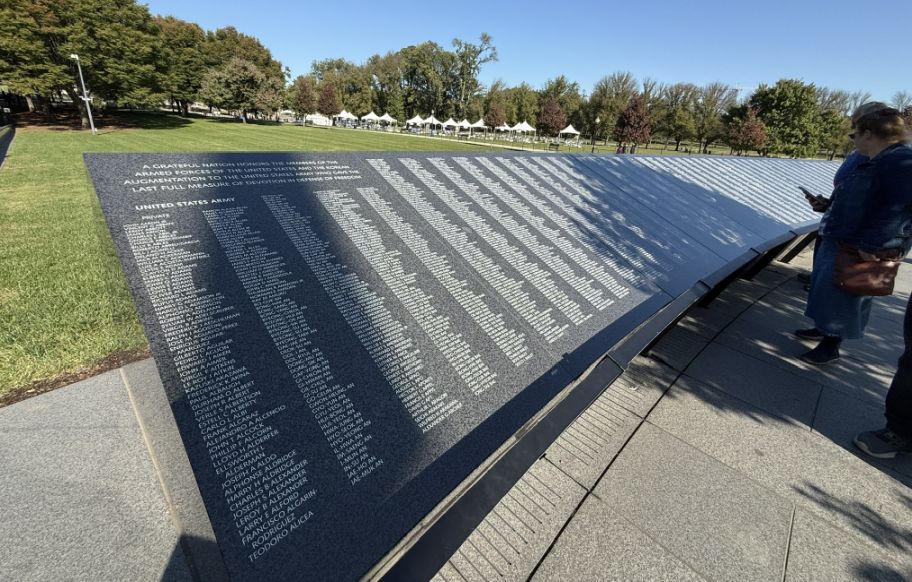
Just beyond, the granite wall of names stretches out, row after row, individual lives pulled back out of the statistics and given their own place to stand.
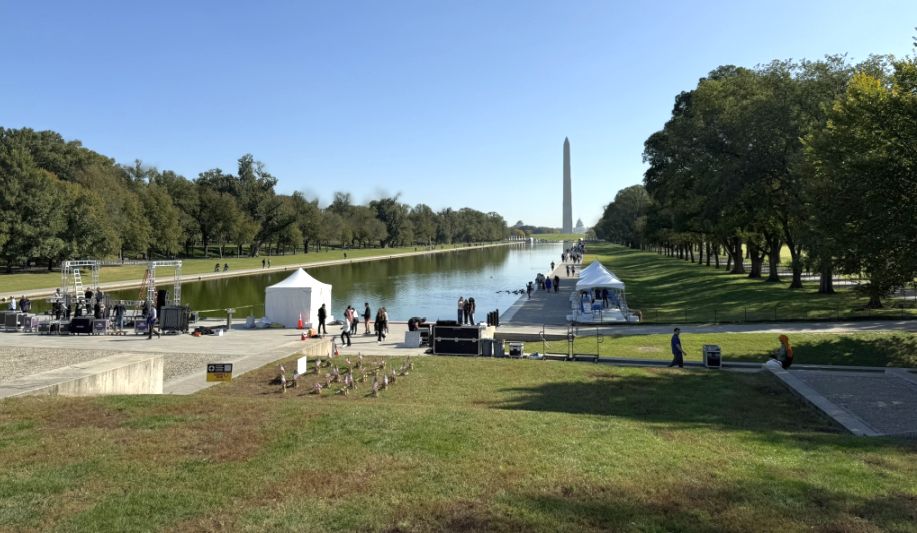
When we leave the Korean War Memorial and begin walking toward the Lincoln Memorial, the landscape opens wide. The landscape shifts from intimacy to grandeur. The long walk opens onto the Washington Monument, rising clean and pale against the sky.
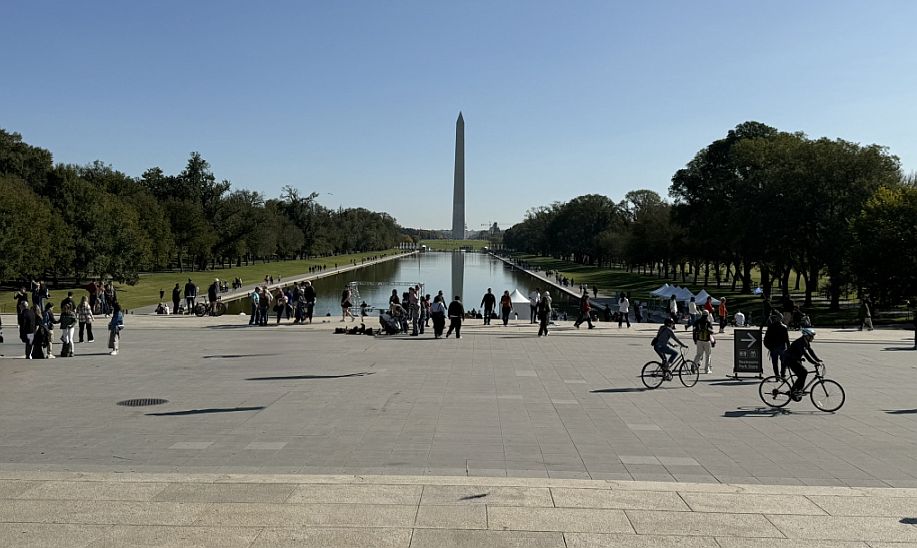
The vastness of the Mall gives you room to breathe again, almost like a pause between chapters of history.
 |
 |
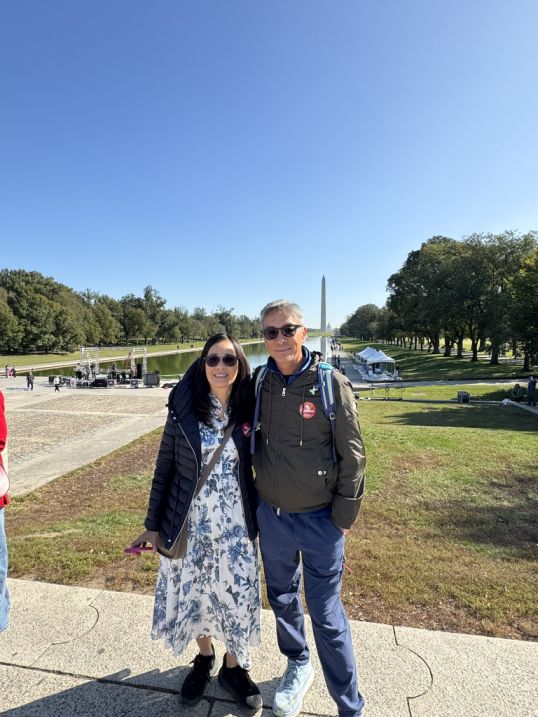
The Washington Monument behind us.
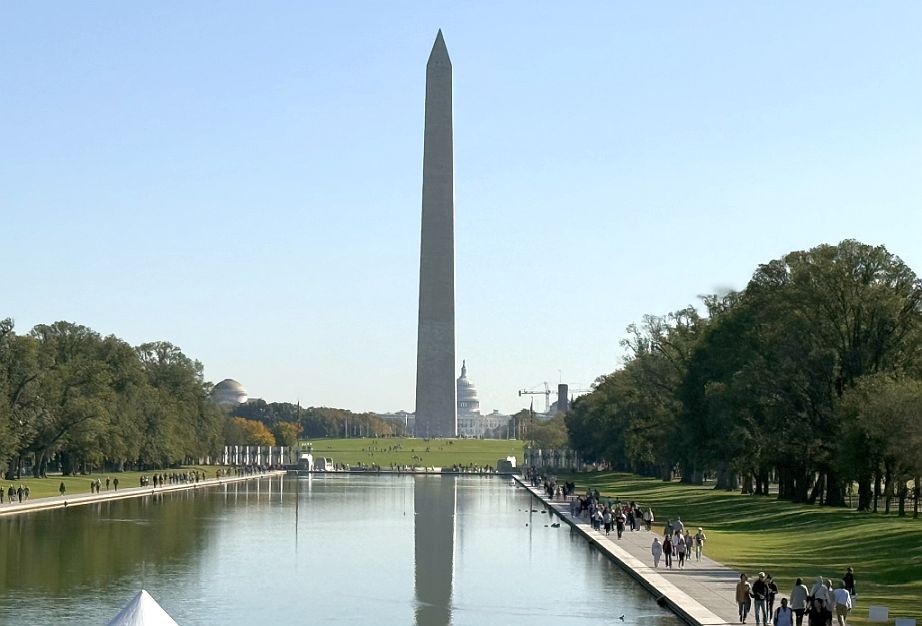
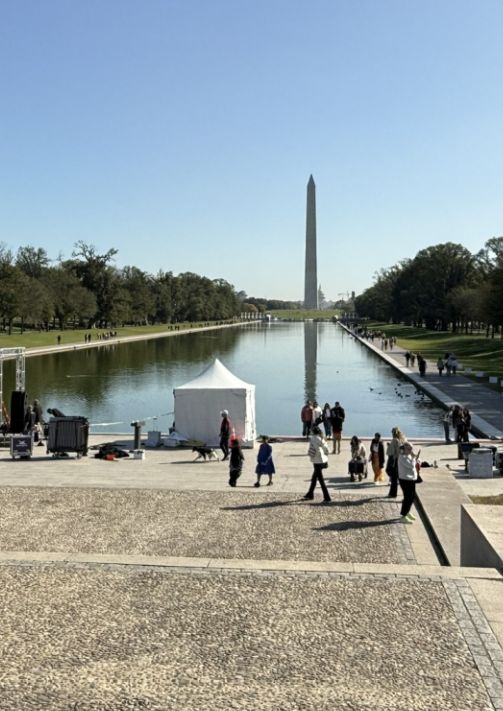
The Washington Monument with its pale obelisk rising clean and silent against the sky, reflected in the long basin stretching before it.
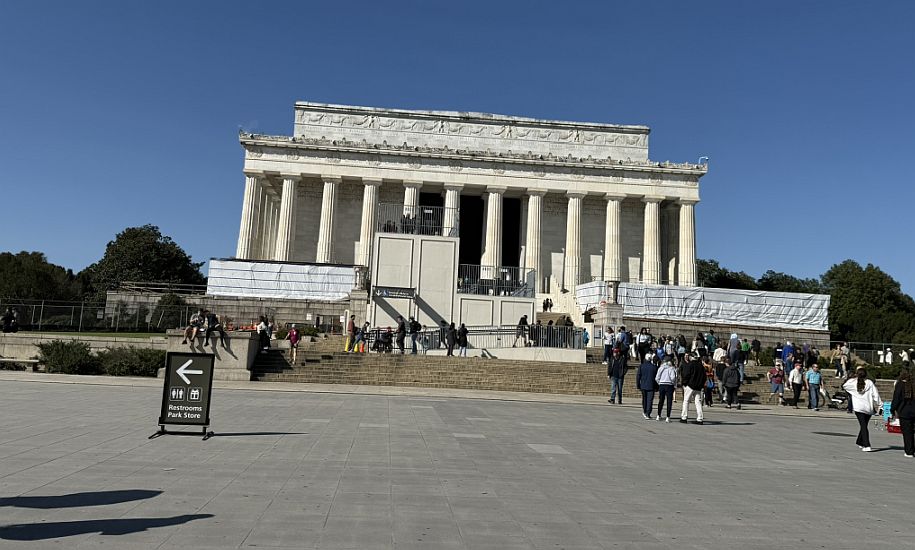
We are approaching the Lincoln Memorial, you don’t enter straight on.
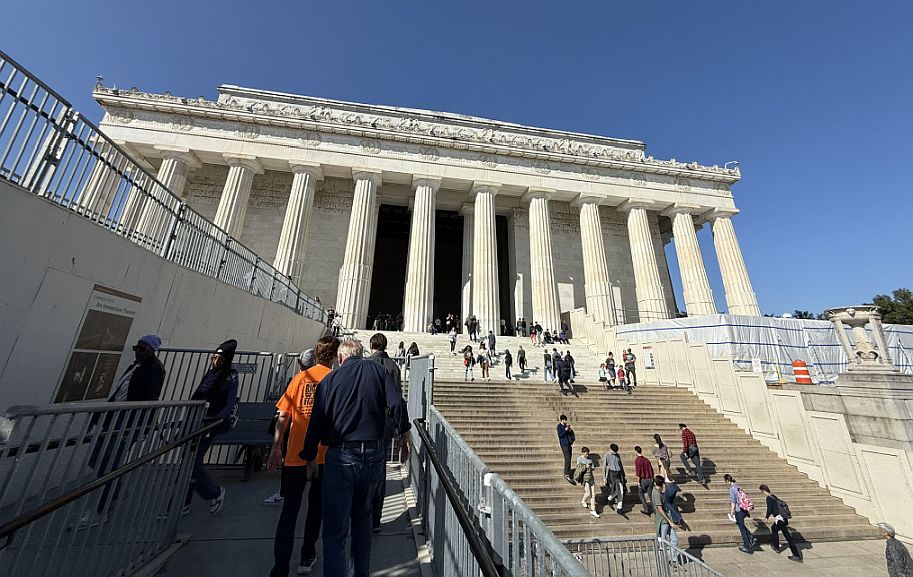
Instead, our guide led us to move around the side, climbing gradually, the massive columns in front of us before getting to see what’s inside.
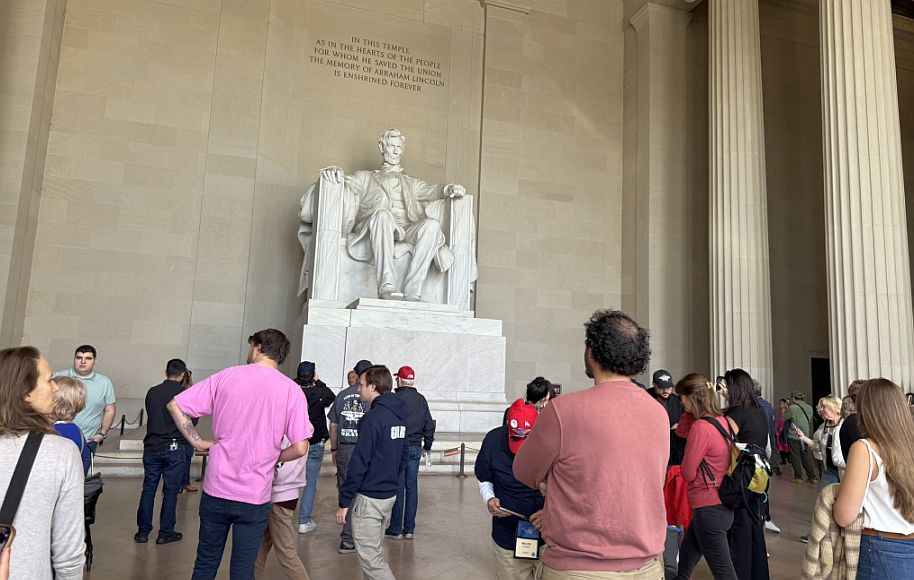
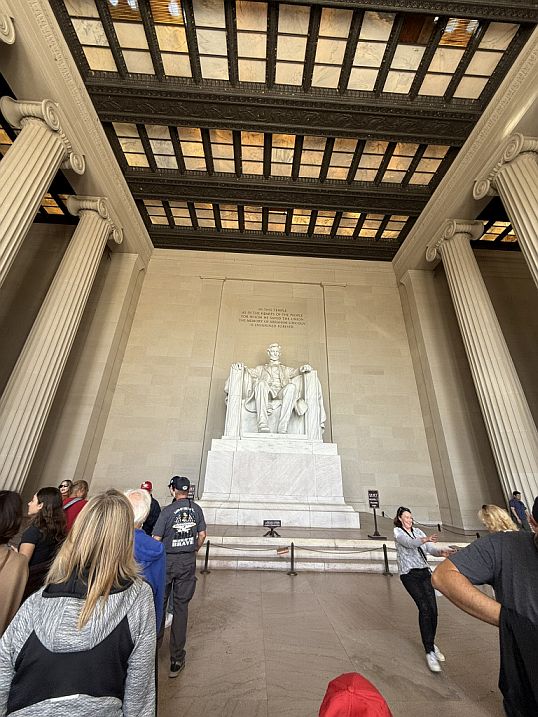
Then we stepped inside, and there he is. The Lincoln Memorial is a masterpiece of symbolism, designed to honor Abraham Lincoln as the "Savior of the Union." Architect Henry Bacon modeled the building after the Parthenon in Athens, the birthplace of democracy, to reflect Lincoln’s defense of democratic ideals.
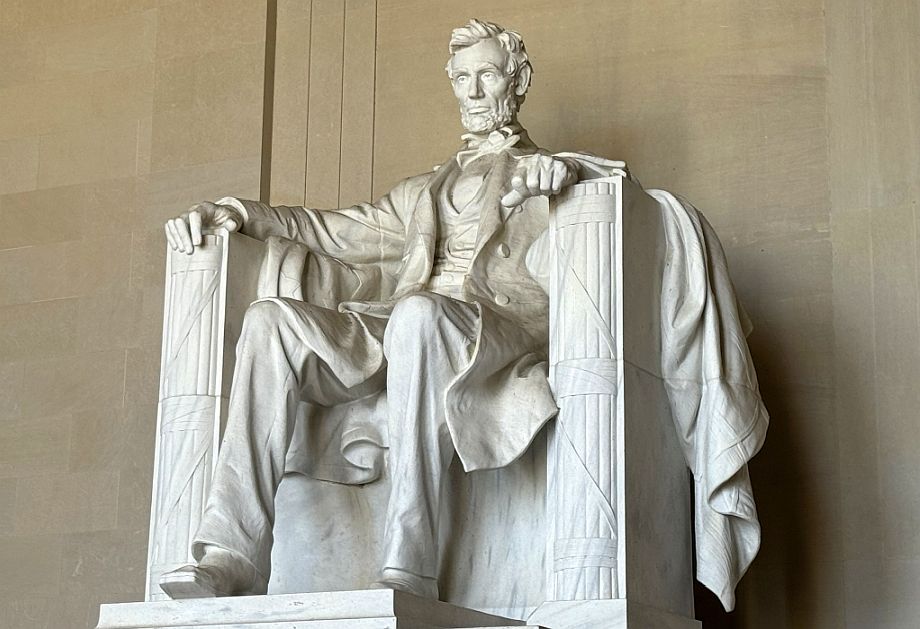
The statue of Abraham Lincoln is far larger than expected, yet deeply restrained. He sits, not standing in triumph, but seated, thoughtful, burdened, present. His hands tell their own story: one clenched, one open. Strength and compassion. Resolve and mercy. His face isn’t distant or idealized; it’s worn, contemplative, as if he’s still carrying the weight of the nation’s fracture.
 |
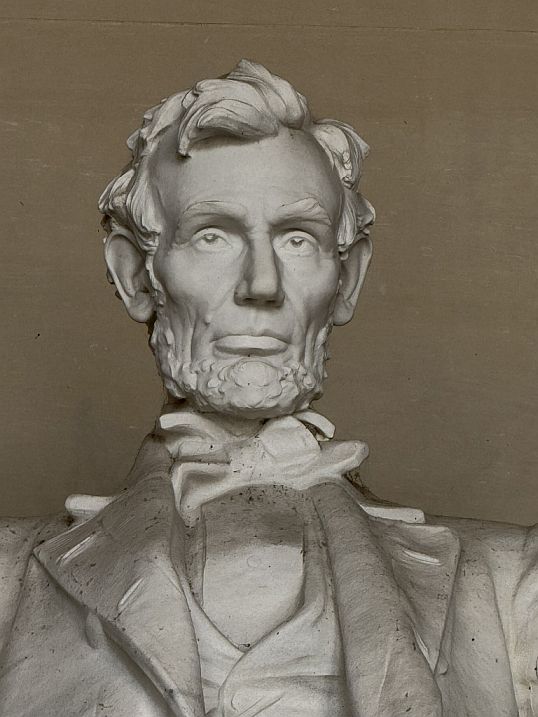 |
Sculpted by Daniel Chester French and carved by the Piccirilli brothers, the 19-foot-tall statue depicts Lincoln in a moment of deep contemplation during the Civil War.
The statue was originally planned to be only 10 feet tall, but designers realized it would be "lost" in the massive chamber, so it was nearly doubled in size. If this Lincoln were to stand up, he would be 28 feet tall.
 |
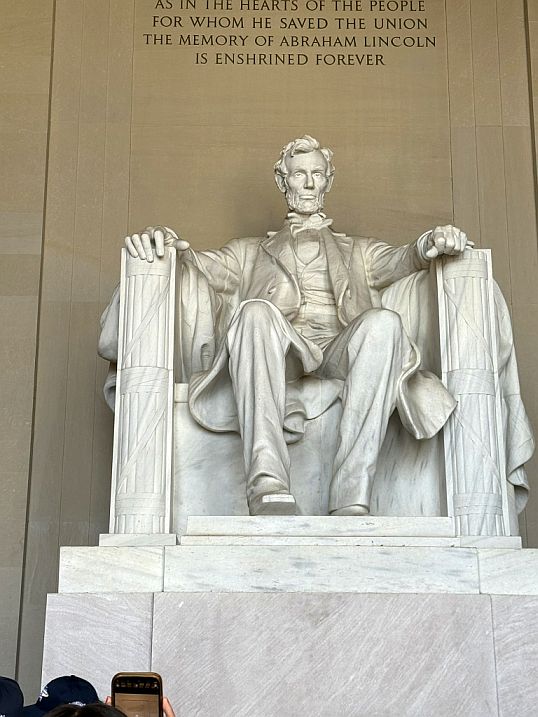 |
Reviewers and historians often point out the contrast in his hands. His left hand is clenched in a fist, representing the strength and determination required to lead the nation through war. His right hand is more open and relaxed, symbolizing his compassionate nature and "charity for all."
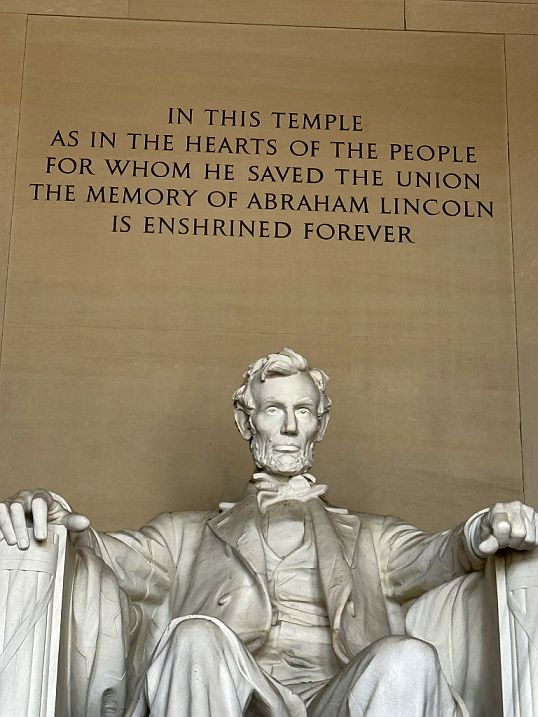
Directly behind and above Lincoln’s head is a powerful epitaph written by Royal Cortissoz. It reads: "IN THIS TEMPLE / AS IN THE HEARTS OF THE PEOPLE / FOR WHOM HE SAVED THE UNION / THE MEMORY OF ABRAHAM LINCOLN / IS ENSHRINED FOREVER" This text explicitly frames the building not just as a monument, but as a "temple" to the man who preserved the United States.
 |
 |
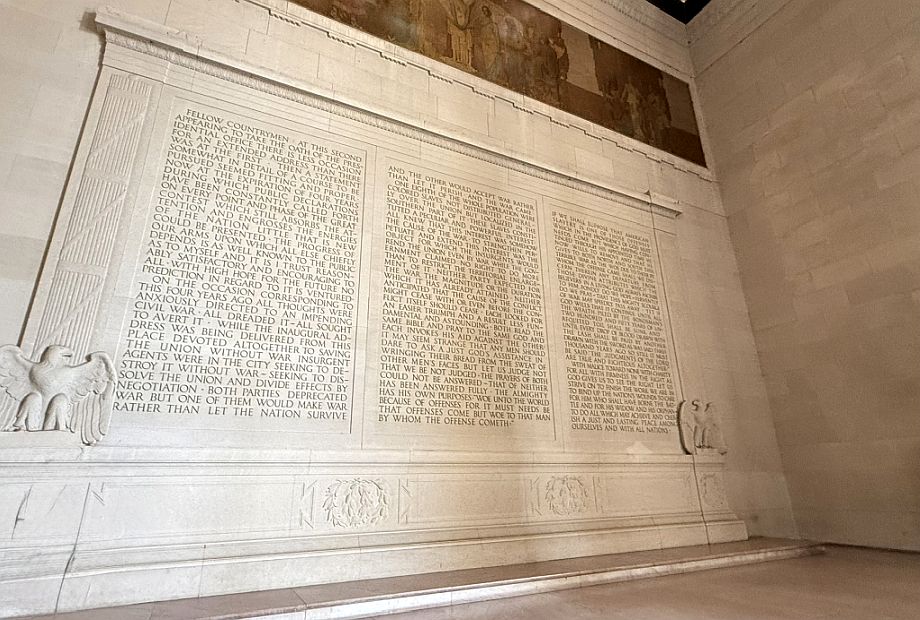
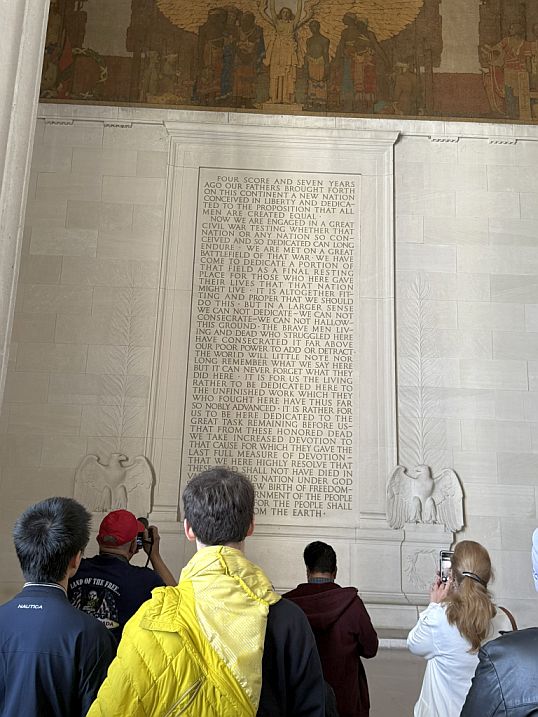
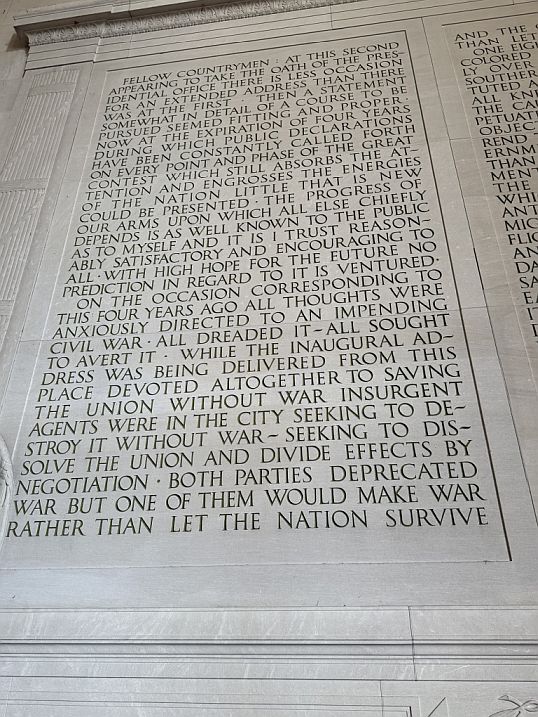
This large wall with the three panels contains Lincoln’s Second Inaugural Address, delivered on March 4, 1865, as the Civil War was nearing its end. It is widely considered one of the most profound speeches in American history.
Lincoln wasn't celebrating victory. Instead, he was reflecting on the tragedy of the war, suggesting that both North and South were being punished for the "offense" of slavery. The third panel (to the right) concludes with the iconic lines: "With malice toward none; with charity for all..." It was his plea for the nation to bind up its wounds and achieve a lasting peace.
 |
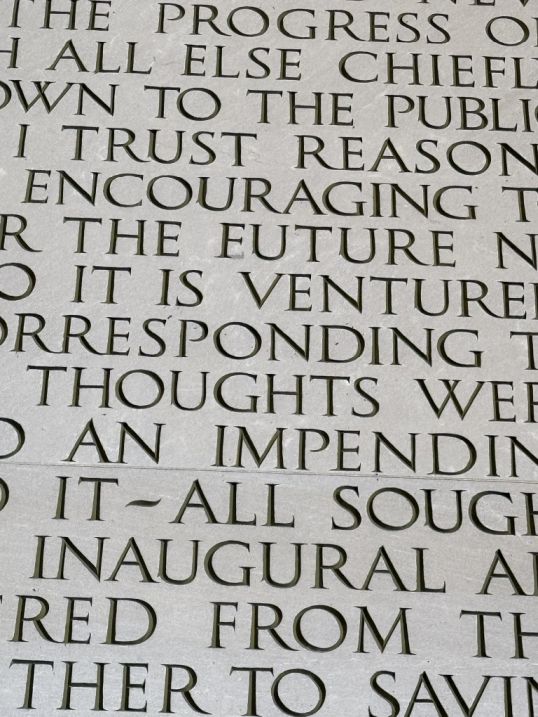 |
Our tour guided pointed out that on the second (middle) panel, you can find a permanent "typo" in the stone. The Word: "FUTURE"
The Error: The stone carver accidentally carved an "E" instead of an "F".
The Fix: They realized the mistake almost immediately and filled in the bottom horizontal stroke of the "E" with a small piece of stone to make it look like an "F."
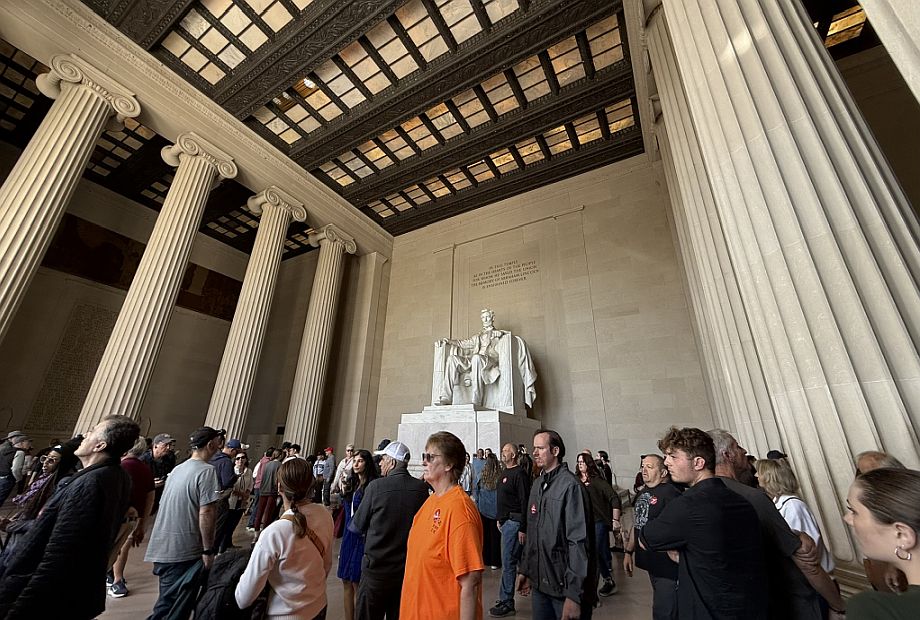
The memorial is surrounded by a peristyle of 36 fluted Doric columns, which carry a specific historical weight. Symbolism of 36: There were 36 states in the Union at the time of Lincoln's death in 1865. Each column represents one of those states, and you can see their names carved in the frieze directly above each column.
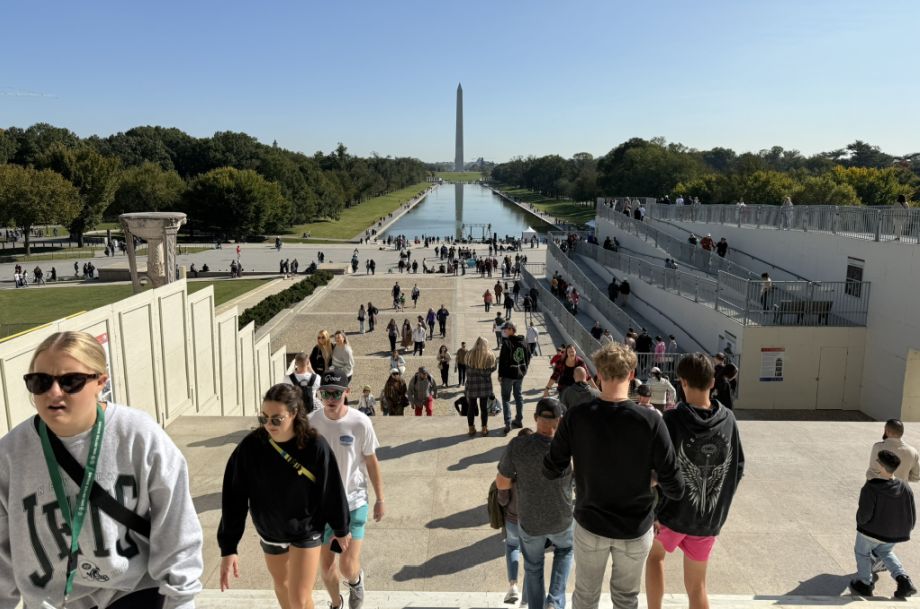
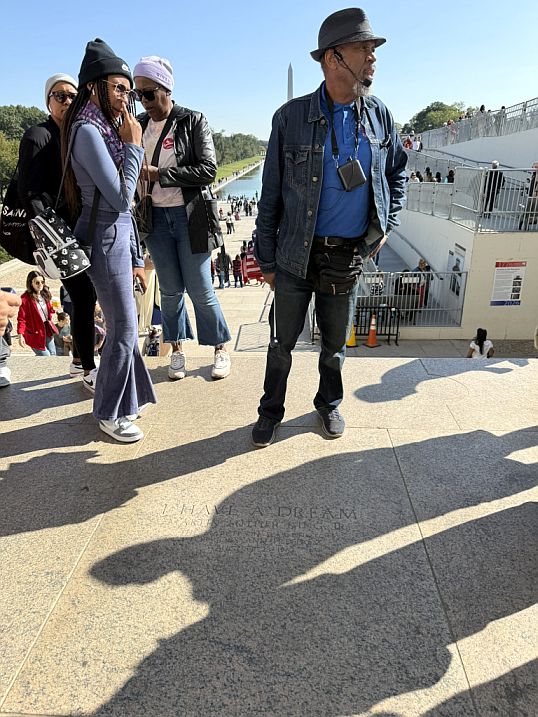
We are now leaving the memorial and this is the view of the Washington monument from the top of the Lincoln Memorial.
 |
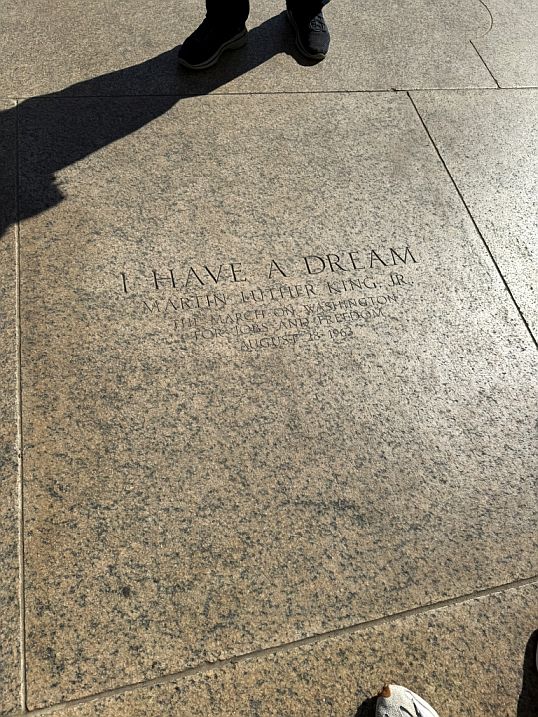 |
Before leaving the Memorial, our tour guide pointed out the inscription
marking where Dr. Martin Luther King Jr. stood is located on the landing of
the
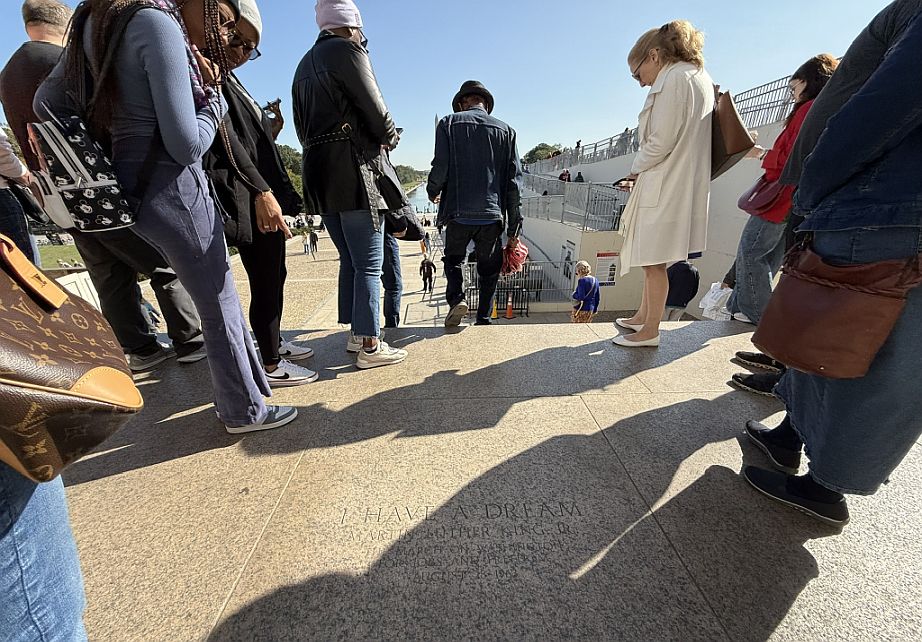
The placement of this quote is deeply symbolic, transforming the memorial from a monument of the past into a living site for civil rights. The location emphasizes the connection between Lincoln’s work to end slavery and King’s work to end segregation. It suggests that the "temple" Lincoln occupies is not complete until his promises are realized for all citizens.
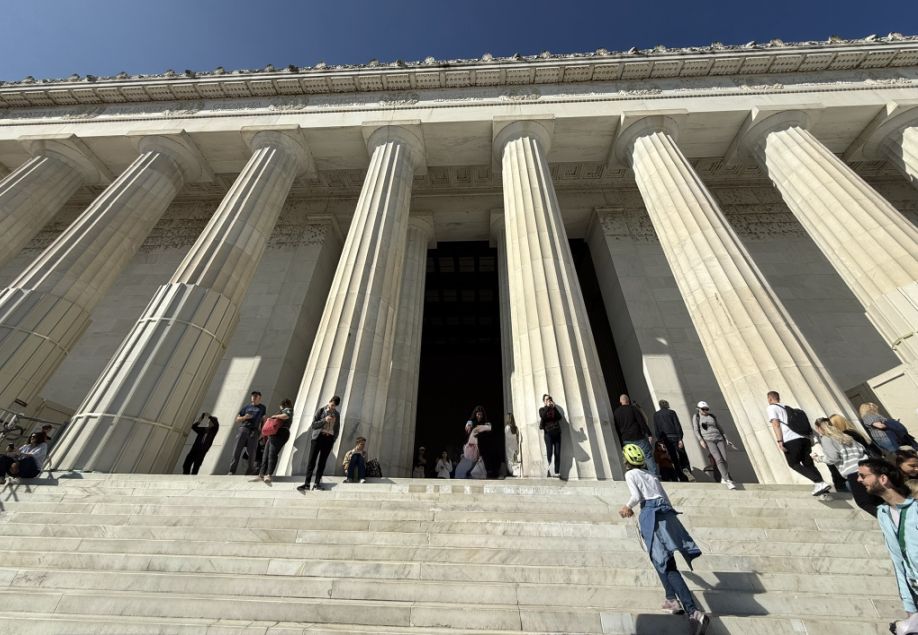
Before leaving the Memorial, I turned around and took a picture of the building. Architect Henry Bacon chose the Greek Doric style, modeled after the Parthenon in Athens. This choice was deliberate: because ancient Greece was the birthplace of democracy, the memorial honors Lincoln as the man who saved the world's greatest modern democracy.
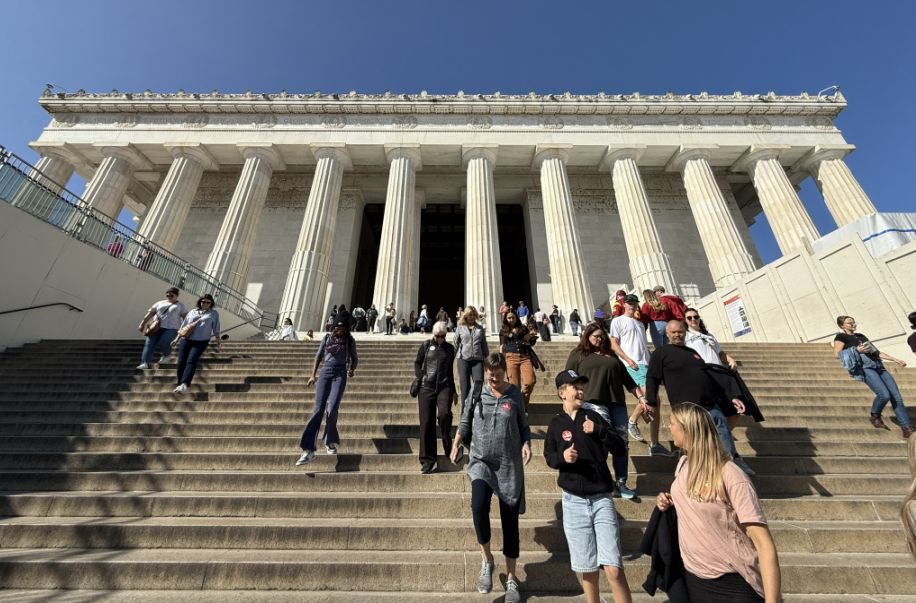
The entire building sits on a high rectangular platform. This elevates Lincoln above the surrounding landscape, emphasizing his status as a towering figure in American history.
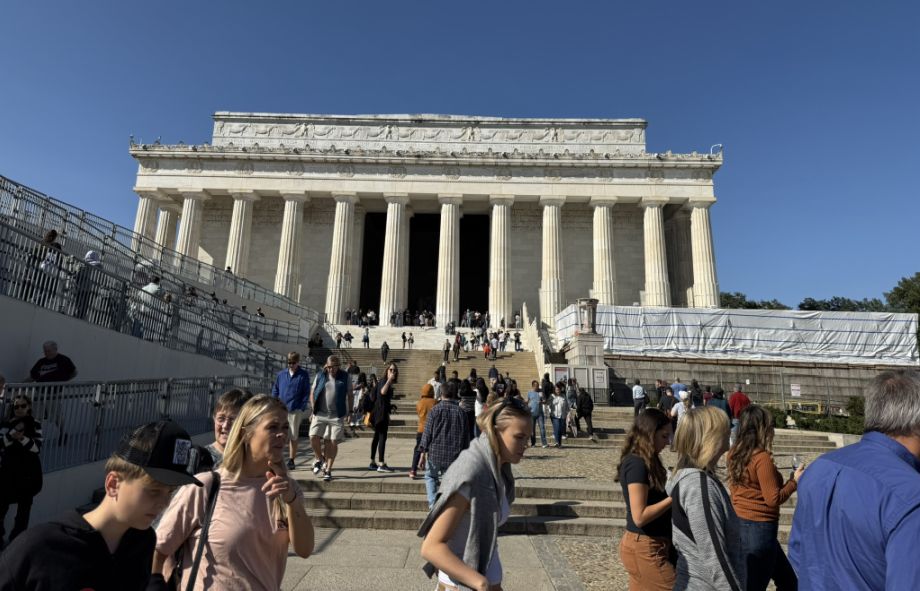
The exterior is white Colorado Yule marble, the interior walls are Indiana
limestone, the floor is pink Tennessee marble, and the ceiling tiles are made
of Alabama marble soaked in paraffin to make them translucent. Because the
memorial was built on reclaimed "swamp" land (the Potomac flats), engineers
had to sink 122 concrete piers deep into the bedrock to support the 38,000-ton
structure. Construction began on February 12, 1914, and took eight years to
complete. It
was finally dedicated on May 30, 1922.
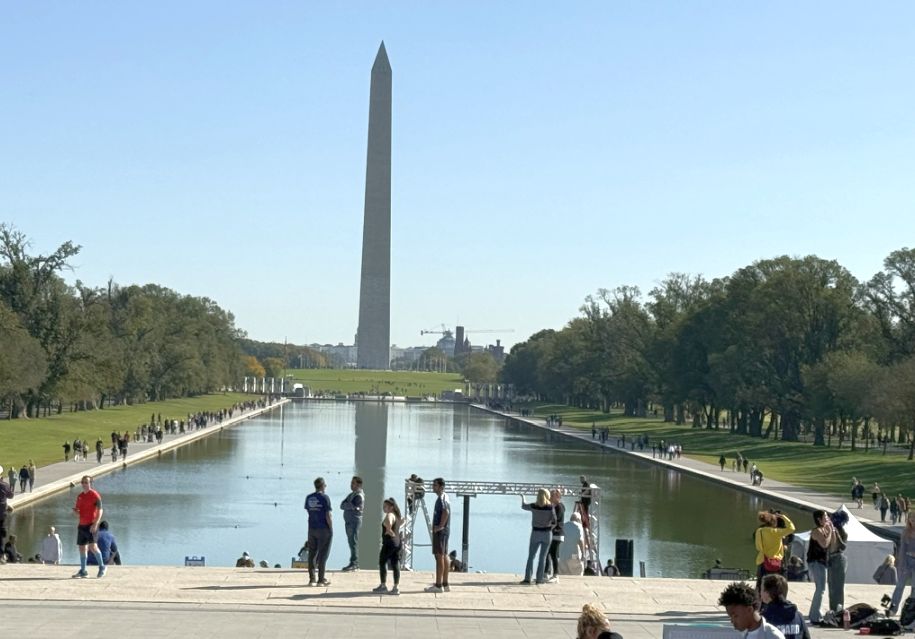
We now leaving the area and headed to our next destination.
NEXT... Day 2- Vietnam War Memorial