6 days in Washington DC- 10/18- 10/23/2024
Day 5- National Air and Space Museum-10/22/2024
The National Air and Space Museum in Washington, D.C., is one of the most popular museums in the world and part of the Smithsonian Institution. It's a must-see for anyone interested in aviation and space exploration! The museum's origins trace back to 1946 when the National Air Museum was established. However, the current iconic building on the National Mall didn't open until 1976. Its creation was driven by the Smithsonian's extensive collection of aviation and space artifacts, which had been growing since the late 19th century.
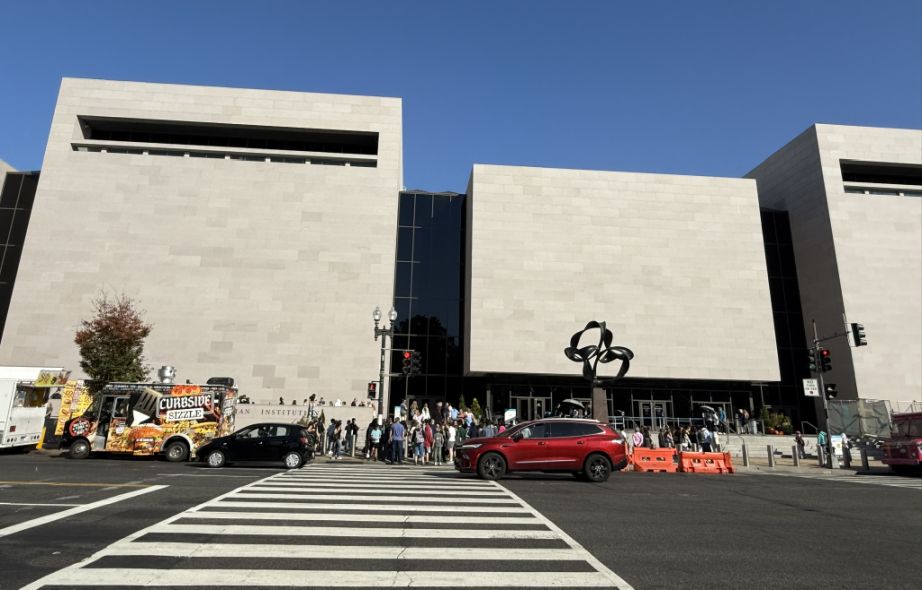
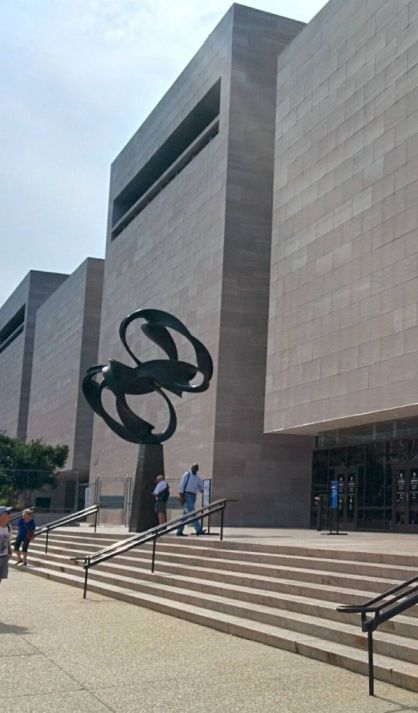
From the outside, the museum has a clean, modern look. The building is made of Tennessee marble with large glass windows and sleek bronze frames. It feels solid and geometric, almost like a spacecraft hangar built into the National Mall. It sits prominently along the Mall, not far from the U.S. Capitol, and blends into the grand civic architecture of Washington while still feeling distinctly modern. After its recent renovations, the façade looks refreshed and brighter.
 |
 |
There was a long line to get in the museum but the good news is, despite the crowds, the security lines are very efficient and well organized. The flow of visitors is handled smoothly, and we were inside before we know it.
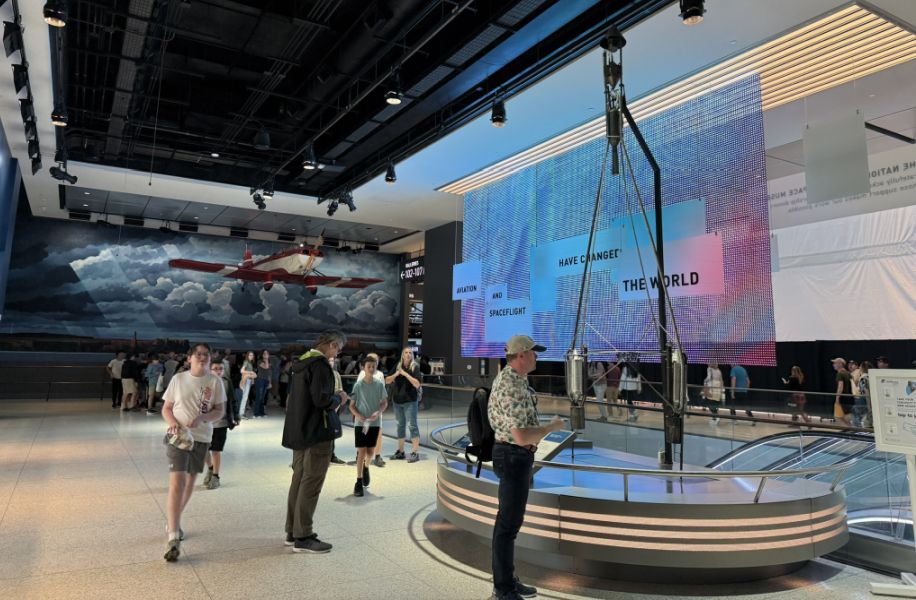
As soon as we entered, the space opens dramatically.
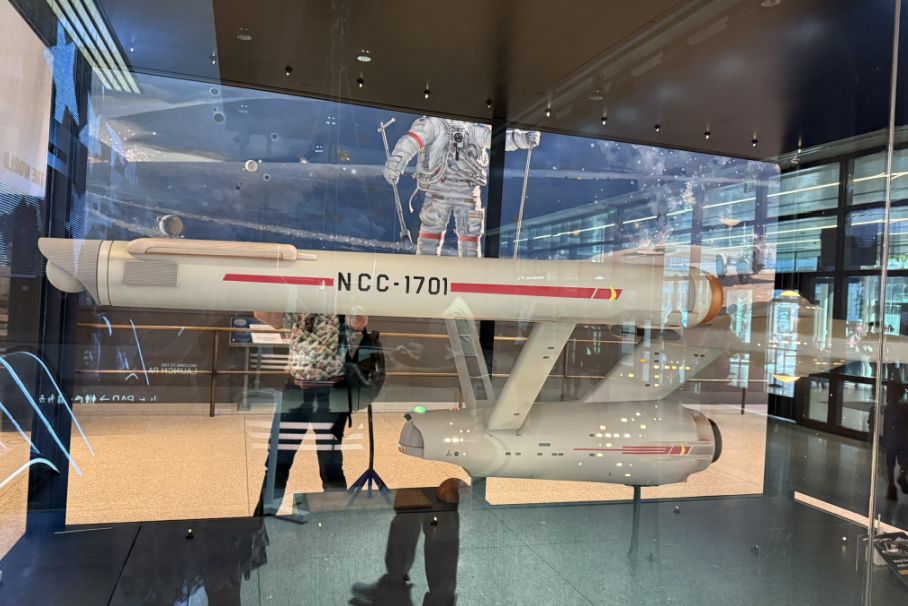
Star Treck Starship Enterprise, Studio Model is the original filming model from the 1960s Star Trek TV series, specifically the U.S.S. Enterprise NCC-1701. It’s about 11 feet long and built mostly from wood. The Smithsonian restored it several times since acquiring it in the 1970s to preserve the show-accurate lighting and colors. It’s displayed not just as a prop, but as a symbol of how science fiction has inspired real-world engineering and exploration, NASA scientists often credit Star Trek for sparking their curiosity and passion.
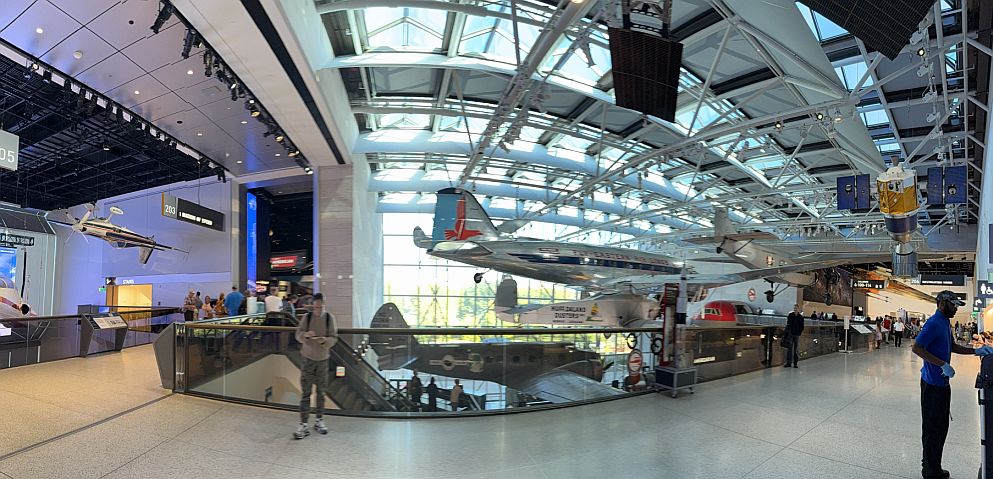
The ceiling soars high overhead, and hanging above are historic airplanes and spacecraft that seem to float in midair. The lighting is bright and natural, streaming through the large windows, making the aircraft gleam.
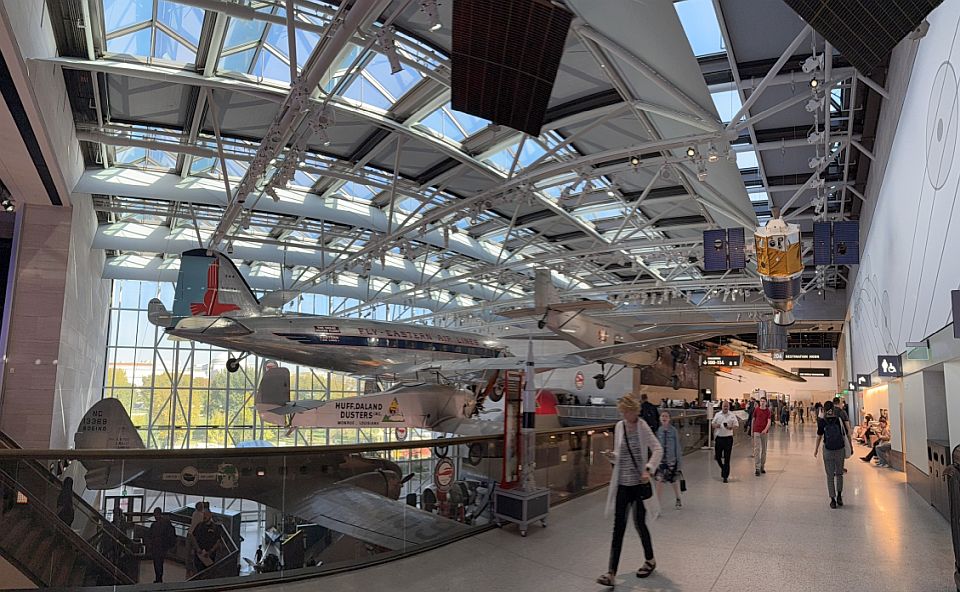
The dramatic ceiling display is one of the museum’s signatures. Each aircraft is carefully suspended to evoke the feeling of flight in motion.
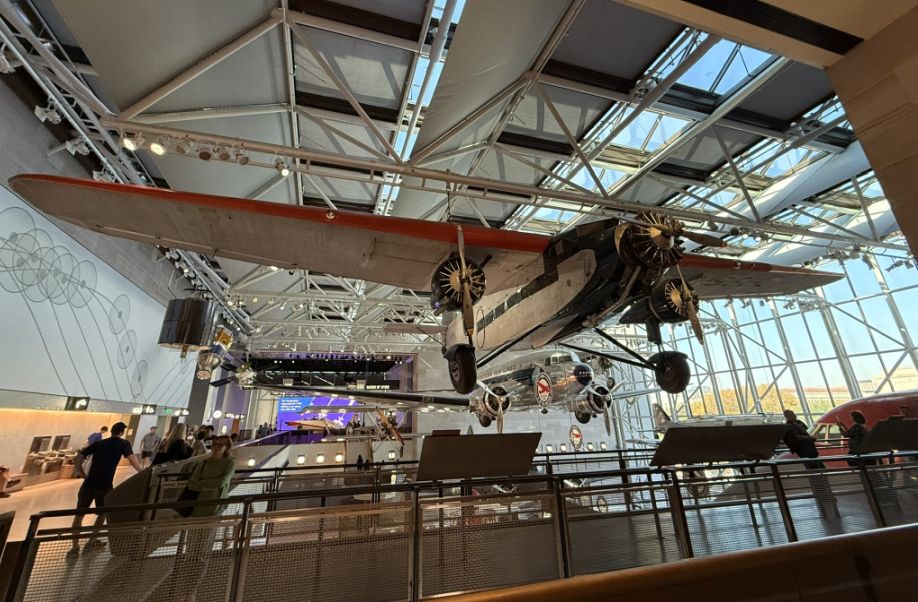
Some of the planes are famous such as the Wright Flyer (1903 replica or restored version): The world’s first successful powered flight.
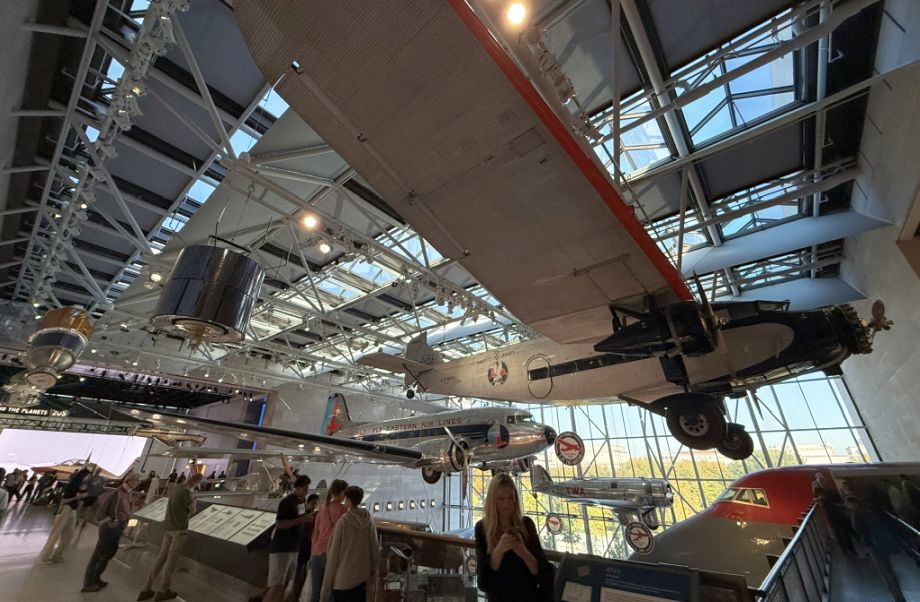
The Spirit of St. Louis (1927): Charles Lindbergh’s plane for the first solo nonstop transatlantic flight.
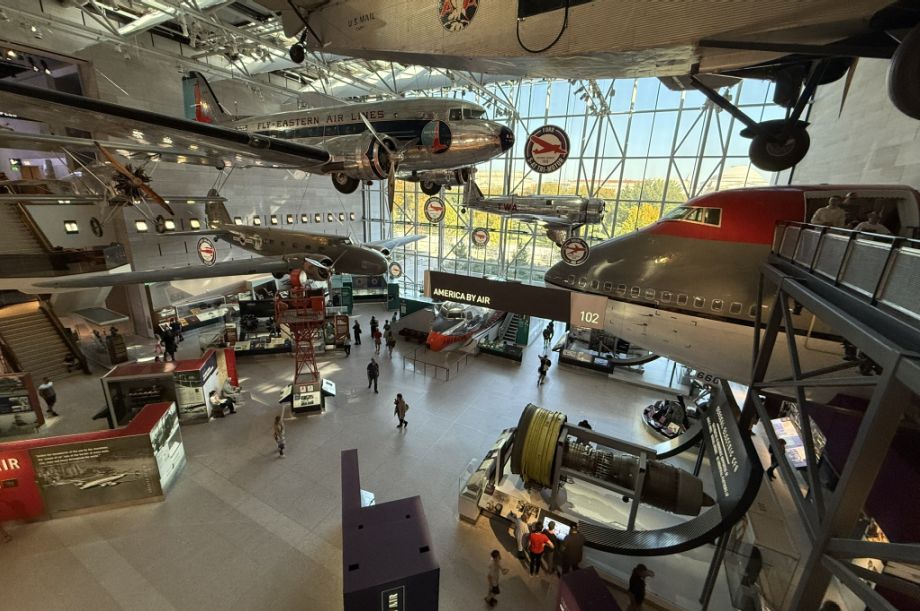
The Bell X-1: The rocket plane that broke the sound barrier with Chuck Yeager at the controls in 1947. The North American X-15: A rocket-powered research aircraft that helped pave the way for spaceflight in the 1960s.
Each one marks a giant leap in human achievement, and the way they’re arranged helps tell the story of how we went from the first flight to space in just 66 years!
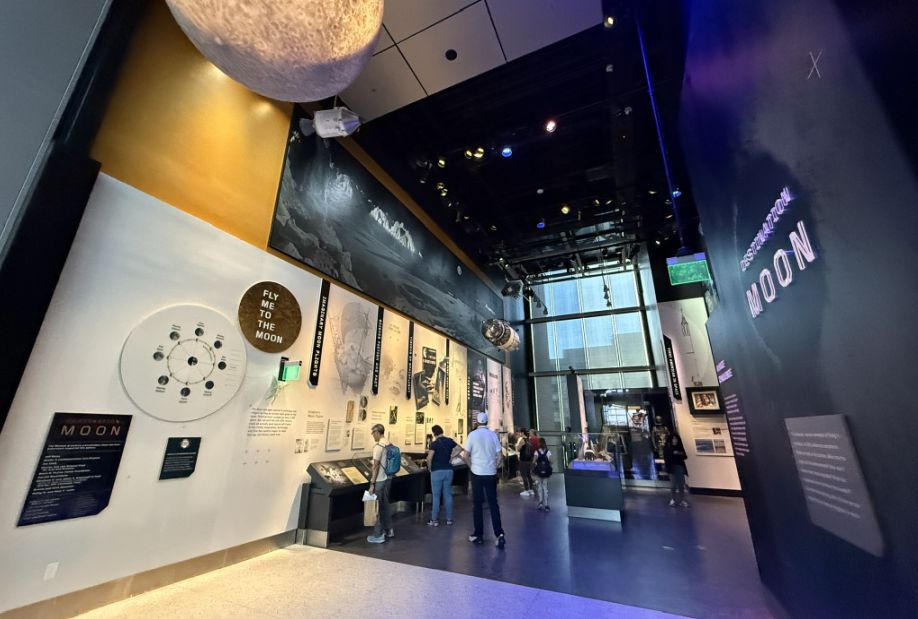
We are now heading to one of the most inspiring sections of the National Air and Space Museum! The Destination Moon gallery is where the story of humanity’s dream, struggle, and triumph in reaching the Moon unfolds, from myth and imagination to the real Apollo missions.
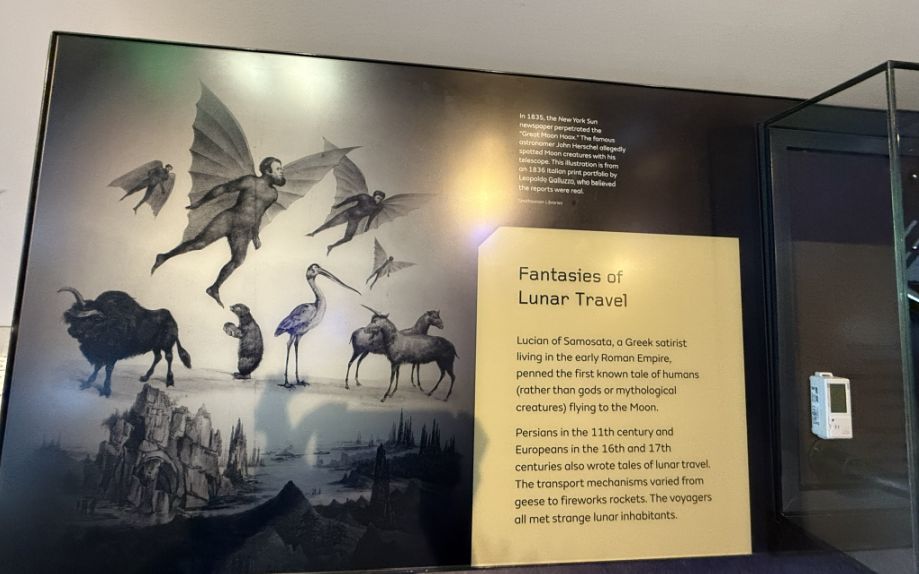
This opening section shows how people dreamed about reaching the Moon long before technology made it possible. This artwork is an early science fiction illustrations, and film references, all imagining moon voyages.
 |
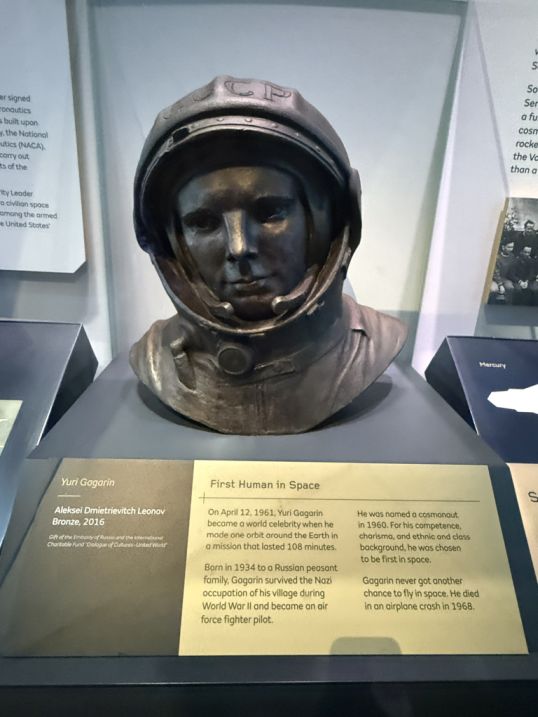 |
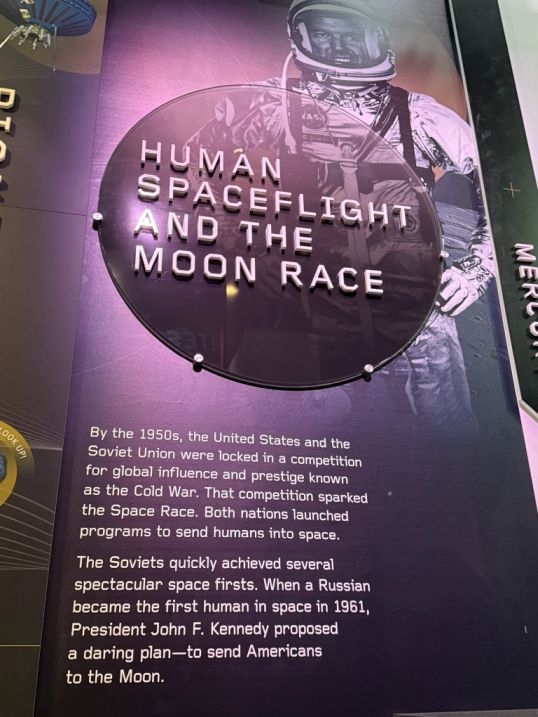
This marks the shift from imagination to reality. The display commemorates the intense space rivalry between the United States and the Soviet Union during the Cold War era.
Yuri Gagarin was a Soviet cosmonaut and the first human in space (April 12, 1961). His 108-minute orbit around Earth aboard Vostok 1 made him an international hero and triggered the space race that would lead to the Moon landings. The sculpture symbolizes human courage and international milestones in space exploration.
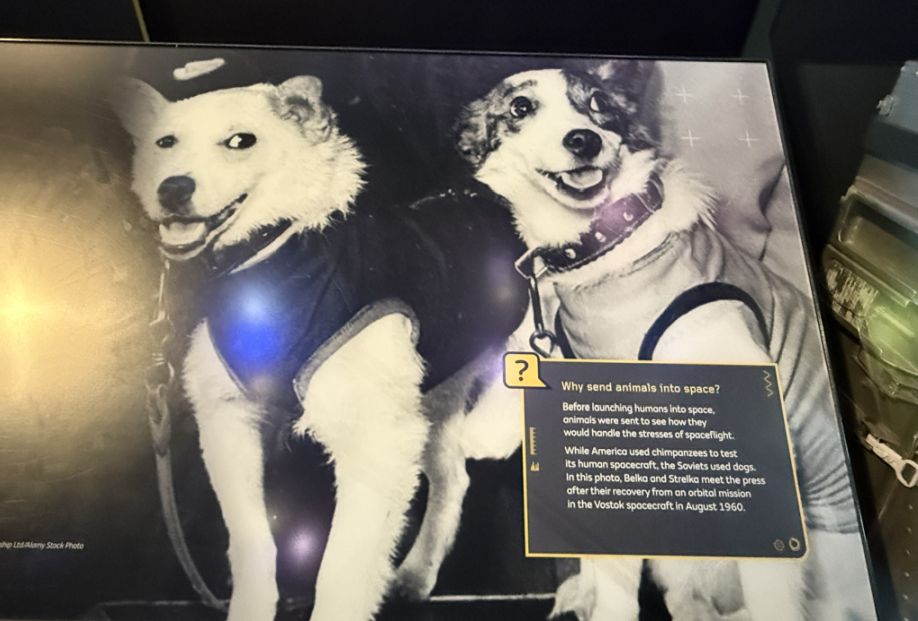
The Soviet Space Dogs probably Belka and Strelka were sent by the USSR into orbit in 1960 aboard Sputnik 5. They became the first living beings to orbit and return safely to Earth, an essential step toward proving space travel could be survivable. Their story is both scientific and deeply human, these little animals paved the way for human astronauts.
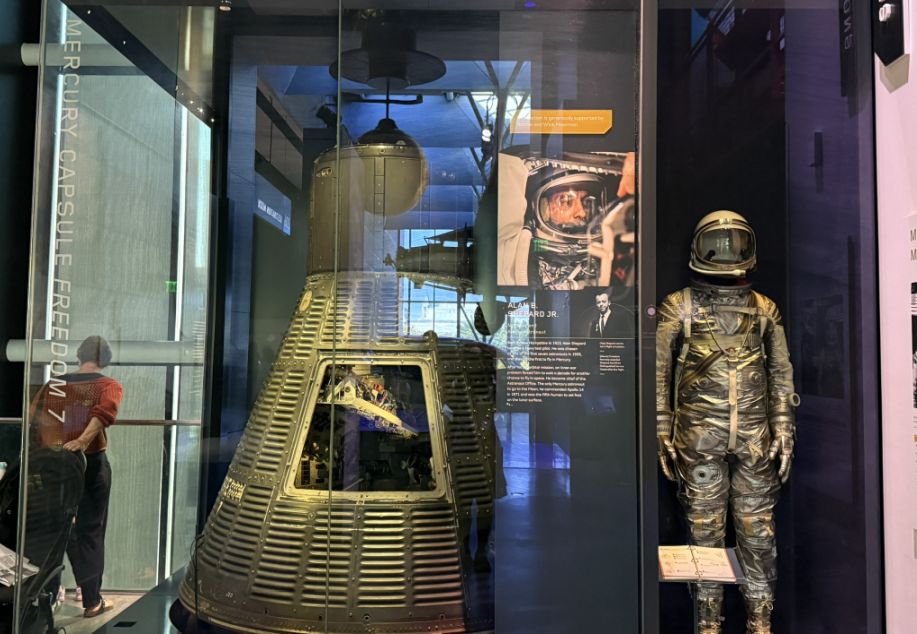
The Mercury Program, America’s First Step into Space.
The Mercury Program (1958–1963) was NASA’s first human spaceflight effort. Its goal: Put a human into orbit, study how the human body handled spaceflight, and safely return the astronaut to Earth. Alan Shepard became a national hero overnight. His calm professionalism and precision under pressure made him one of NASA’s best. He later returned to space in 1971 as commander of Apollo 14, walking on the Moon and even hitting golf balls on the lunar surface!
 |
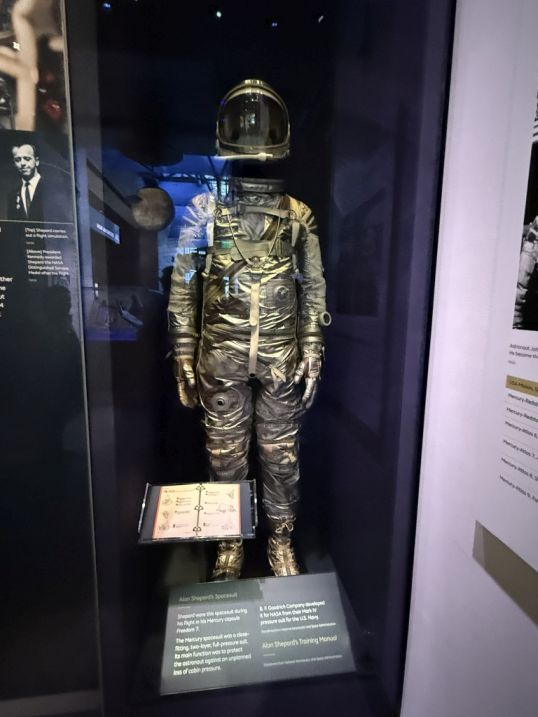 |
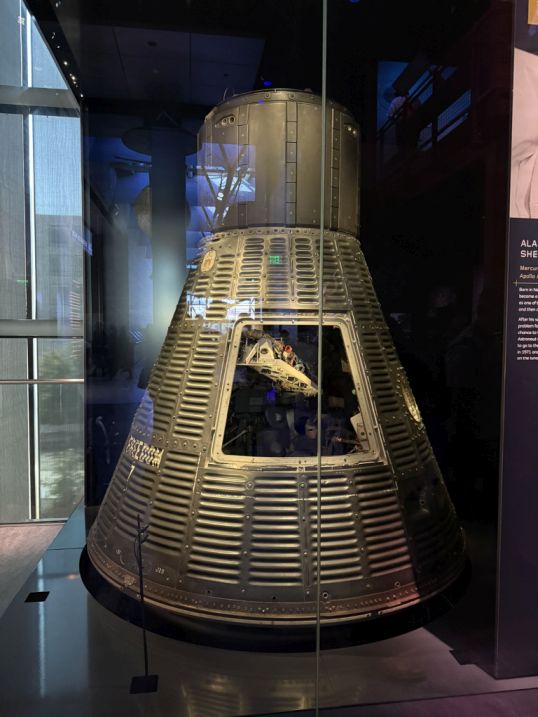
Capsule name: Freedom 7. Alan Shepard’s Historic Flight on May 5, 1961. He was the first American man in space. Just 15 minutes and 28 seconds, but it changed history! A suborbital flight, meaning it went into space but didn’t complete a full orbit around Earth. Reached about 116 miles above the Earth, about 5,100 mph, and landed safely in the Atlantic Ocean, where Shepard and the capsule were quickly recovered by the U.S. Navy.
Shepard famously had to pilot the capsule manually, proving humans could control a spacecraft rather than just ride it automatically.
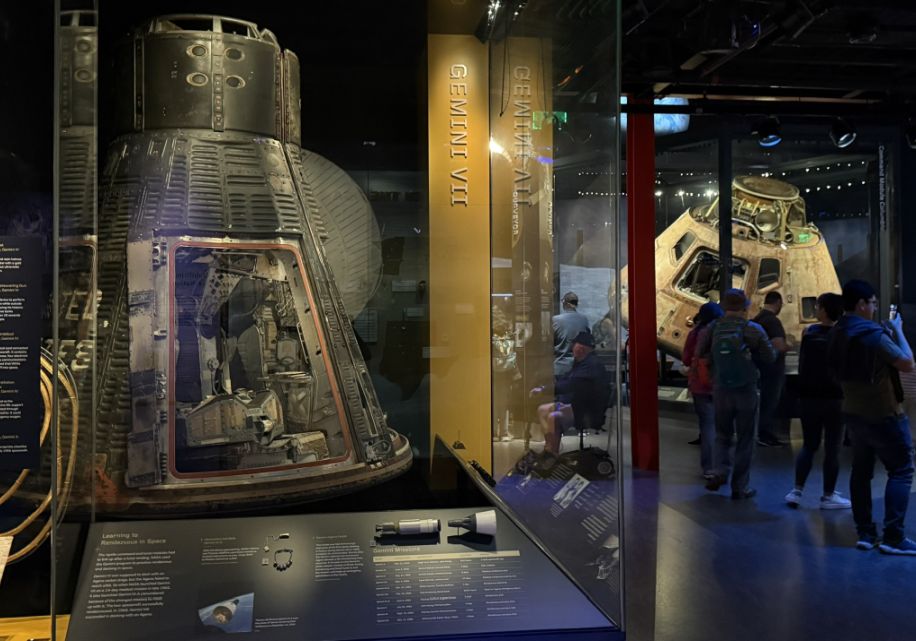
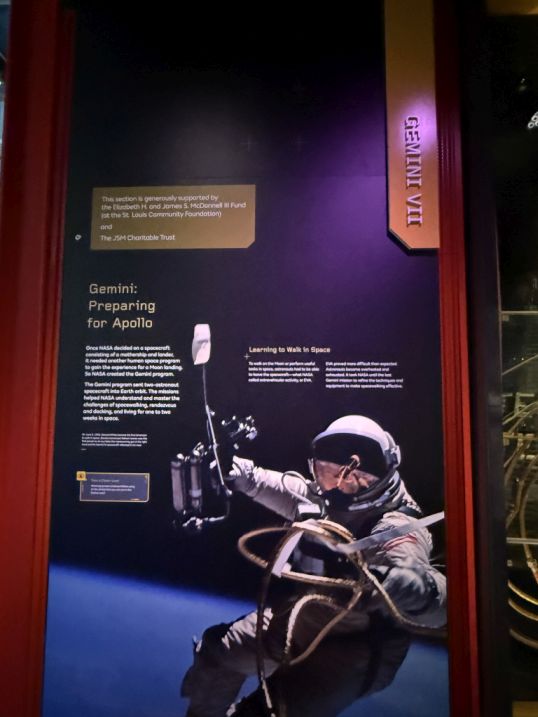
The Gemini program was the bridge between early missions (like Mercury) and Apollo, crucial for learning how to live and work in space.
 |
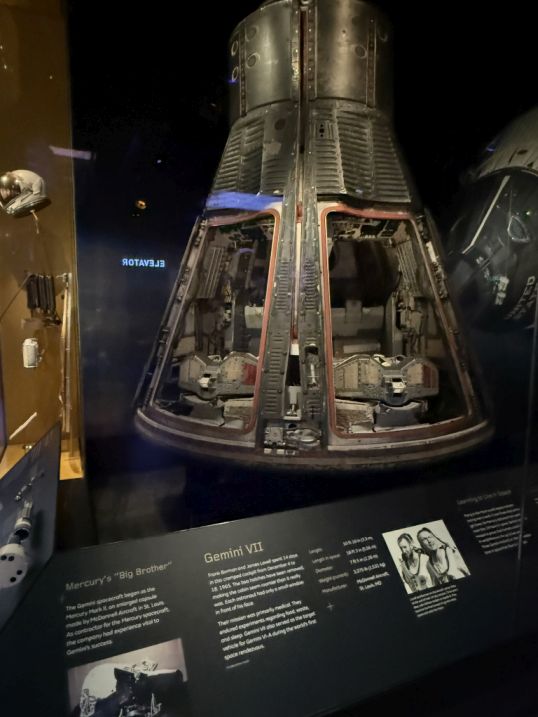 |
Gemini VII flew in 1965, carrying astronauts Frank Borman and Jim Lovell on a 14-day mission, proving humans could endure long durations in orbit.
 |
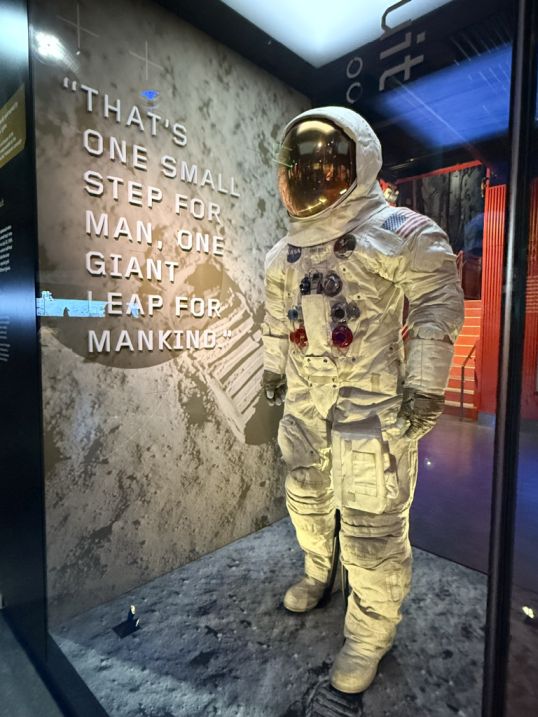 |
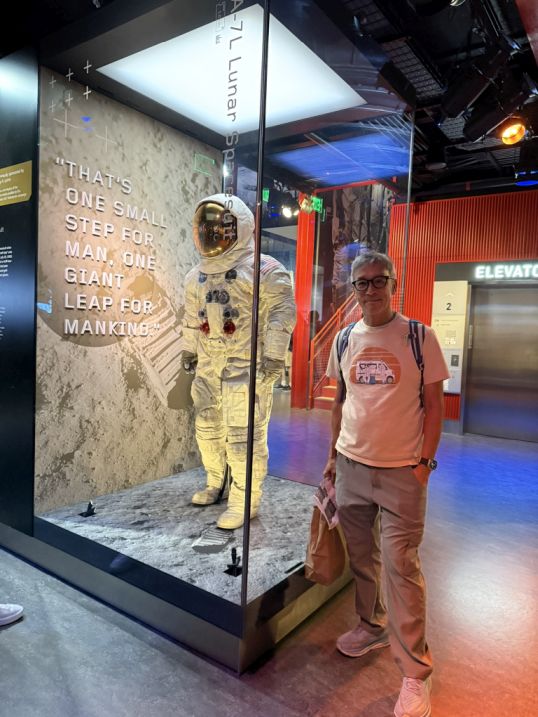
The quote “That’s one small step for man, one giant leap for mankind” was spoken by Neil Armstrong when he stepped onto the lunar surface on July 20, 1969, during Apollo 11. It captures the spirit of exploration, a moment when a human stood on another world for the first time.
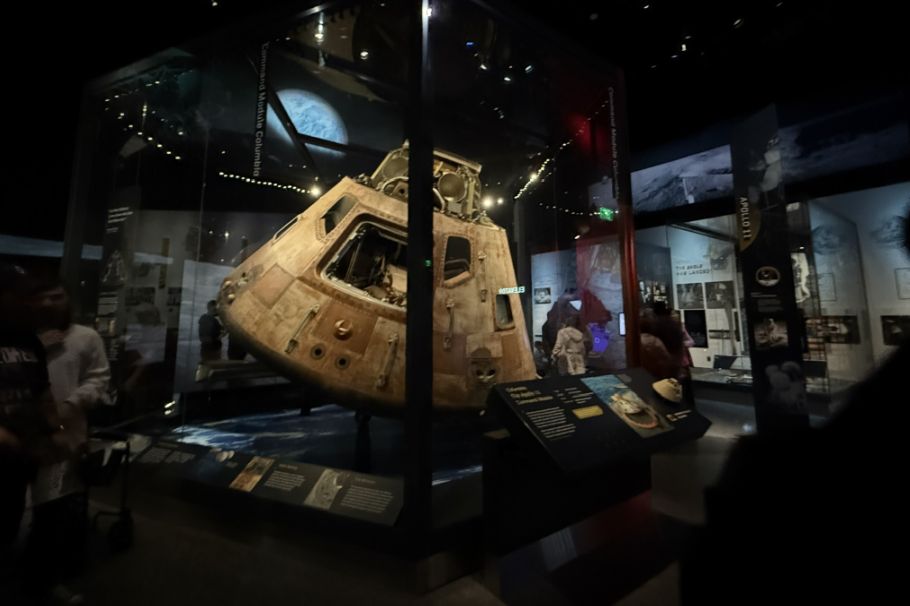
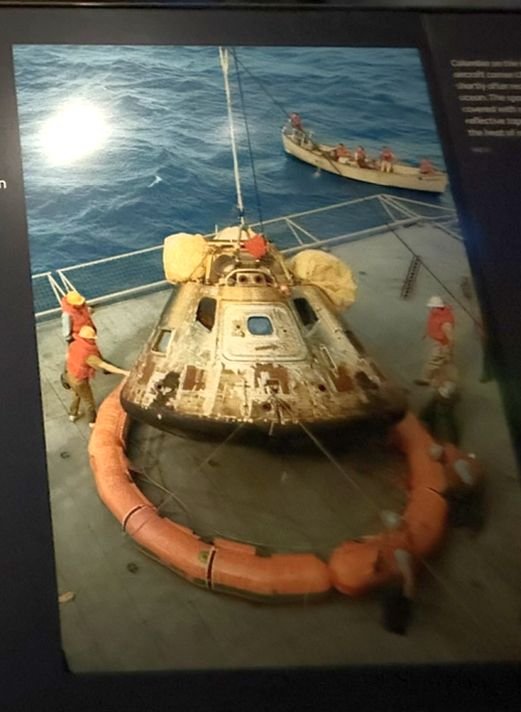
Columbia: The Apollo 11 Command Module
Columbia was the only part of the spacecraft from the first Moon landing expedition to return to Earth. After serving as the mothership in lunar orbit. Columbia carried the crew and their precious lunar samples through the fierce reentry into Earth's atmosphere. After Columbia's triumphant 50 state tour in 1970-1971, NSA transferred it to the Museum for preservation and display.
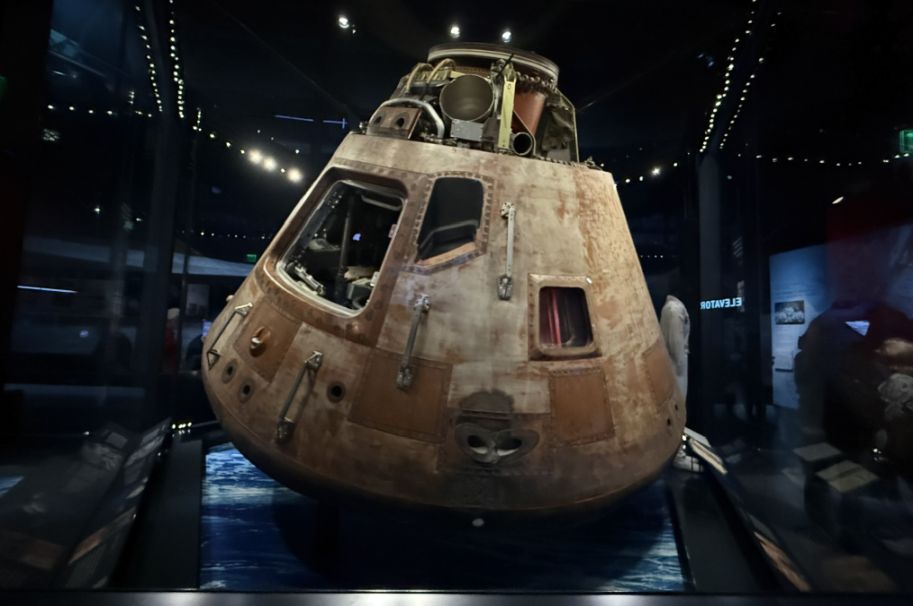
The capsule may look surprisingly small. That’s one of the first things people notice. Three astronauts: Neil Armstrong, Buzz Aldrin, and Michael Collins lived inside that tight cone-shaped space for eight days. The outside looks dark and scorched hat’s from the intense heat of re-entry into Earth’s atmosphere. It traveled nearly 1 million miles round trip. Only Columbia came back to Earth. The lunar module stayed behind in space. While Armstrong and Aldrin walked on the Moon, Michael Collins stayed alone in Columbia, orbiting the Moon and waiting for them to return. Without this command module, there would have been no way home.
 |
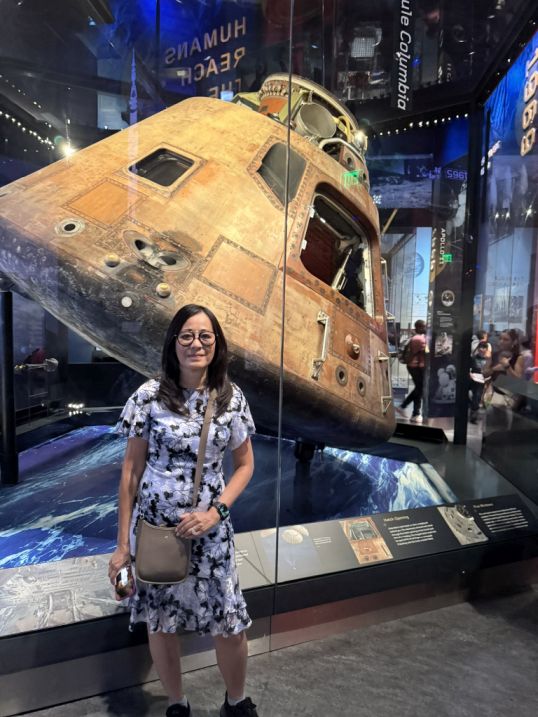 |
This is the vehicle that brought the first humans home from another world, A spacecraft that survived temperatures of about 5,000°F during reentry, One of the most significant artifacts of the 20th century. It’s surprisingly compact, but it represents one of humanity’s boldest achievements.
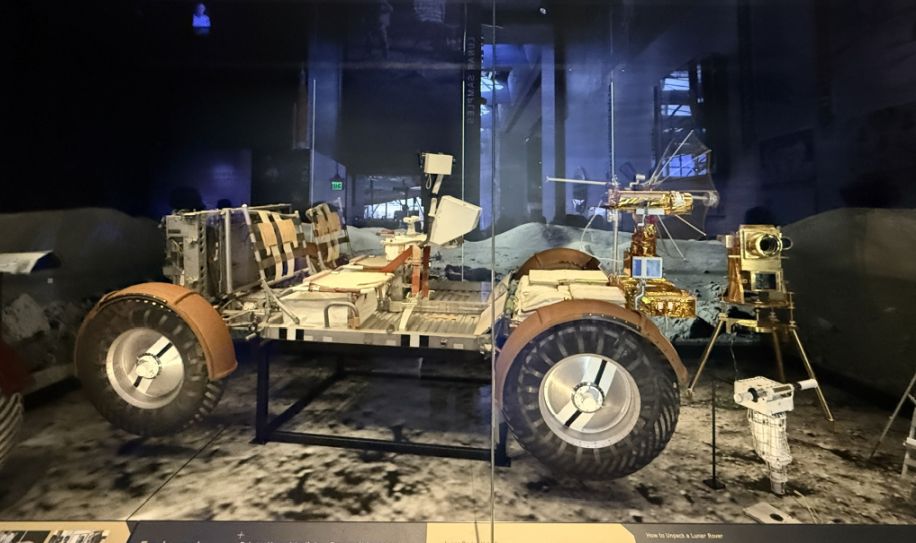
Equipment for Roving. The lunar module was redesigned for the last three Apollo missions to transport a rover and other equipment for extended exploration. It also carried more oxygen, water, and electrical poser, so astronauts could stay three days on the Moon. The rovers enables astronauts to visit more geologic features, collect more samples, and carry an impressive number of tools.
 |
 |
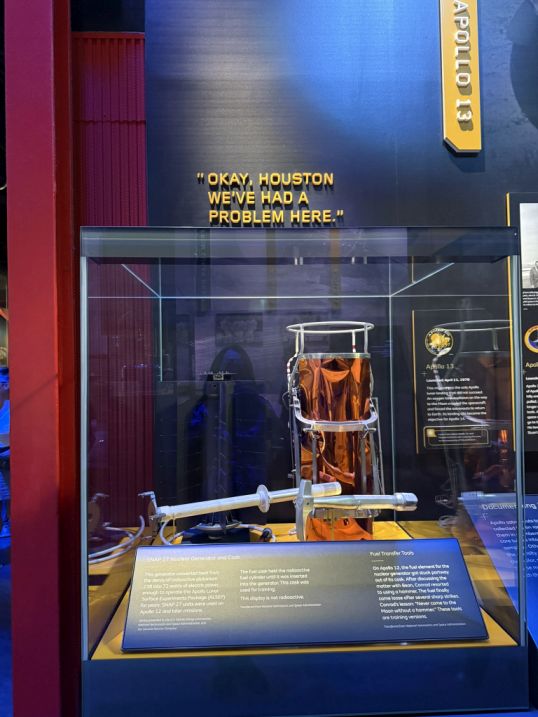
"Okay, Houston we've had a problem here." That famous line comes from Apollo 13. It was astronaut Jack Swigert who calmly radioed Mission Control after an oxygen tank exploded in space. Commander Jim Lovell then repeated the message.
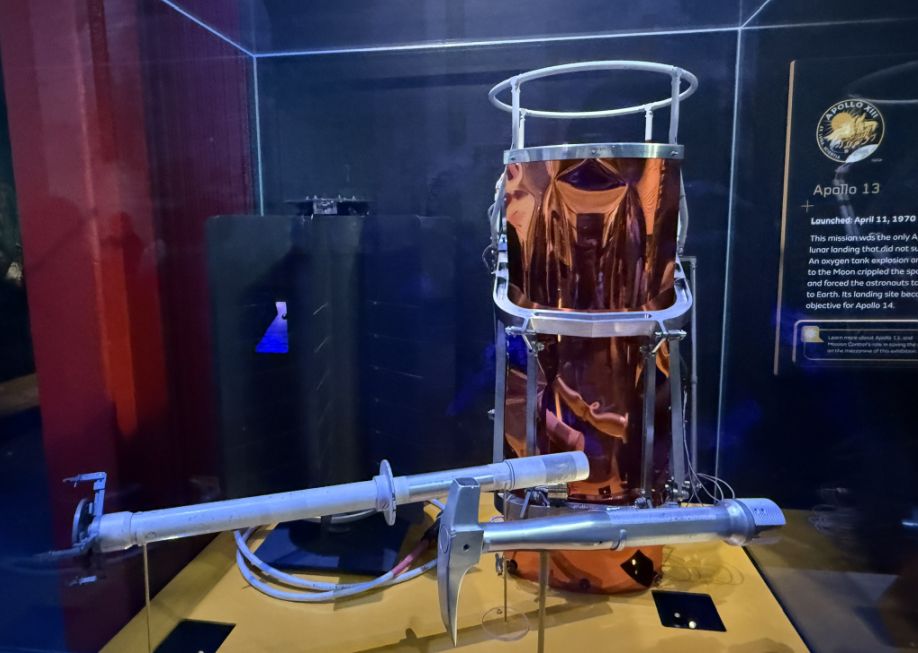
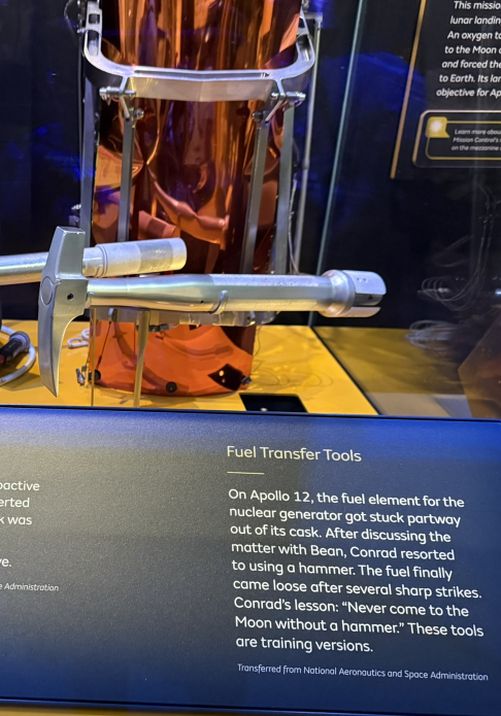
The Apollo 12 mission (November 1969) followed soon after Apollo 11. It aimed to prove that astronauts could land precisely near a specific target and perform more advanced scientific work on the Moon. Just seconds after launch, Apollo12 was struck by lightning twice! The spacecraft lost power and guidance temporarily. After discussing the Metter Conrad resorted to using a hammer. The fuel finally came loose after several sharp strikes. Conrad's lesson: "never come to the Moon without a hammer".
 |
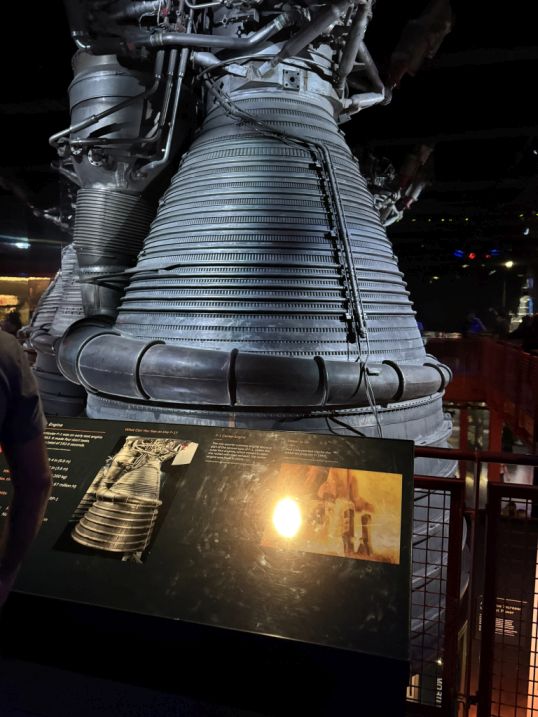 |
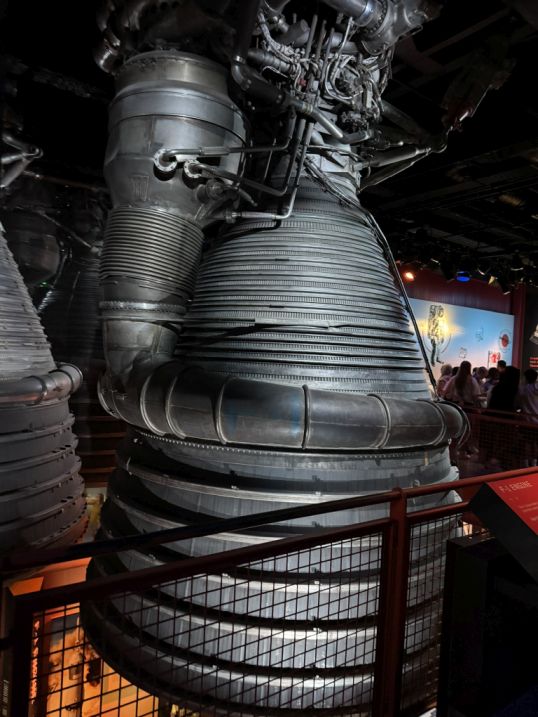
F-1 Engine. This particular F-1 was an early test engine built in 1963. It made four start tests, burning for a total of 192.6 seconds. Length 18 ft. 4 inches, Max. Diameter: 11 ft. 11 inches, Weight: 18,000 lb., Max. thrust: 1,522,000 lb. at sea level.
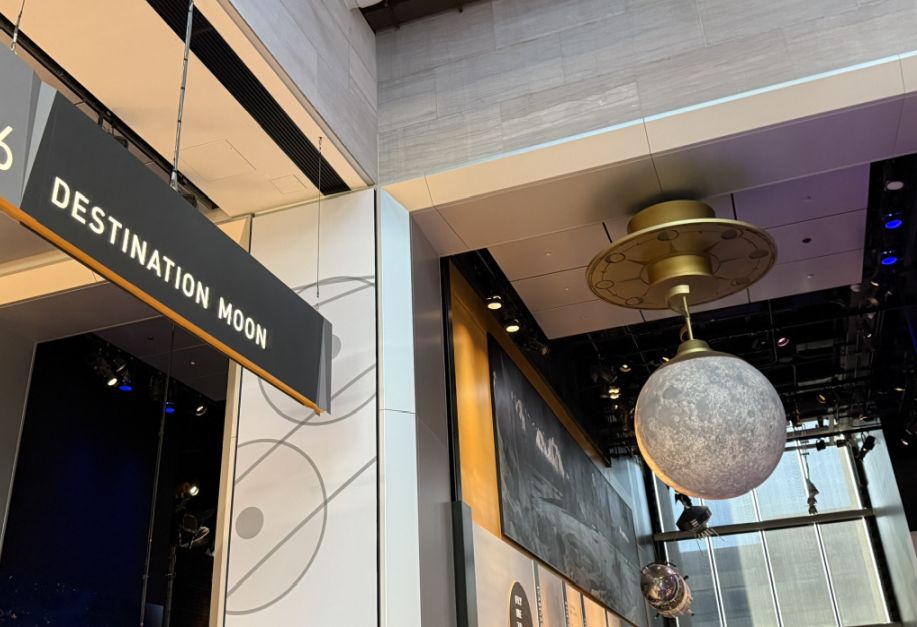
We are now in one of the most mysterious and evocative sections of Destination Moon, titled “The Far Side of the Moon”. This area explores what we don’t usually see, the lunar far side, the hidden hemisphere that always faces away from Earth. It’s a fascinating story that blends exploration, science, and mystery.
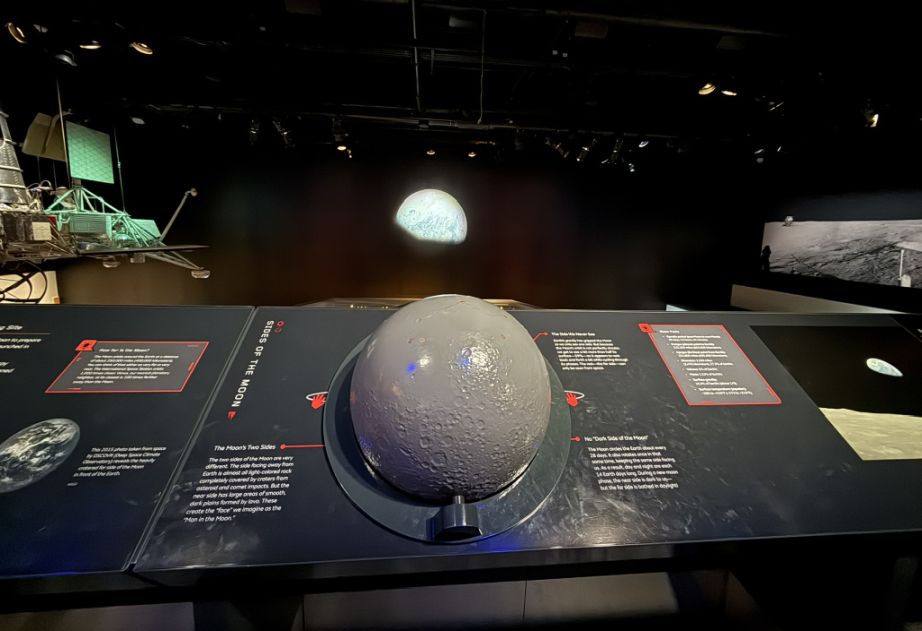
Why It’s Called the “Side of the Moon”. The Moon is tidally locked to Earth, meaning it rotates at the same rate it orbits us. As a result, one side (the “near side”) always faces Earth, while the far side remained unseen until the Space Age. For thousands of years, no one on Earth knew what that hidden half looked like!
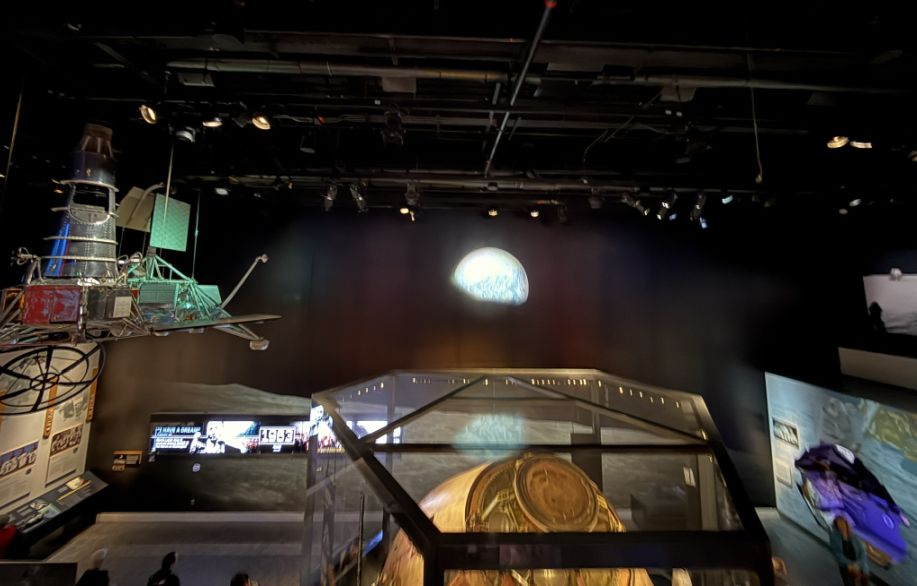
Later, during the Apollo missions, astronauts orbited around the Moon, passing behind it, totally cut off from radio contact for almost 45 minutes each orbit. Imagine that: complete radio silence, floating behind the Moon, with only stars and the lunar surface outside the window!
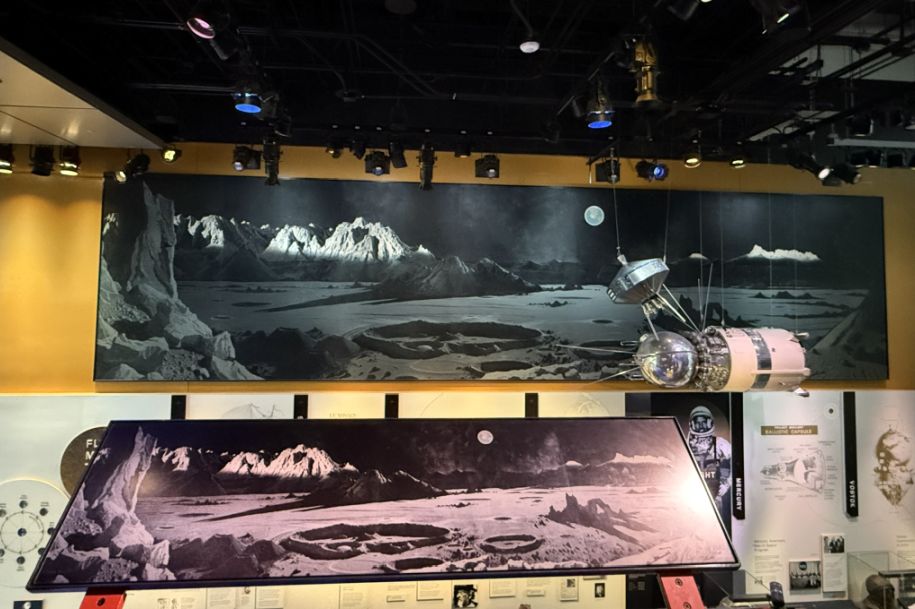
A lunar Landscape, Oil on canvas, 1957 by Chesley Bonestell is one of the most beautiful and visionary artworks in the entire museum.
On March 28, 1957 six months before the Soviet Union launched Sputnik, the Boston Museum of Science unveiled this huge mural in the lobby of its Charles Hayden Planetarium.
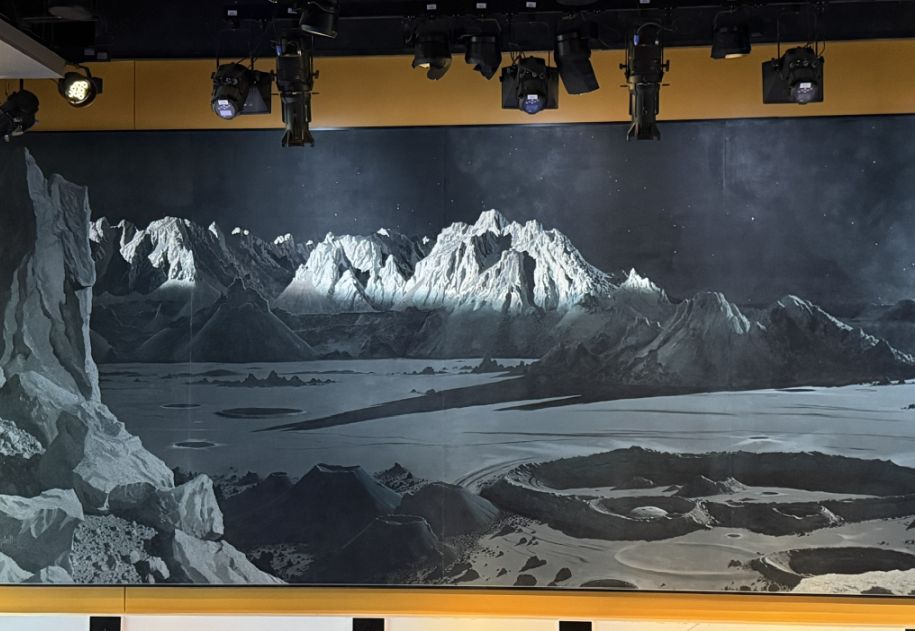
Bonestell portrayed the Moon as everyone expected it to be: with sharp peaks, jagged canyons, and steep crater walls, In 1970, that museum took down the mural after pictures from the Moon showed that the constant rain of meteorites and space dust rounder off lunar hills and mountains. The Smithsonian acquired the mural in 1976 and restored it for this exhibition.
 |
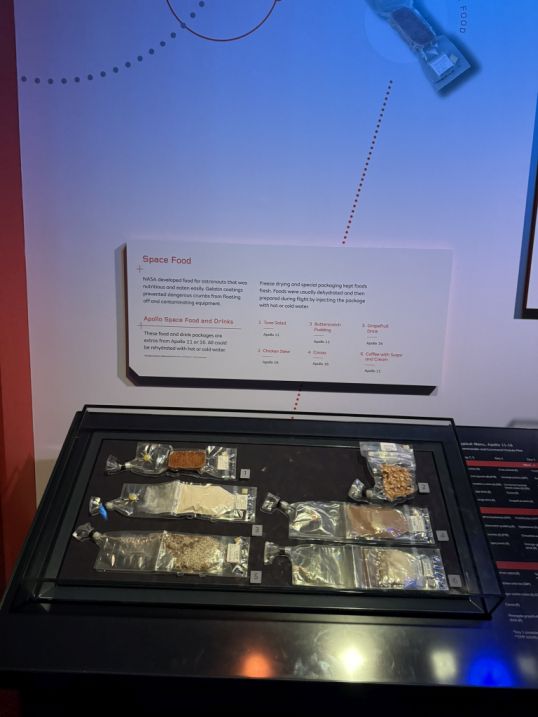 |
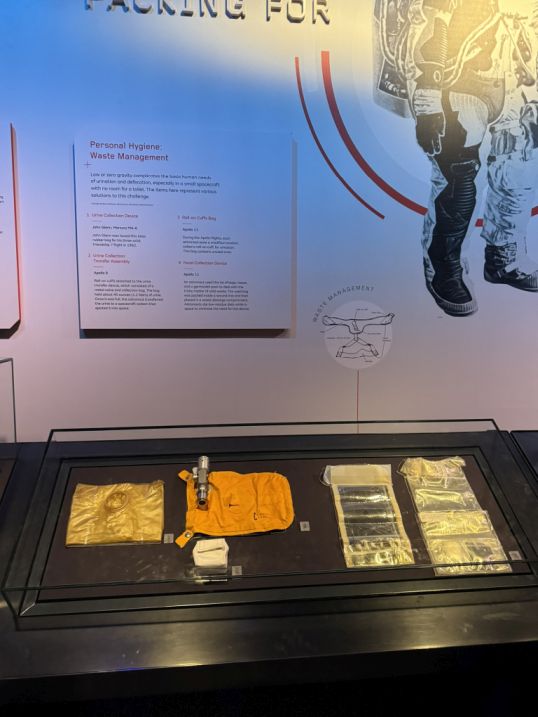
Personal Hygiene and space food.
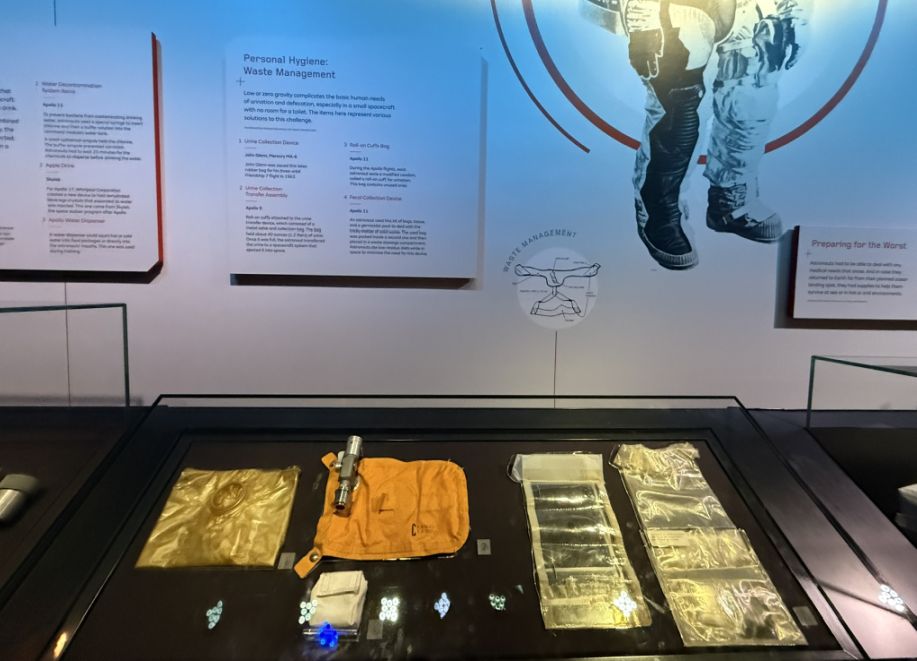
Personal Hygiene: Waste Management. Low or zero gravity complicates the basic human needs or urination and defecation, especially in a small spacecraft wit not room for a toilet. The items here represent various solutions to the challenge.
on the left: 1- Urine collection Device-John Glenn was issue this latex rubber bag for his three orbit Friendship 7 flight in 1962
2- Urine Collection transfer assembly-Apollo 9-Roll-on cuffs attached the urine transfer device, which consisted of a metal valve and collection bag. The bag held about 4 ounces of urine. Once it was full, the astronaut transferred the urine to a spacecraft system that ejected it into space.
3-Roll on Cuffs Ba-Apollo 11-Druing the Apollo flights, each astronaut wore a modified condom, called a roll-on cuff, for urination. This Bag contains unused ones.
4-Fecal Collection Device-Apollo 11- An astronaut used this kit of bags, tissue, and a germicidal pack to deal with the tricky matter of solid waste. The use bag was packed inside a second one and then placed in a waste stowage compartment. Astronauts ate low-residue diets while in space to minimize the need for this device.
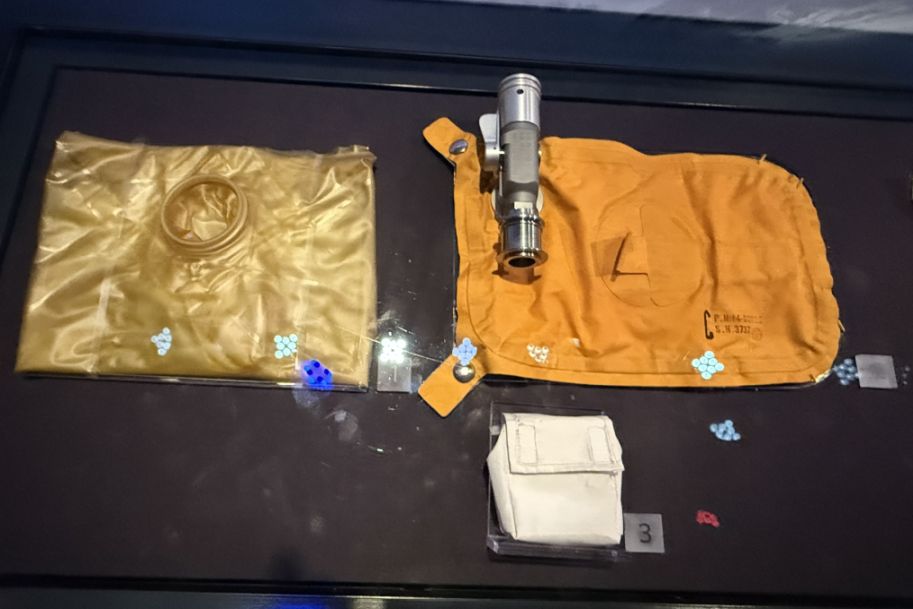
Close view of the Urine collection Device and Urine Collection transfer assembly.
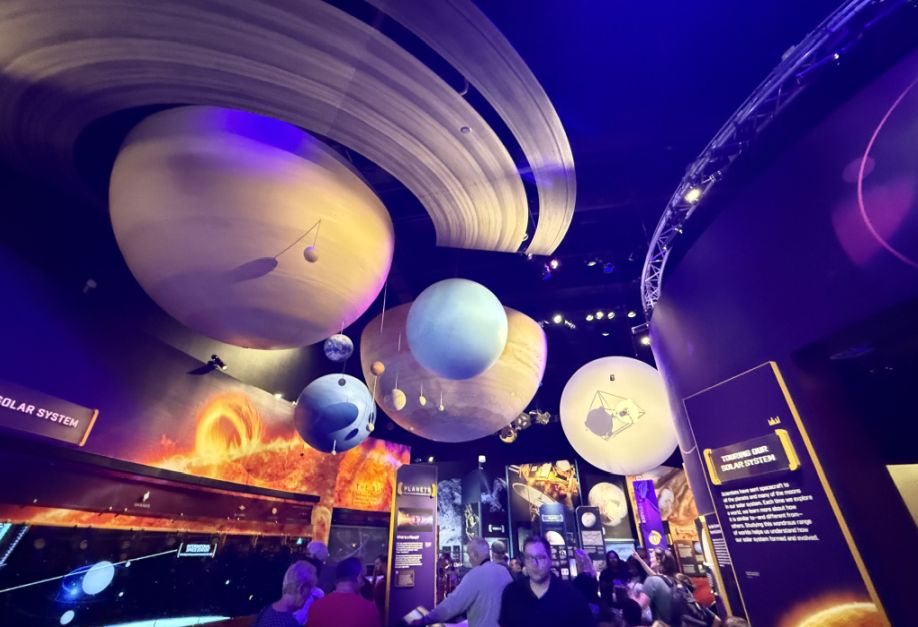
We just entered one of the museum’s most colorful and awe‑inspiring areas called the Exploring the Planets or Our Solar System gallery. It’s the perfect follow‑up to Destination Moon after journeying 240,000 miles to the Moon, we are now stepping into a space that spans billions of miles across the Solar System.
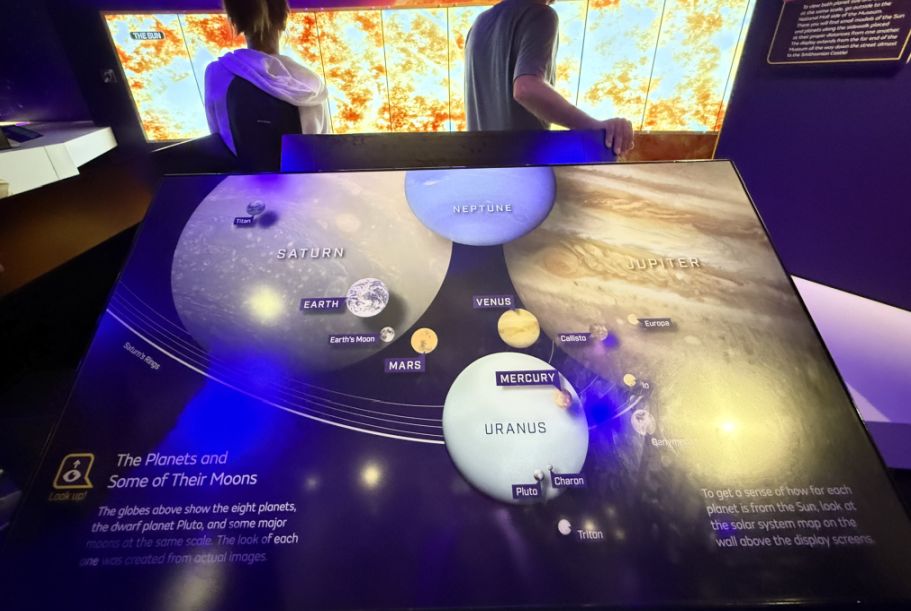
The planets and some of their moons.
 |
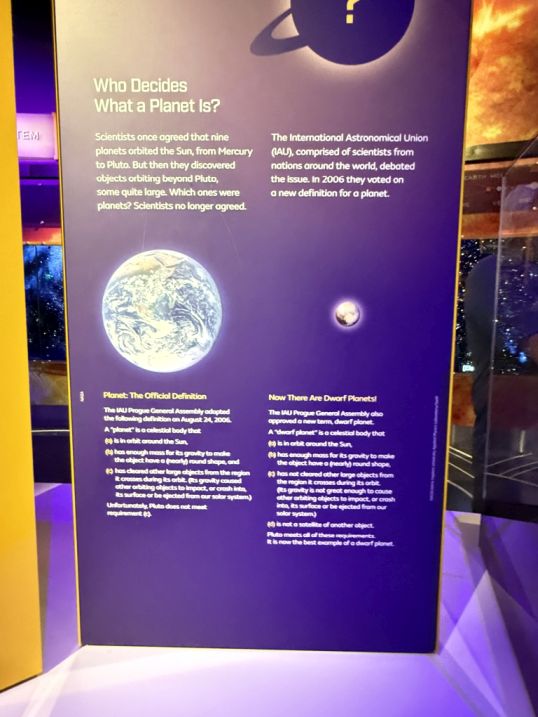 |
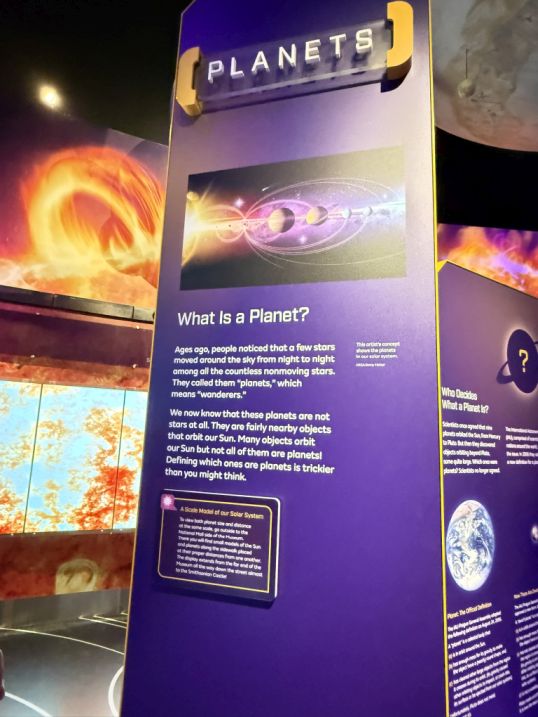
What is a planet? Orbit the sun, be round (have enough gravity to pull itself into a sphere), have "cleared it orbit”, meaning it dominates its path around the Sun. This is why Pluto is no longer classified as a full planet, it hasn’t cleared its orbit and shares it with many other objects in the Kuiper Belt.
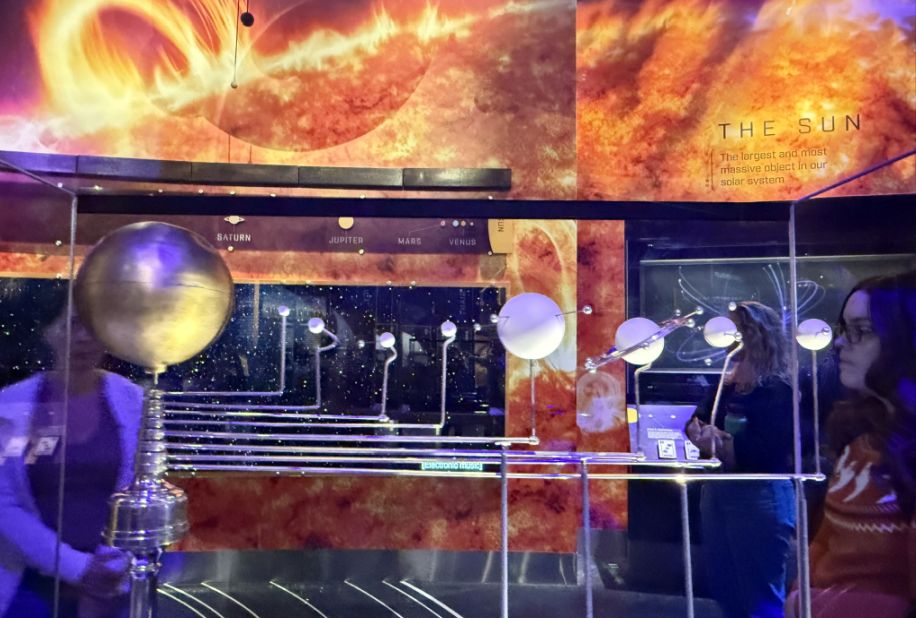
So today, our solar system has eight planets: Mercury, Venus, Earth, Mars, Jupiter, Saturn, Uranus, and Neptune
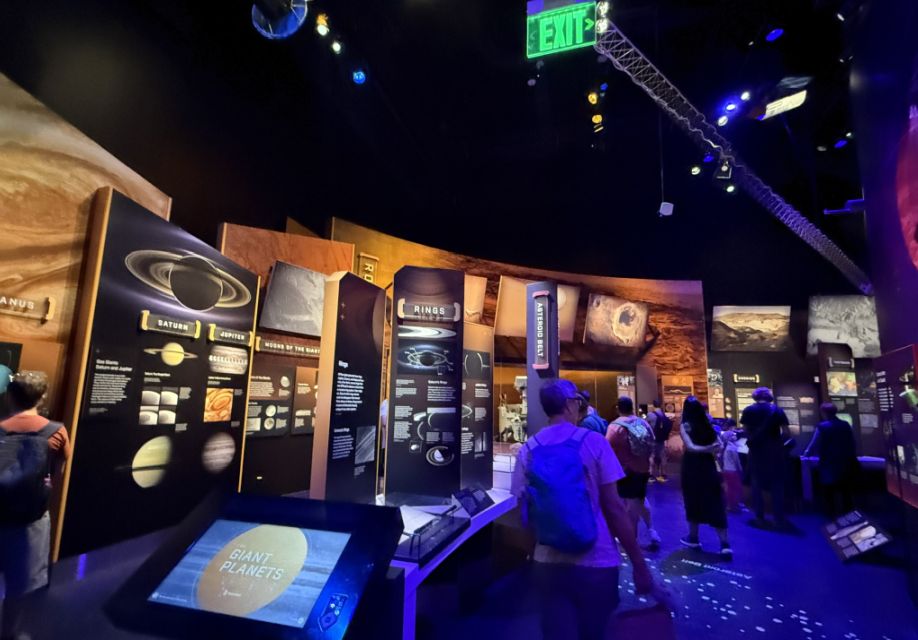
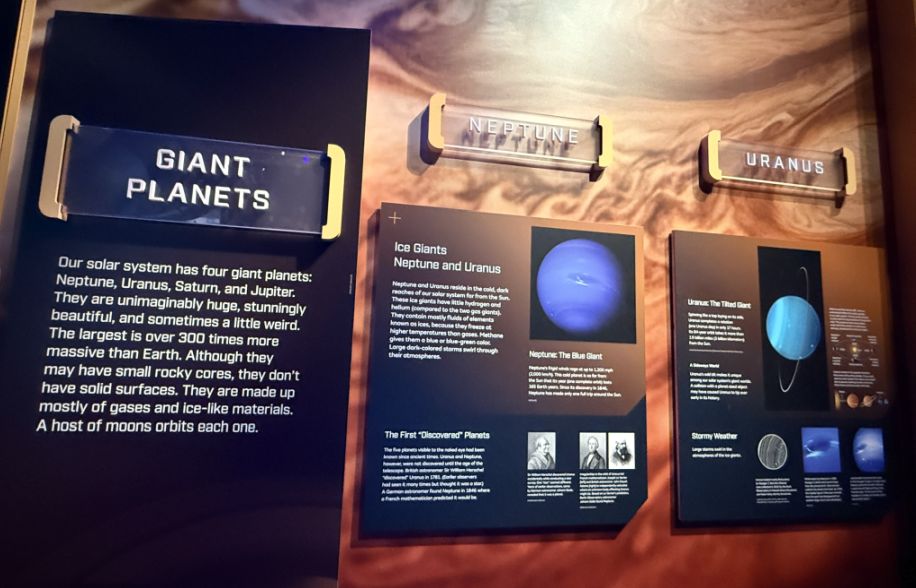
Giant planets is where the story of our cosmic neighborhood becomes truly enormous, worlds so vast that Earth would fit inside them many times over, each one a fascinating miniature solar system of its own. Astronomers group them into two categories: 1- Gas Giants: Jupiter and Saturn, 2-Ice Giants: Uranus and Neptune.
 |
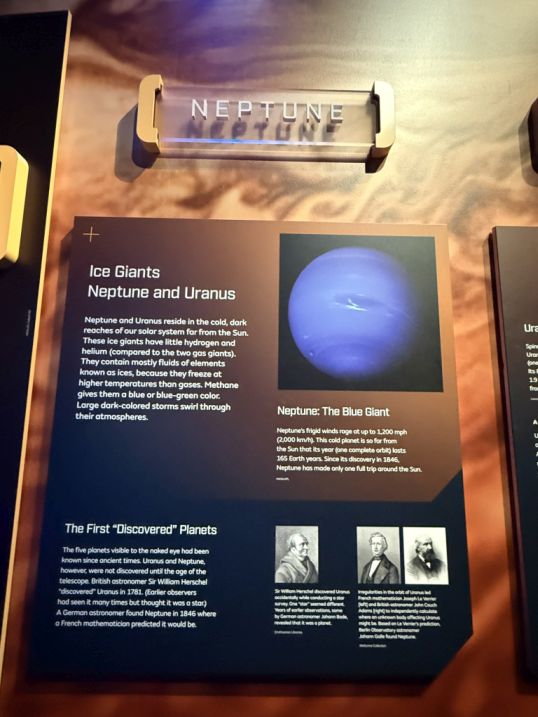 |
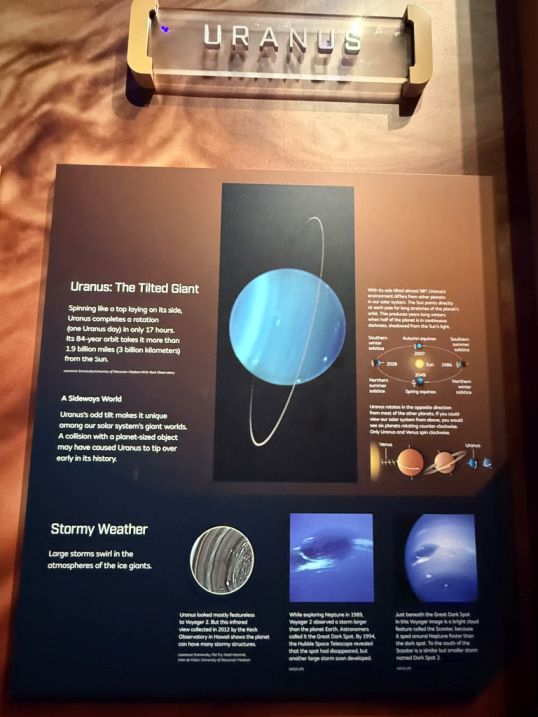
Uranus and Neptune are classified under Ice Giants.
Uranus Rotates on its side! (Its axis is tilted about 98 degrees.) Seasons last more than 20 years each, since the planet rolls like a barrel as it orbits the Sun. Has a faint ring system and a pale blue‑green color due to methane gas in its atmosphere. Explored only once by Voyager 2 in 1986, but new telescope images suggest a dynamic, stormy world.
Neptune, The Windy, Distant Giant is the farthest major planet from the Sun. Known for the Great Dark Spot, a massive storm system similar to Jupiter’s. Winds blast faster than 1,000 mph, the fastest in the Solar System. Its deep blue color comes from methane absorbing red light. Voyager 2 flew by in 1989, giving us our first detailed look; newer telescopic images (like those from James Webb) still astonish scientists.
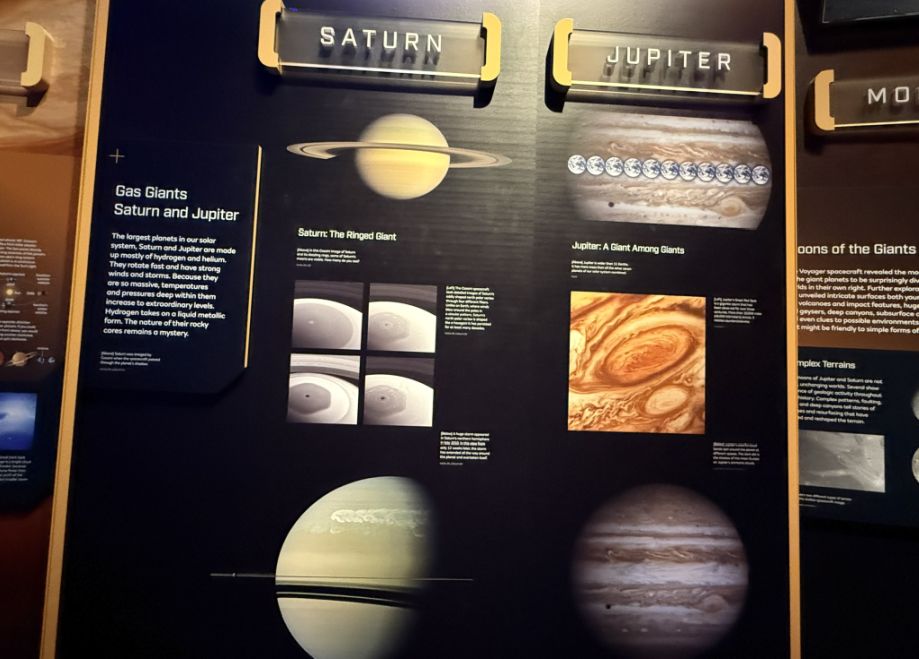
Saturn and Jupiter are classified under Gas Giants.
Saturn, Lord of the Rings, Famous for its brilliant ring system, made of ice chunks and rock debris orbiting the planet. The rings look solid, but they’re incredibly thin, only about 30 feet thick on average! Saturn’s family is spectacular, Titan has thick orange skies and methane lakes; Enceladus shoots watery plumes from its icy surface. The Cassini mission (2004–2017) studied Saturn up close, discovering new details about the rings and moons before diving heroically into the planet’s atmosphere at mission’s end.
Jupiter, the King of Planets, Largest planet in the Solar System, could swallow 1,300 Earths! Great Red Spot: A gigantic storm that’s been raging for centuries, larger than Earth itself. Moons: Over 90 known, including the “Galilean Moons”, Io (volcanic), Europa (icy ocean world), Ganymede (biggest moon in the Solar System), and Callisto (ancient, cratered world).
Look for images or models from Voyager, Galileo, and Juno, which have shown breathtaking views of Jupiter’s swirling atmosphere.
This part of the gallery reminds us that he Solar System isn’t just rocky planets, it’s dominated by these immense gas and ice worlds. They shaped the Solar System’s evolution, flinging asteroids, forming moons, and influencing every smaller body’s orbit. Even now, scientists are discovering new moons and atmospheric phenomena, proving exploration never truly ends.
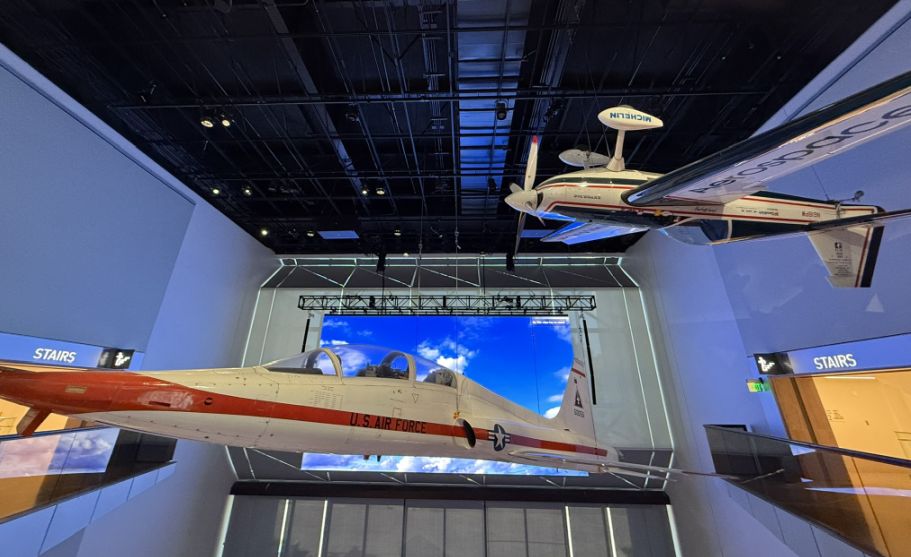
We are now in one of the most dramatic spaces in the National Air and Space Museum, the large aviation hall where the aircraft are suspended overhead. This level tells the story of aviation milestones.
The plane with the red line is the Northrop T-38ATalon. It was the first supersonic trainer aircraft, used extensively by the U.S. Air Force, and it is still used by NASA to train astronauts. Many astronauts, including Apollo and Space Shuttle crews trained in the T-38. NASA uses it to simulate the high-performance handling and decision-making required in spacecraft.
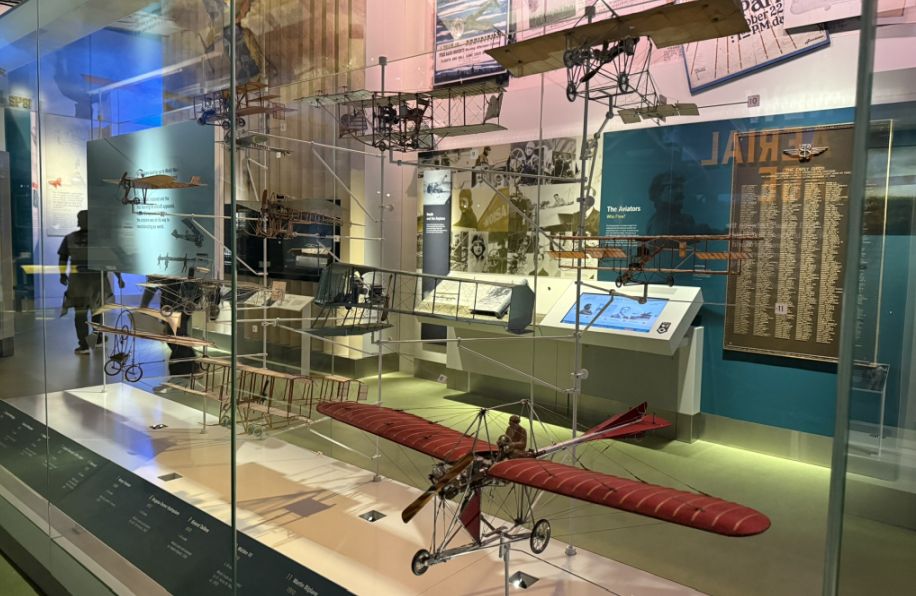
We are now a the Early Flight gallery. The pioneers of aviation, most notably the Wright Brothers, were literally bicycle mechanics. They applied the same logic of lightweight frames, chain drives, and balancing to their flying machines.
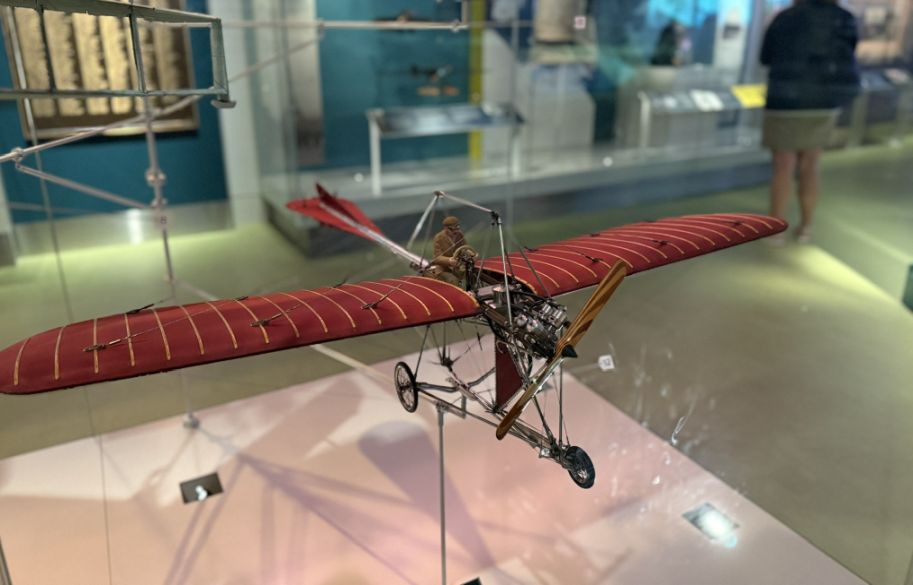
This is reproduction of the Santos-Dumont Demoiselle, it’s famous for its tiny size and delicate look. The "velvet" appearance comes from the silk or cotton fabric used for the wings, and the "brown stripes" are the bamboo spars and wire bracing that hold it together. it was built by Alberto Santos-Dumont using bicycle technology. He used a framework of reinforced bamboo and seated the pilot on a tiny seat right between the wheels. Santos-Dumont was so generous that he gave away the blueprints for free, hoping everyone would build their own "personal plane" like a flying bicycle.
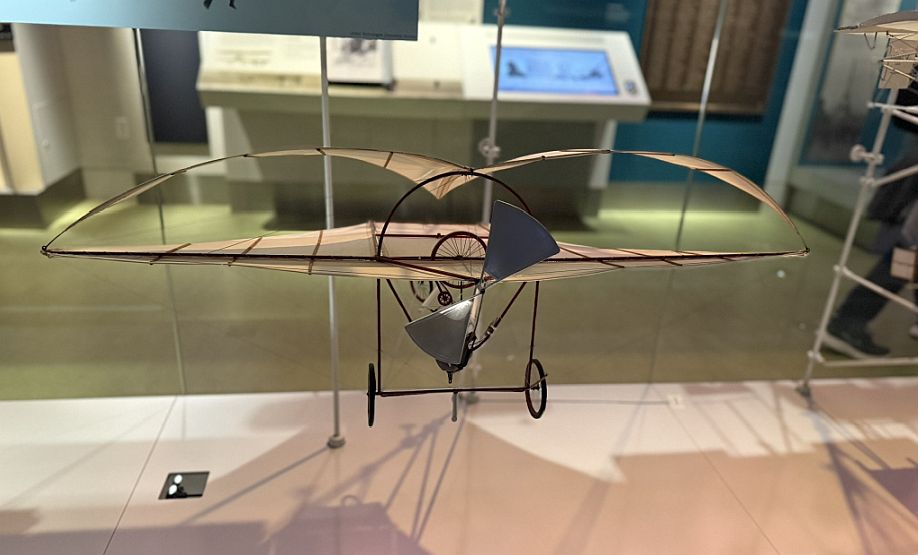
This is a model of William Samuel Henson’s "Aerial Steam Carriage" (patented in 1842). It is one of the most famous "might-have-beens" in aviation history. Even though it never actually flew, it is incredibly important because it was the first design to include almost all the elements of a modern airplane, 60 years before the Wright brothers! It features a tricycle landing gear, which was very advanced for the 1840s. The wings are braced with a "king-post" and wire system, very similar to how early bicycle wheels were spoked for strength and lightness. It used a lightweight wooden frame that looked like the skeletal chassis of early cycles.
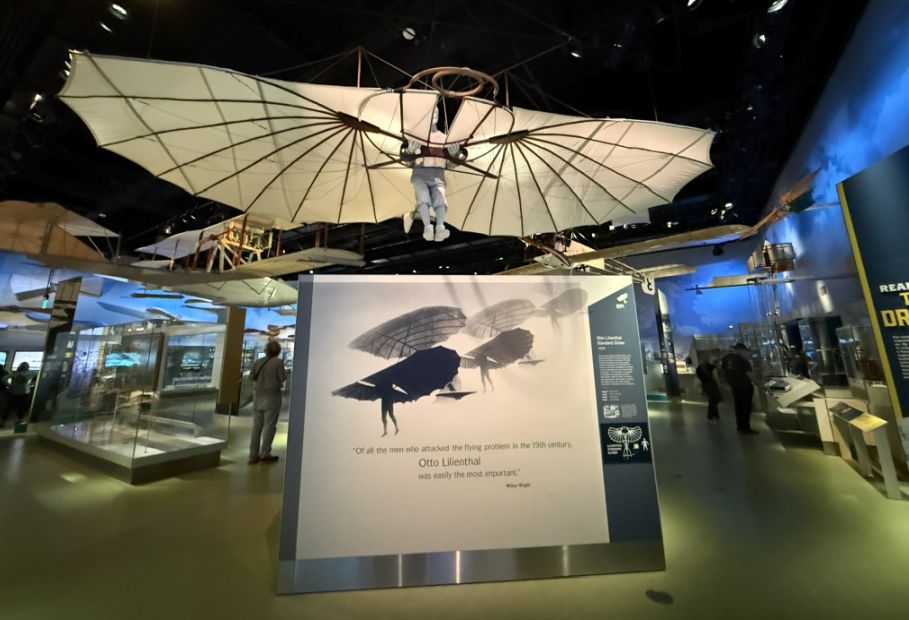
The panel you see is a famous quote from Wilbur Wright himself. Wilbur wrote that "Of all the men who attacked the flying problem in the 19th century, Otto Lilienthal was easily the most important." Lilienthal was the first person to make successful, repeated glides. He didn't sit in the plane, he hung from it by his armpits and swung his legs to steer, much like a modern hang glider. Tragically, he died in a crash in 1896. When the Wright brothers read about his death in the newspaper, it's what actually sparked their serious interest in solving the "flying problem."
 |
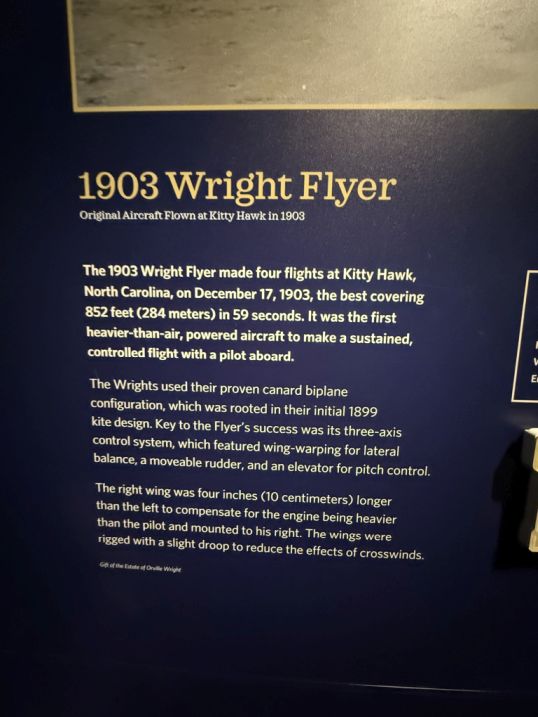 |
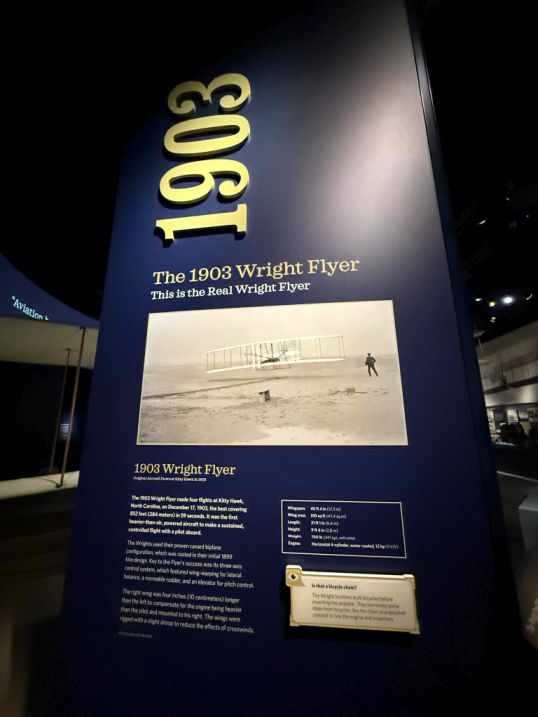
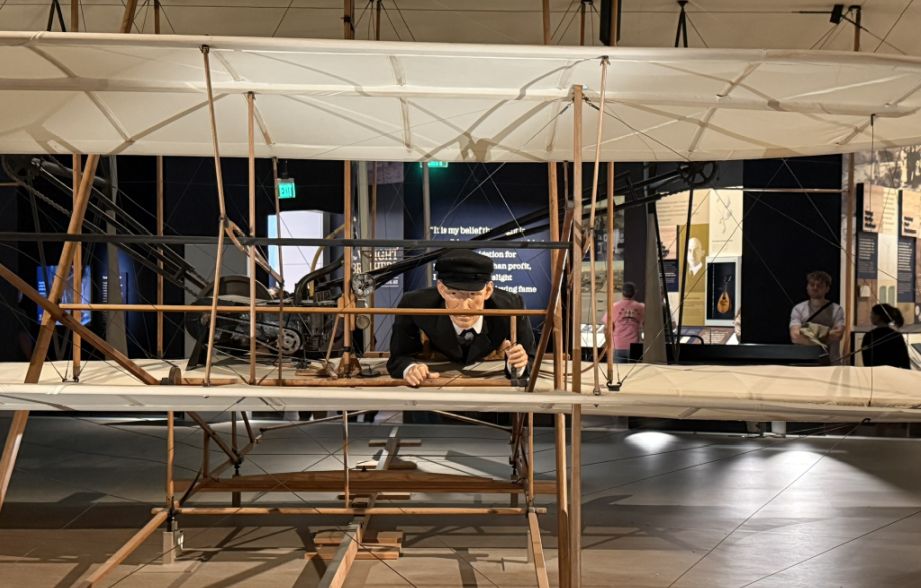
The Wright Flyer (1903) made four flights at Kitty Kawk, North Carolina, on December 17, 1903, the best covering 852 feet in 59 seconds. It was the first heavier that air, powered aircraft to made a sustained controlled flight with a pilot abort.
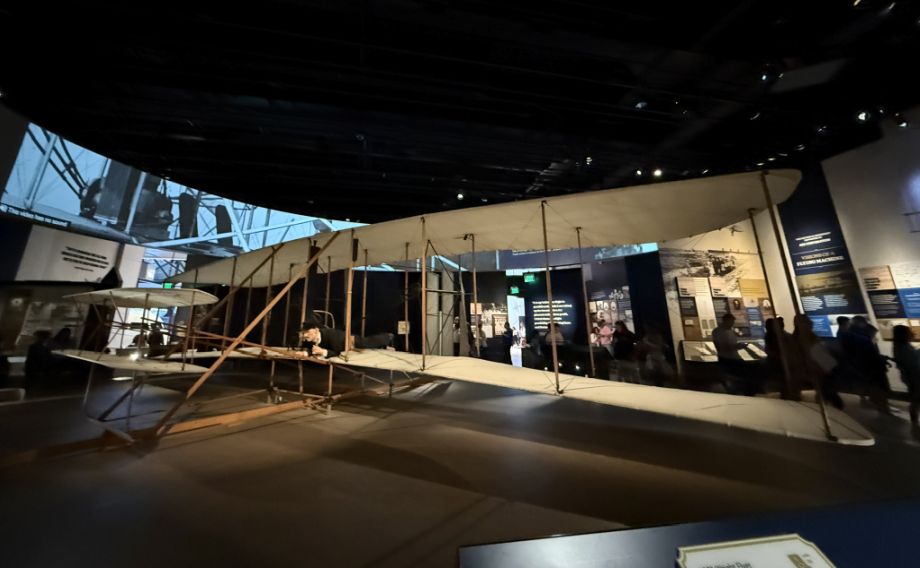
The wings were huge back then because engines were incredible heavy and weak. This a model represent Orville Wright, and he is lying down for a very practical (and slightly uncomfortable) reason: Aerodynamics.
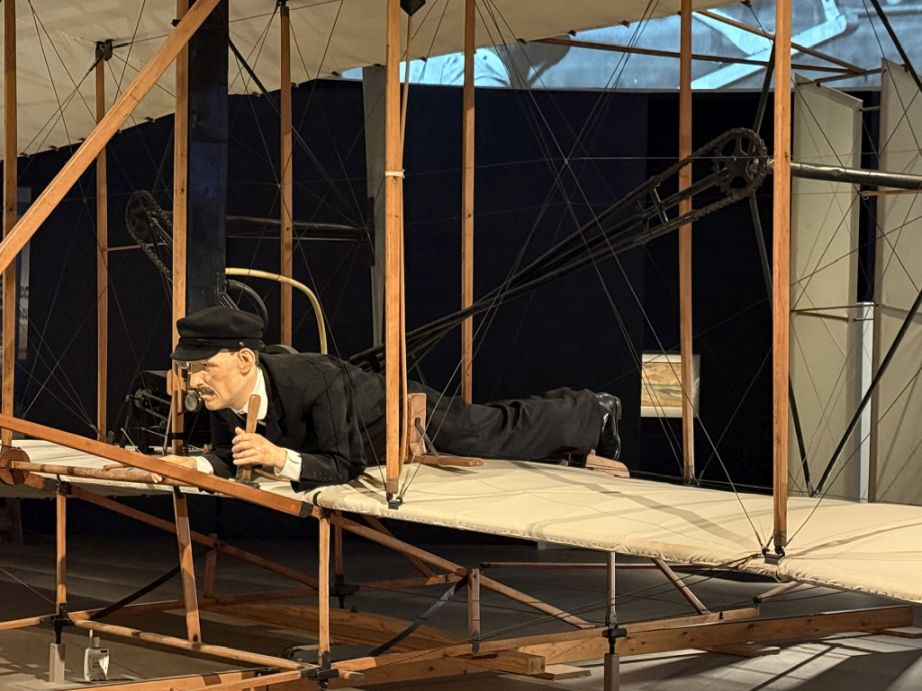
The Wright brothers realized that the biggest enemy of flight was "drag" (air resistance). By lying flat on his stomach, the pilot presented a much smaller profile to the wind than if he were sitting upright. This allowed the tiny 12-horsepower engine to push the plane through the air more efficiently. If you look closely at that mannequin, you'll see he isn't just lying there, he’s "hitched" into the machine. His left hand operates a lever that moves the "elevators" (the small wings out in front) to make the plane go up or down. The Right Hand is used to brace himself or manage the engine's fuel valves.
His left hand operates a lever that moves the "elevators" (the small wings out
in front) to make the plane go up or down. The Right Hand:
he generally used his right hand to brace himself or manage the engine's fuel
valves. While Orville is the one usually depicted in
the display, the brothers actually flipped a coin
to see who would get to make the first attempt.
Visitors consistently rank the National Air and Space Museum as one of the most inspiring museums in Washington. People love seeing iconic artifacts like the Apollo spacecraft and historic aircraft up close, and many say it brings out a sense of wonder and childhood curiosity. While it can be crowded, most agree the exhibits are engaging, beautifully displayed, and well worth the visit.
NEXT... Day 5- Museum of the American Indian