
6 days in Washington DC- 10/18- 10/23/2024
Day 3-Virginia Museum of Fine Arts-10/20/2024
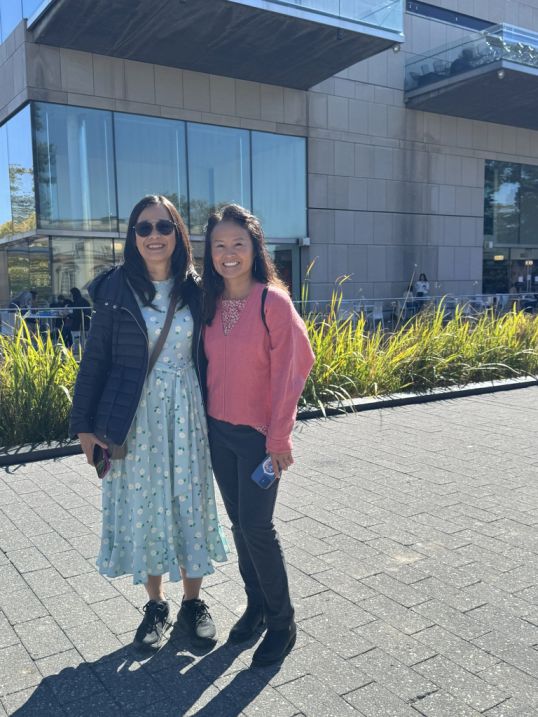
We’re driving from Washington, D.C. to meet up with Lisa and her husband, which we’re really looking forward to. We met Lisa during our five-day trip to Tasmania, and over those days we had the chance to spend a lot of time together and truly get to know her. It’s amazing how travel can create such meaningful connections in a short time.
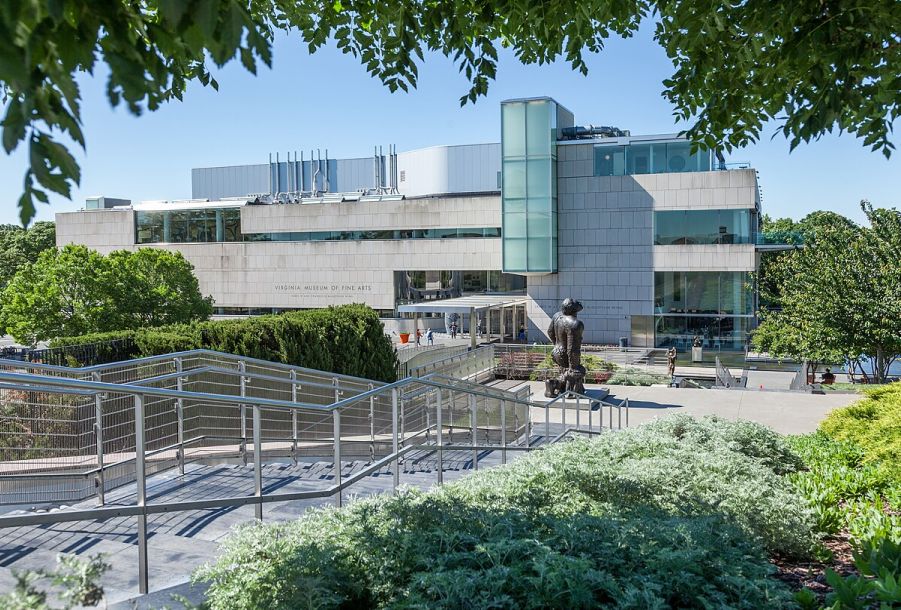
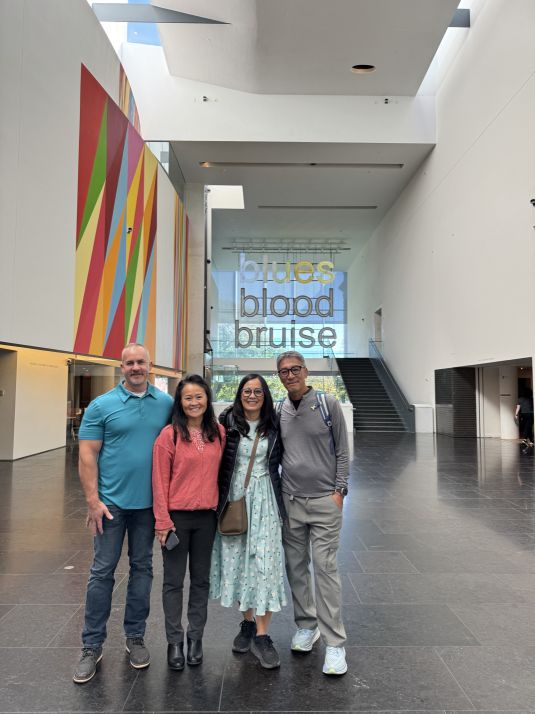
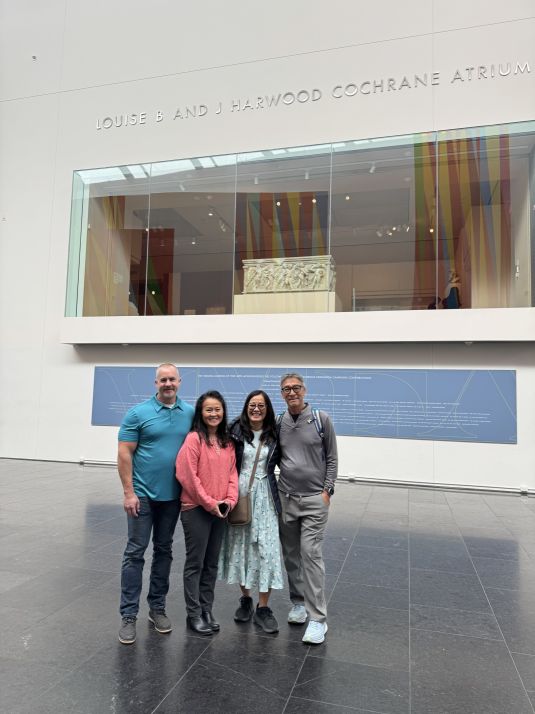
Since we’re currently in D.C., it felt like the perfect opportunity to reconnect in person. We decided to meet at the beautiful Virginia Museum of Fine Arts, a wonderful setting to catch up, stroll through the galleries, and enjoy some time together surrounded by art and peaceful gardens.
 |
 |
Lisa made arrangement and we are meeting her and her husband at the Virginia Museum of Fine Arts. The Virginia Museum of Fine Arts is one of the most celebrated art museums in the United States, and a very special cultural landmark in Richmond, Virginia. The Museum World-class collection: The museum’s permanent collection has over 50,000 works spanning almost 5,000 years and cultures around the globe, from ancient art to contemporary masterpieces. The museum also have one of the largest collections of Fabergé eggs outside Russia.
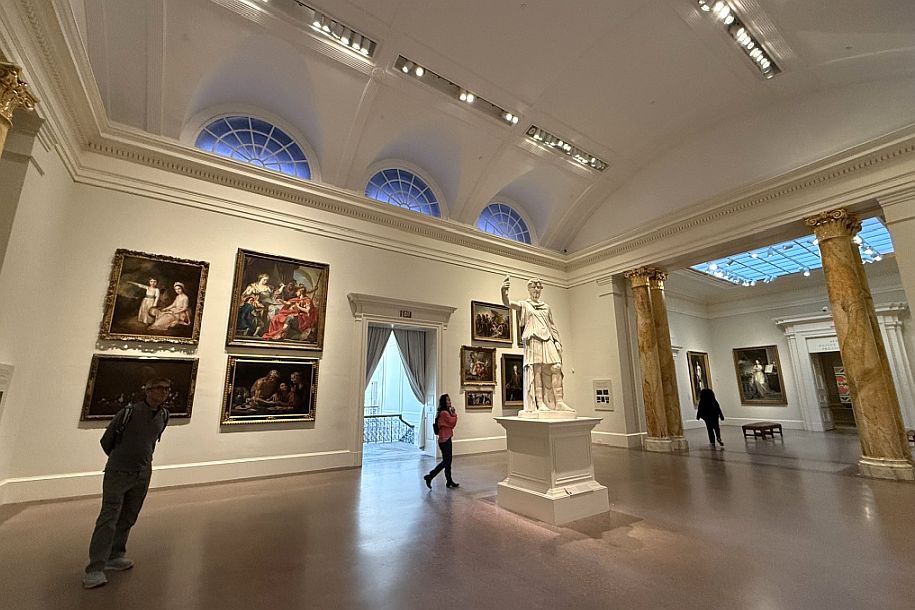
The museum began in 1932 from a collection of donated paintings and public funding. Its campus has grown over decades and saw a major expansion in 2010. Today, it’s widely recognized as one of the top art museums in the U.S., blending beautiful galleries with inviting public spaces. General admission to the permanent collection is free, and the museum is open every day of the year.
 |
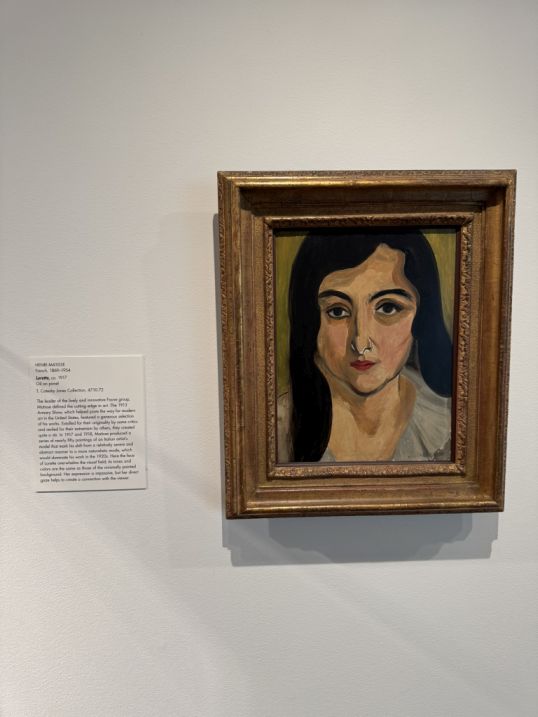 |
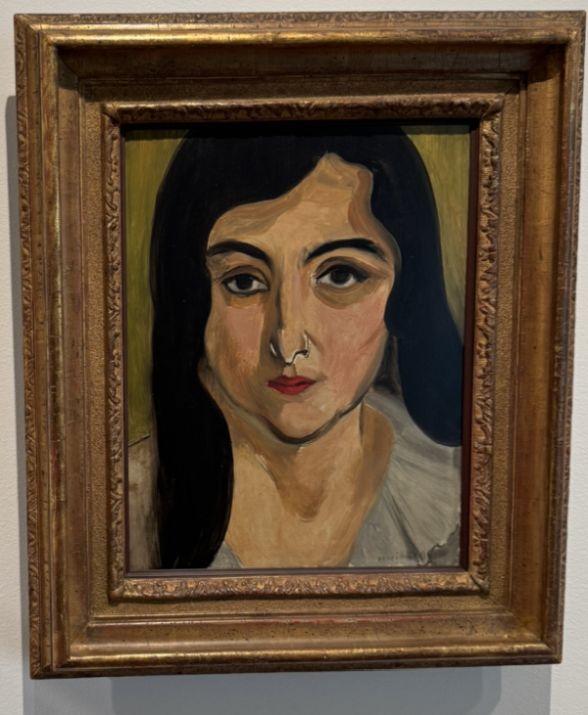
Lorette, 1917. Oil on panel by Henri Matisse, French, 1869-1954
Matisse was the leader of the lively and innovative Fauve group, Matisse define the cutting edge in art. The 1913 Armory show, which helped pave the way for modern art in the United States, featuring a generous selection of his works. Extolled for their originality by some critics and revile for their extremism by others, they created quite a stir. In 1917 and 1918, Matisse produced a series of nearly fifty paintings on an Italian artist' model that mark his shift from a relatively severe and abstract manner to a more naturalistic mode, which would dominate his work in the 1920s. Here the face of Lorette overwhelms the visual field; its tone and colors are the same as those of the minimally panted background. Her expression is impassive, but her direct gaze helps to create a connection with the viewer.
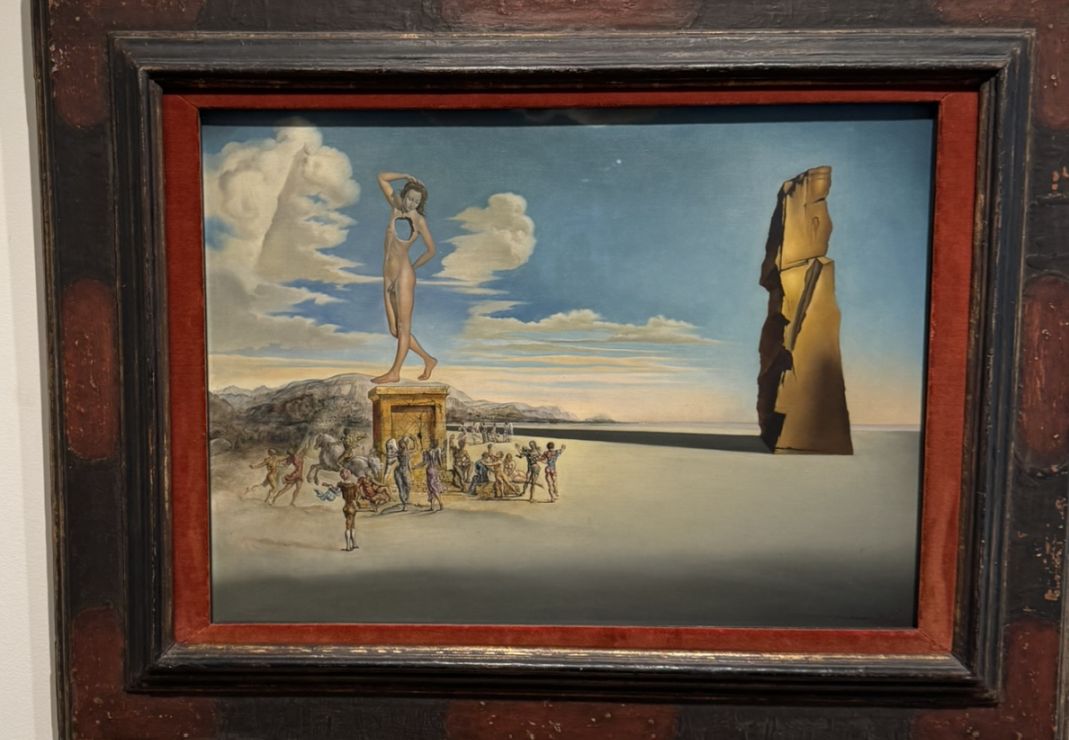
The God of the Bay of Roses, 1944, Oil on canvas-Salvador Dali, Spanish, 1904-1989
In the late 1920s, Dali began to create Surrealistic images he likened to "hand painted dream photographs." By presenting the disturbing visions of his unconscious in brilliant detail, he hoped to lend credibility to the irrational realms of fears and fantasies.
The God of the Bay of Roses pays homage to the artist's Russian-born wife and muse, Gala, Whose portrait appears on the bifurcated sculpture's pedestal, encircles by a bevy of revelers. Like the most hypnotic of Dali's work, it suggests a portal into another world. The painting dated from the couple's residency on the West Coast, on year before the artist worked with film director Alfred Hitchcock on the famous nightmare sequence in Spellbound.
 |
 |
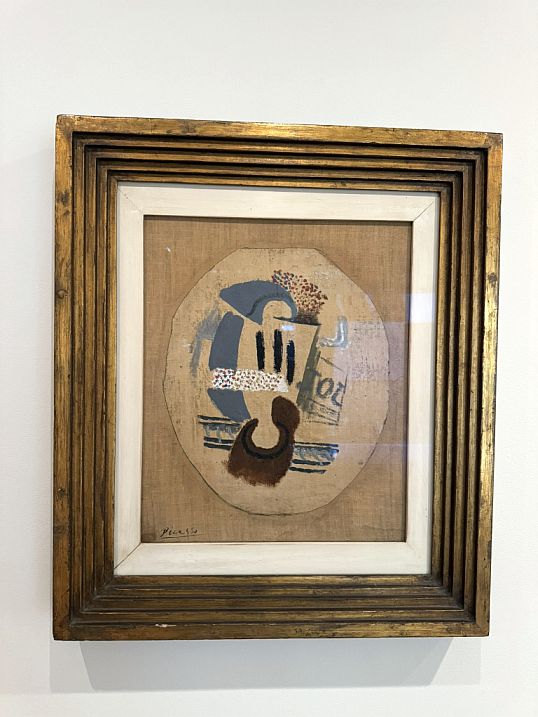
On the left is Still Live (Wineglass and Newspaper, 1913-1914, Oil on canvas-Pablo Picasso, Spanish, 1881-1973
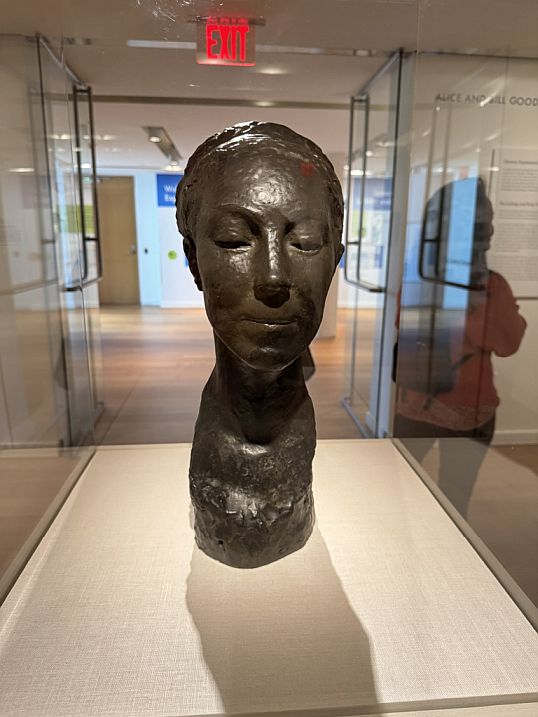
On the right is Portrait of a girl, 1920, Plaster, Milly Steger, German, 1881-1984
 |
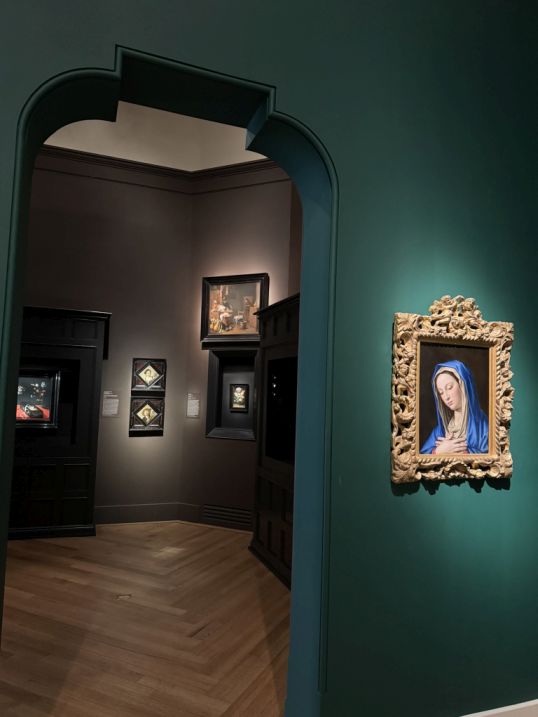 |
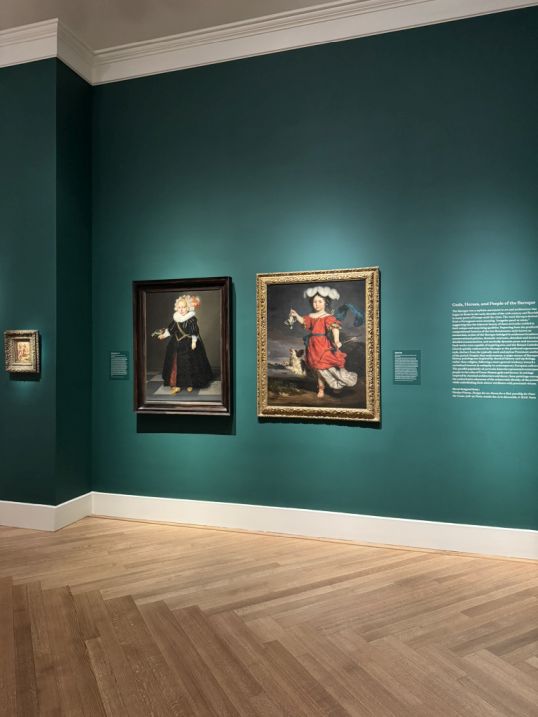
We are at the European art gallery which includes more than 10,000 objects in all media, including paintings, sculpture, decorative art, and work of paper, dating from the early medieval period to the mid-20th century.
 |
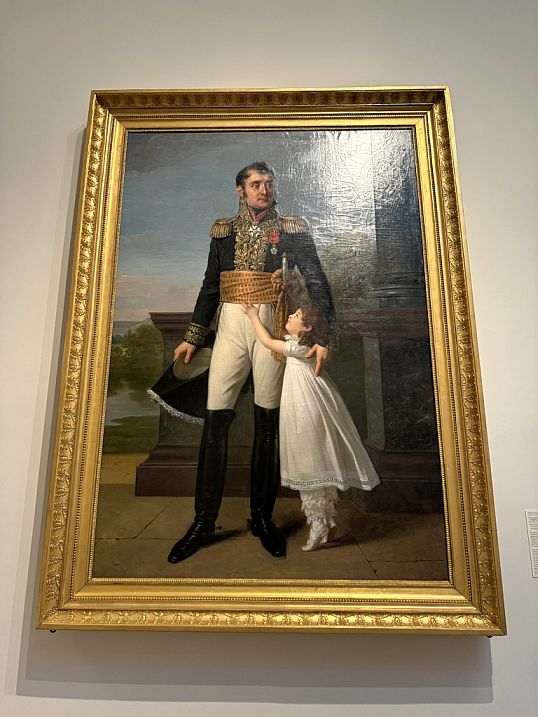 |
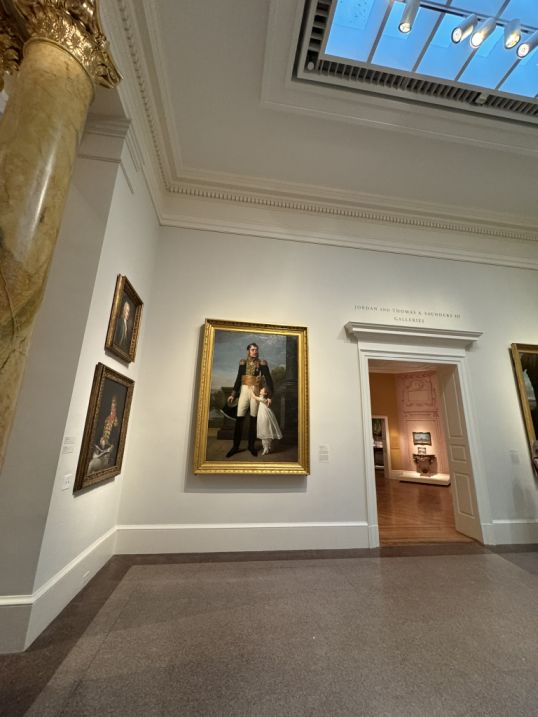
Portrait of Jean-Batiste, Baron Solignac, and his daughter, Louise Delphine by Robert Jacques Francois Lefevre, French, 1755-1830.
Lefèvre was a neoclassical painter, but his style also incorporated elements of Romanticism, particularly in his use of color and emotional depth. He was highly skilled in depicting textures, fabrics, and the nuances of human expression.
This painting offers a fascinating glimpse into the lives of the French aristocracy and military during a pivotal historical period, seen through the skilled hand of a master portraitist. Enjoy your contemplation of this beautiful work!
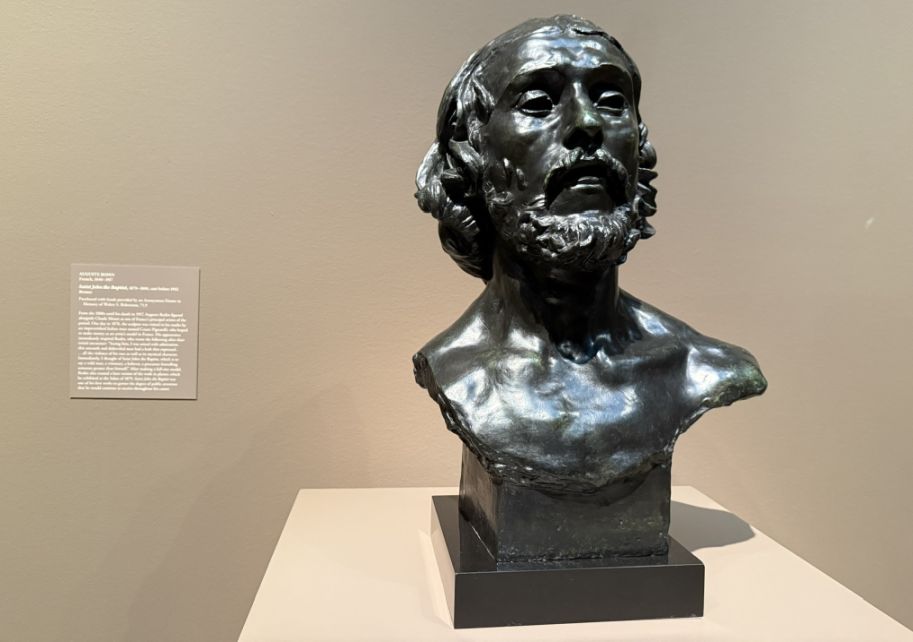
Saint John the Baptist sculpture, 1878-1880. August Rodin, French
From the 1880s until he died in 1917, Auguste Rodin figured alongside Claude Monet as one of France's principal artists of the period. One day in 1878, the sculptor was visited in his studio by an impoverished Italian man named Cesare Pignatelli, who hoped to make money as an artist’s model in France. His appearance immediately inspired Rodin, who wrote the following after their initial encounter: “Seeing him, I was seized with admiration; this uncouth and disheveled man had a look that expressed . . . all the violence of his race as well as its mystical character. Immediately, I thought of Saint John the Baptist, which is to say a wild man, a visionary, a believer, a precursor foretelling someone greater than himself.”After making a full-size model, Rodin also created a bust version of the work in plaster, which he exhibited at the Salon of 1879. Saint John the Baptist was one of his first works to garner the degree of public attention that he would continue to receive throughout his career..
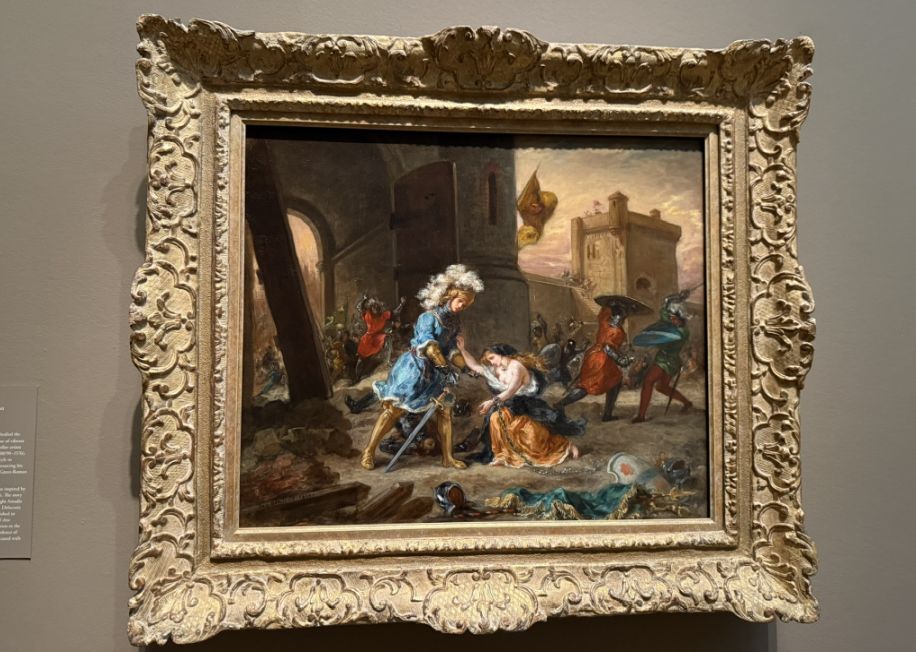
Scene from the Romance of Amadis de Gaule, 1868 by Eugene Delacroix, French, 1798-1863
More than any other mid nineteenth-century artist, Delacroix personified the mature style of Romanticism, founded on the use of brilliant color and fluid handling of paint that recalled earlier artists such as Peter Paul Rubens and Titian. This subject derives from a 14th-century Iberian tale in which a handsome and noble young knight navigates his way through witches, wizards, and an assortment of treachery and danger to prove his love to the beautiful Princess Oriana. Delacroix’s invention of the subject does not correspond to an exact episode in the story, though the resulting painting is convincingly dramatic.
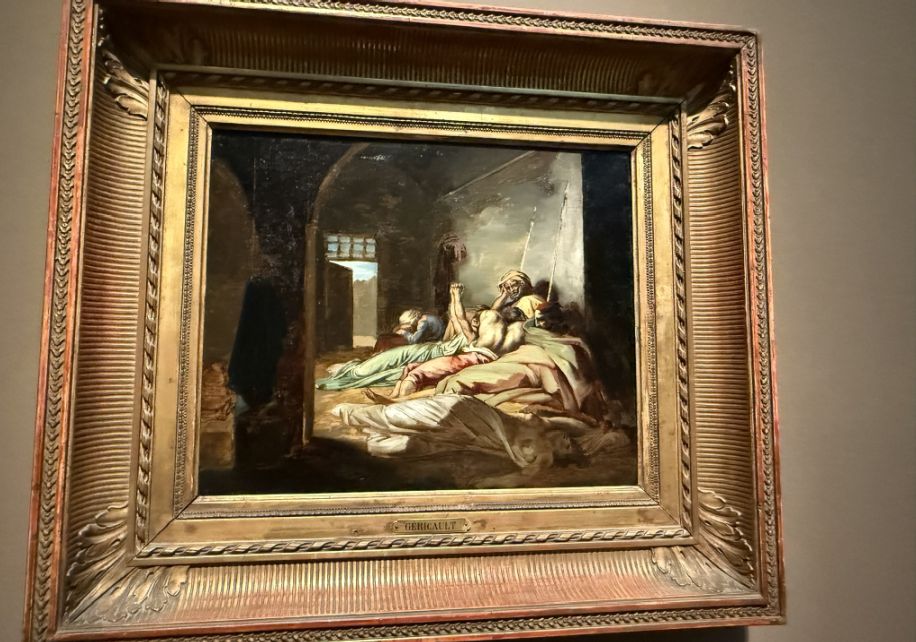
Scene from the Epidemic of Yellow Fever in Cadix, 1820-24 by Theodore Gericault, French, 1791-1824
Géricualt's interest in human suffering continued to preoccupy him even after his immense Ralf of Medusa (showing the terrible aftermath of a shipwreck) failed to win approval at the Salon exhibition of 1819. Géricault perhaps intended this small but powerful scene, also a sensational subject from modern life as a study for a much larger work that, characteristically, the artist never finished.
 |
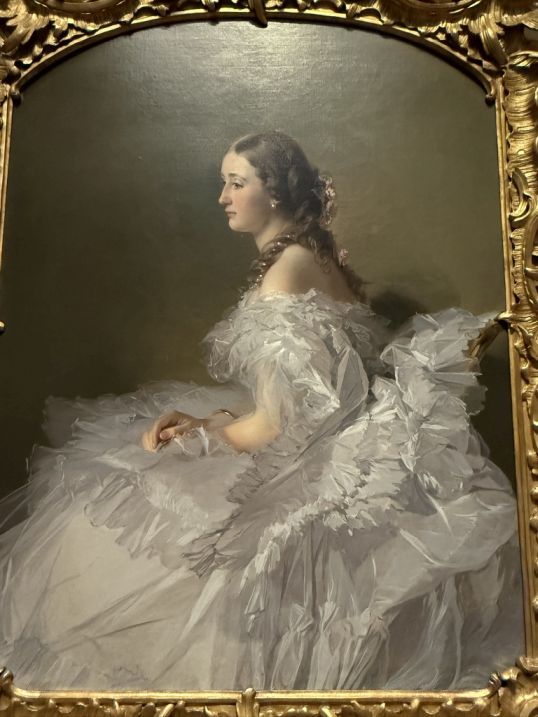 |
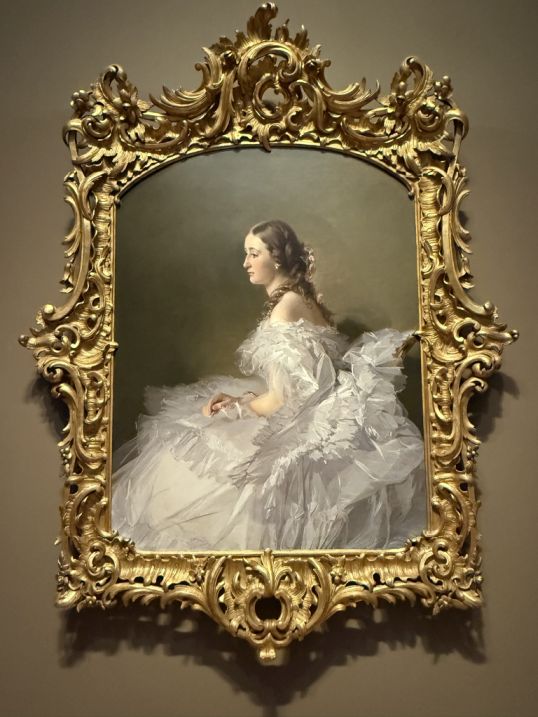
Portrait of Lydia Schabelsky, Baroness Stael-Holstein, 1857-58 by Franz Xavier Winterhalter, German, 1805-1875
Franz Xaver Winterhalter became much sought after in the courts of Europe, especially after his successful portraits of both the young Queen Victoria as well as the Empress Eugénie of France. He was particularly trusted by aristocratic women to produce highly flattering portraits that simultaneously celebrated and recorded their youth, status, good taste, and fashion sense (their gowns were usually designed by Worth, to Winterhalter’s own specifications). In this portrait of Baroness Staël-Holstein, the viewer is confronted with a stunning image of an aristocratic woman, painted at the height of her youth, with the artist paying much attention to the details of the sitter’s costume, jewelry, and hairstyle. In Second-Empire France (1852–1870), fashion and identity were tightly intertwined. Here Winterhalter, who knew how best to serve the needs of his patrons, skillfully draws the viewer’s attention to his subject’s mauve gown through his bold brushwork. To better highlight the sitter, the artist has deployed a drab and dull brown background, which creates a rich contrast with the light and feminine material of the dress. The dress itself is composed of layer upon layer of explosively luxurious fabric, and it subtly mirrors the flower in the sitter’s hair, which is made up of layers of soft and colorful petals and is the ultimate symbol of feminine beauty.
 |
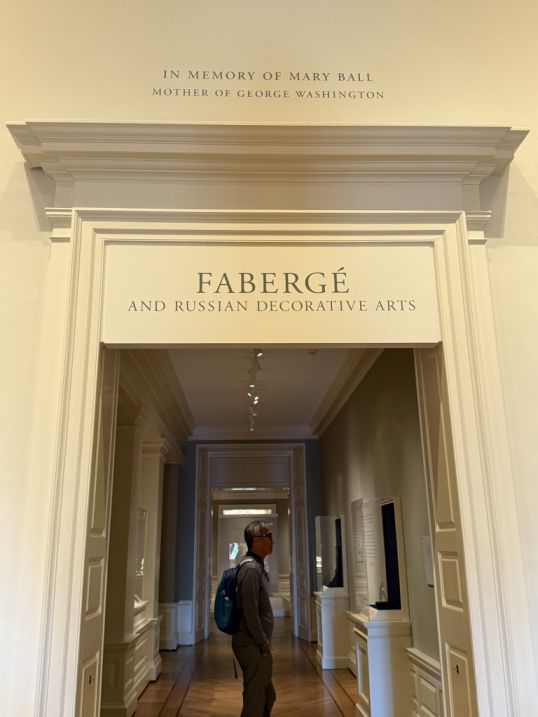 |
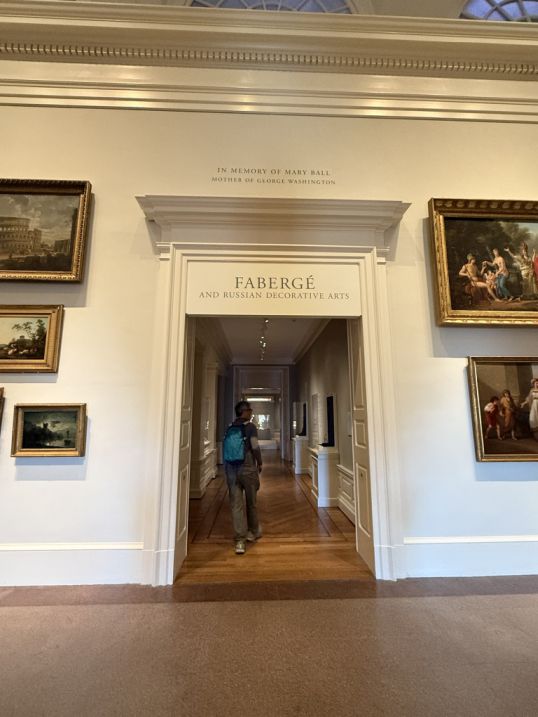
We are now entering the famous Fabegé and Russian Decorative Arts Collection, one of the most significant collections of Fabergé outside of Russia, and truly a jewel in the VMFA's crown.
Carl Fabergé (1846–1920) was a Russian jeweler of French descent, famous for his exquisite and opulent creations, particularly for the Russian Imperial family. The House of Fabergé became synonymous with unparalleled craftsmanship, intricate design, and the lavish tastes of the late 19th and early 20th centuries. His workshops in St. Petersburg rivaled any in the world for their artistry and ingenuity.
The core of the VMFA's collection comes from two major bequests: Lillian Thomas Pratt Collection: This is the most substantial part. Mrs. Pratt, the wife of a General Motors executive, was a passionate and discerning collector of Russian imperial art, especially Fabergé. She amassed a stunning array of pieces during the 1930s and 1940s. Her collection was bequeathed to the VMFA in 1947. Other Acquisitions and Gifts: Over the years, the museum has continued to acquire and receive gifts of Fabergé and related Russian imperial art, further enhancing its holdings.
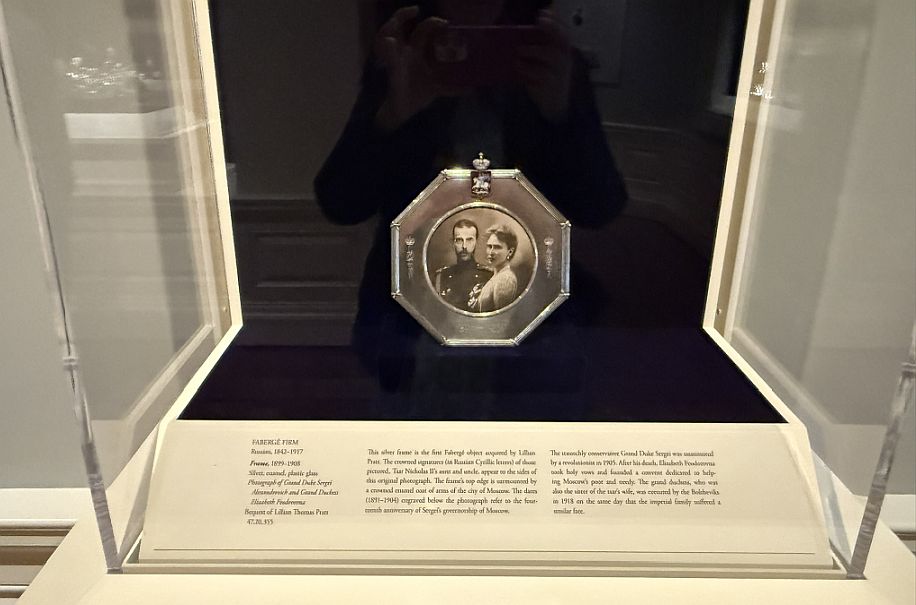
"TSAR NICHOLAS II" and "EMPRESS ALEXANDRA" The silver frame itself is a beautiful Fabergé piece, typical of the fine craftsmanship associated with the firm, often given as imperial gifts or commemorative items. The frame was originally designed to hold a photograph of Grand Duke Sergei Alexandrovich and Grand Duchess Elizabeth Feodorovna. The current photograph (of Nicholas II and Alexandra) means that either the frame was repurposed or it's a display decision by the museum.
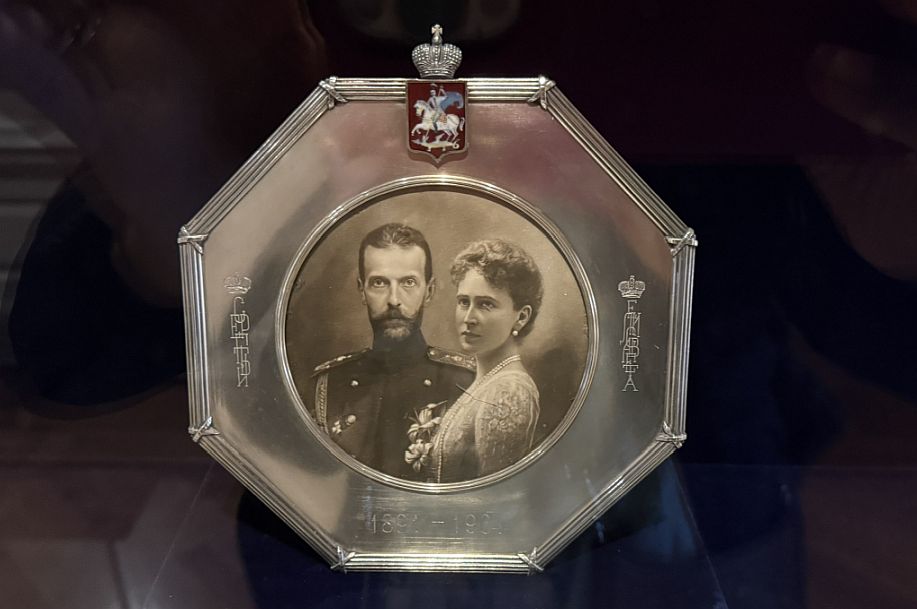
The original label describes the frame's details: a silver frame, enameled with the Moscow coat of arms (St. George and the Dragon) at the top, and crowns with monograms at the sides, commemorating the 500th anniversary of Sergei's governorship of Moscow. The text in the frame actually shows "1894 - 1904", which corresponds to the first decade of Nicholas II's reign, making the photograph of the Emperor and Empress highly fitting for a Fabergé piece of that era.
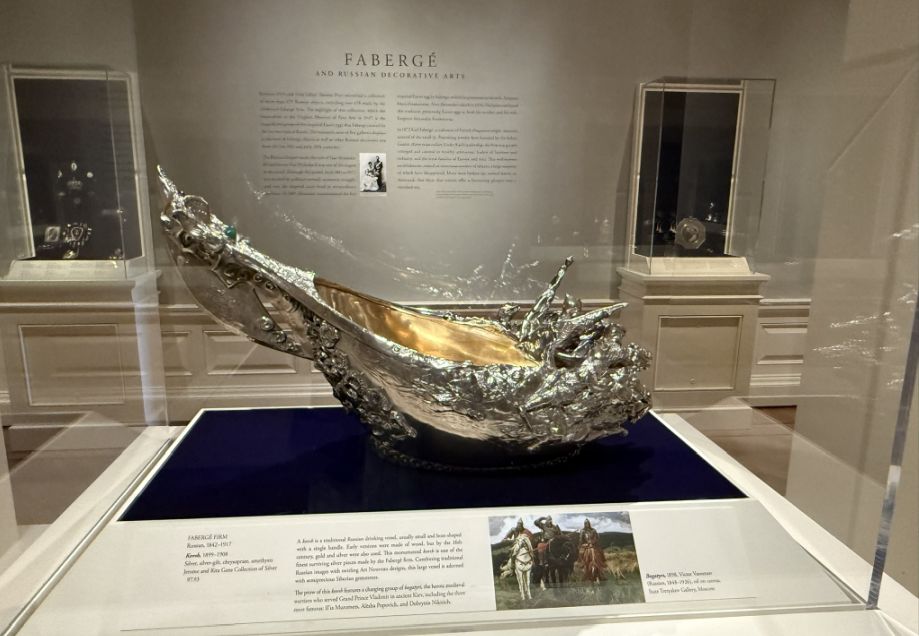
Kovsh, 1899-1917-Silver, silver gilt, chrysoprase, amethysts from Jerome and Rita Gans Collection of Sivler 97.93
A Kosvh is a traditional drinking vessel, usually small and boat shaped with a single handle.
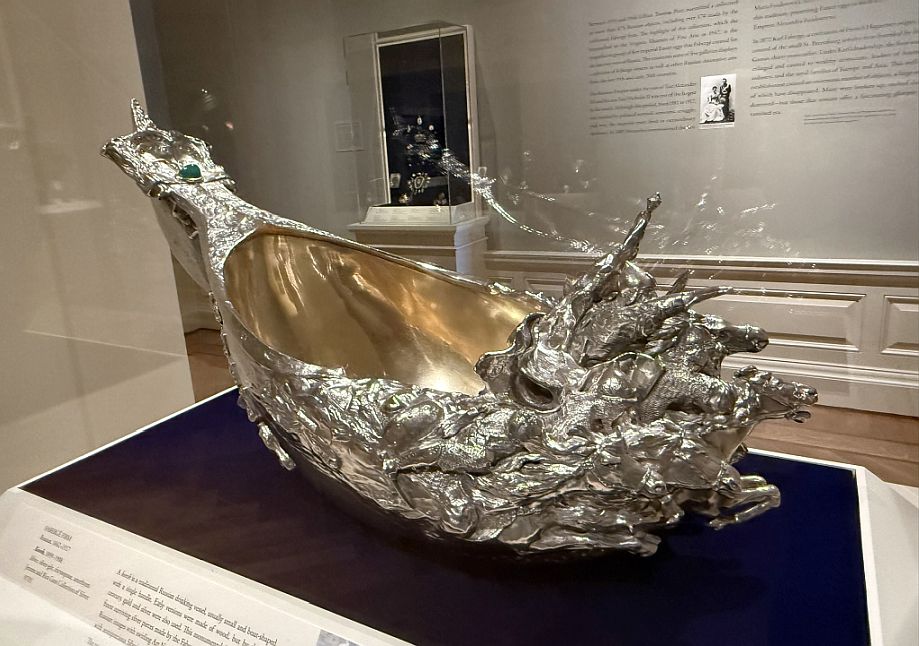
Early versions were made of wood, but by the 16th century, gold and silver were also used. This monumental kovsh is one of the finest surviving silver pieces made by Fabergé firm. Combining traditional Russian images with swirling Art Nouveau designs, this large vessel is adorned with semiprecious Siberian gemstones.
The prow of this kovsh features a charging group of bogatyri, the heroic medieval warriors who served Grand Prince Vladimir in ancient Kiev.
 |
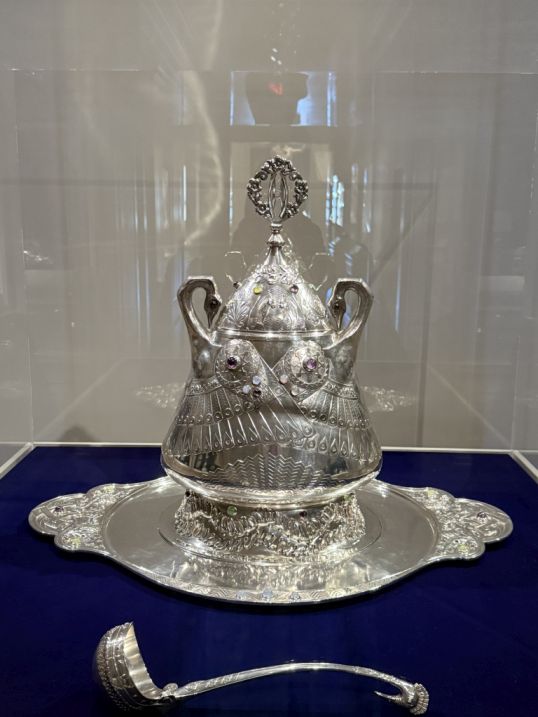 |
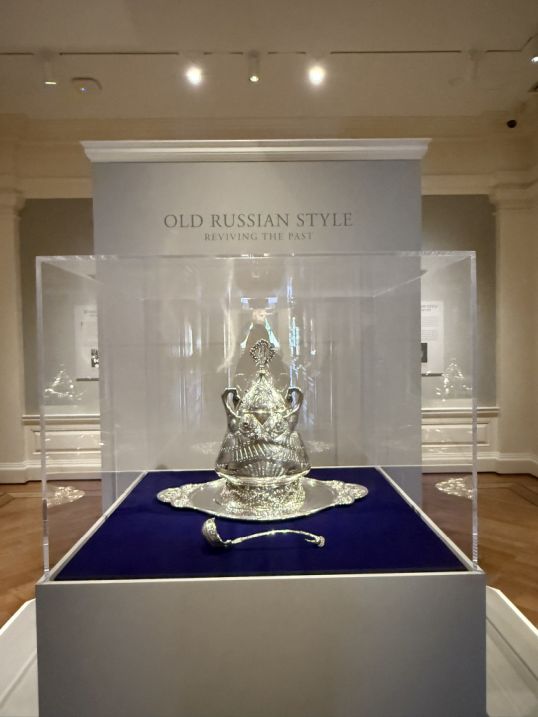
This piece is an exquisite example of an "Old Russian Style" silver drinking vessel, likely a kovsh or a bratina, displayed with a matching serving tray and a ladle.
The object itself, primarily made of silver, features intricate repoussé or chasing work (raised decorative elements), often seen in traditional Russian metalwork. The main vessel has an ornate handle (or handles, though only one is clearly visible) and a shape that might resemble a helmet or a traditional Russian boat, which are characteristics of koushi and bratiny. The top is crowned with an elaborate finial, further emphasizing its ceremonial or decorative nature.
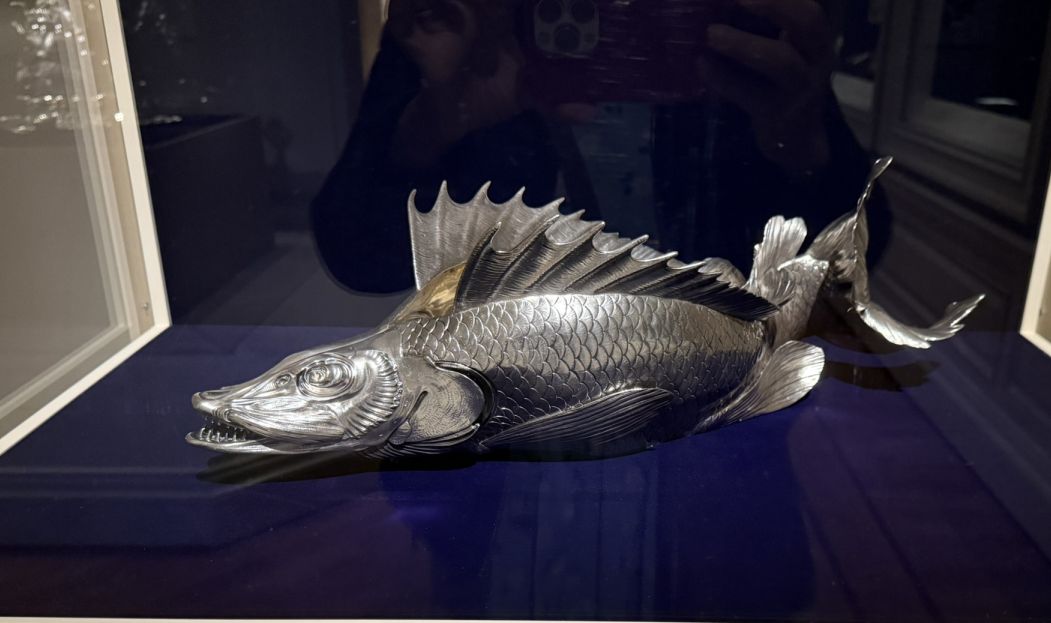
Caviar Bowl shaped as Sturgeon, 1896, Silver By Fabergé Firm, Russian, 1842-1918
The design of this bowl represent a swimming sturgeon, ferocious in appearance, naturalistically fashioned with detailed modeling of body structure, teeth, fins, and scales. The clever choice of subject refers to the Russian sturgeon's production of some of the finest caviar in the world. Made in Moscow, which became the main center of Faberge
e silver manufacturing in 1887, this container would have appealed to affluent connoisseurs o the Old Russian style, In the popular Russian tale of Sadko the Merchants' Son, a pair of giant sturgeon guard the underwater palace of the star of the sea.
 |
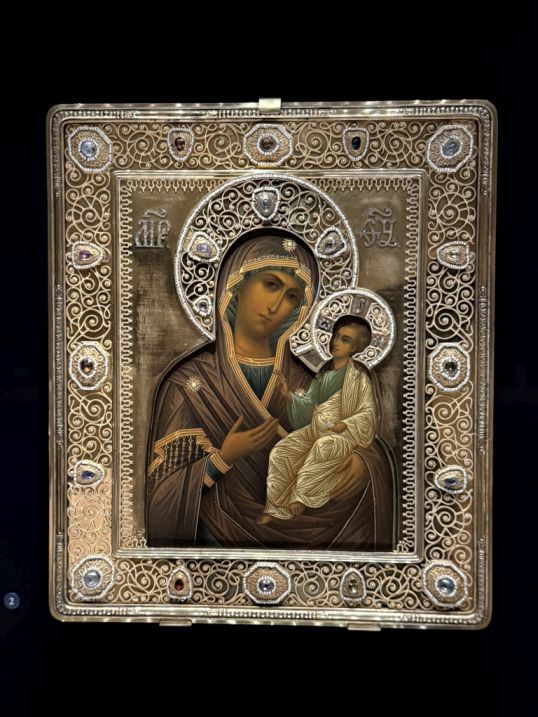 |
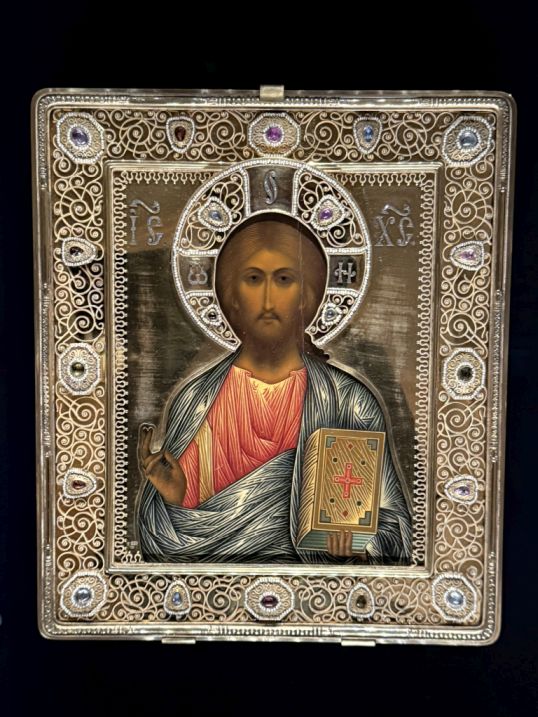
On the left is Christ Pantocrator, 1914-17. oil on panel, silver gilt, silver, garnets, sapphires, possibly topaz, zircon, chrysoberyl, diamonds, pearl, velvet by Fabergé Firm
On the right is The Iverskaya Mother of God, 1914-17, oil on panel, silver-gilt, silver, garnets, sapphires, topaz, zircon, tourmaline, pearls, velvet.
 |
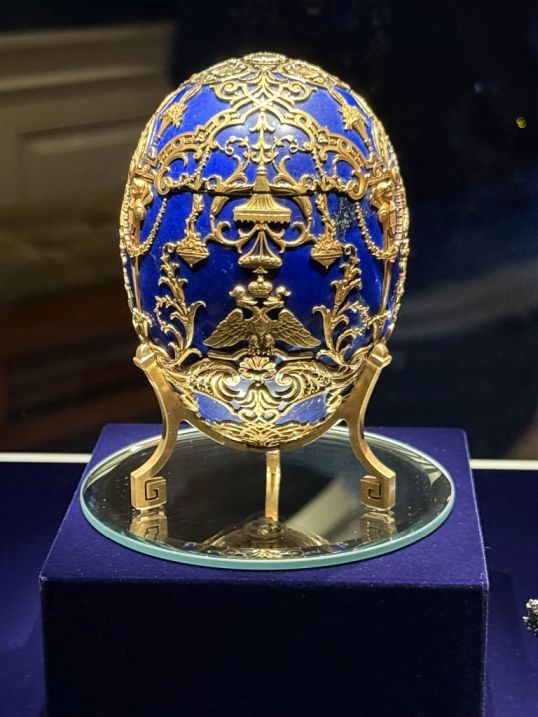 |
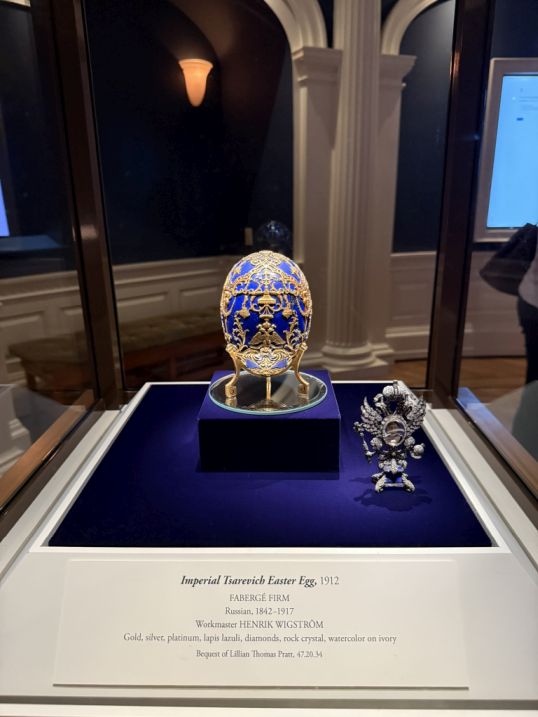
Imperial Tsarevich Easter Egg, 1912-Fabergé Firm, Russian, 1842-1917
Gold, silver, platinum, lapis lazuli, diamonds rock crystal, watercolor on ivory.
The Imperial Tsarevich Easter Egg was presented by Tsar Nicholas II to his wife, Empress Alexandra Feodorovna, in 1912. The egg is cleverly constructed to appear as if it is carved from a single piece of lapis lazuli. It actually has six lapis lazuli sections. The joints are concealed under the elaborate gold decorations that include double-headed eagles, a symbol of imperial Russia. The top of the egg is set with a table diamond (a thin, flat diamond) that covers the Cyrillic monogram AF (for Alexandra Feodorovna) and the date 1912.
 |
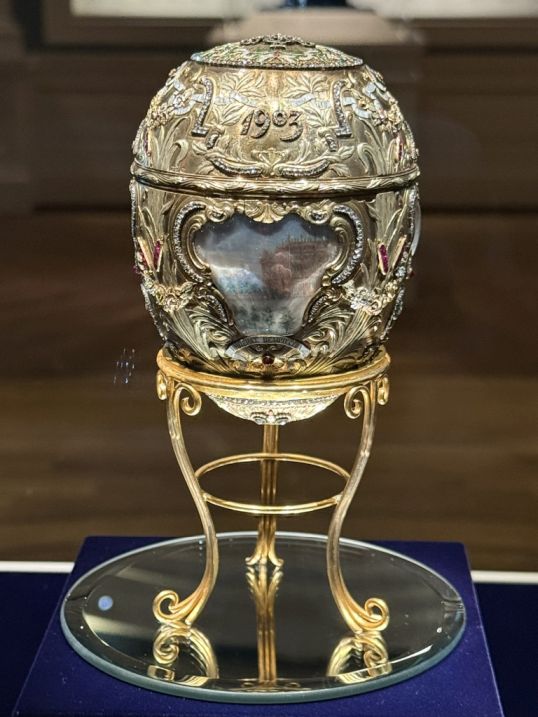 |
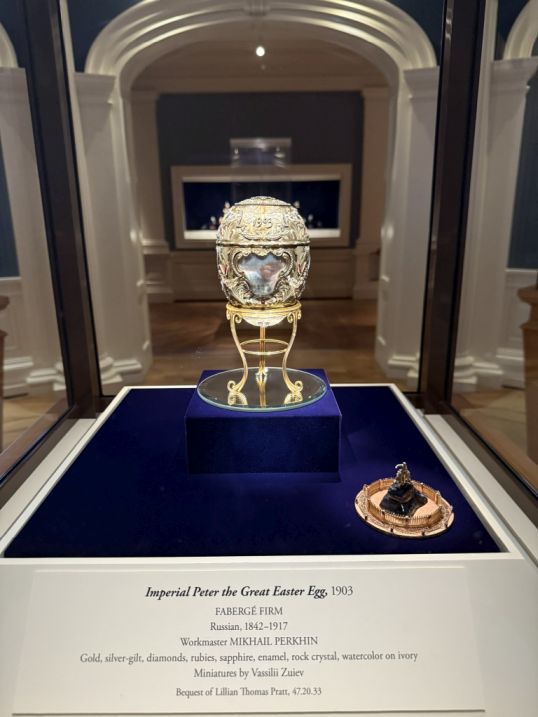
Imperial Peter the Great Easter Egg, 1903-Fabergé Firm, Russian, 1842-1917
Gold, silver-gilt, diamonds, rubies, sapphire, enamel, rock crystal, watercolor on ivory.
The Imperial Peter the Great Easter Egg was presented by Tsar Nicholas II to his wife, Empress Alexandra Feodorovna, in 1903. It commemorates the 200th anniversary of the founding of St. Petersburg by Tsar Peter the Great. The top of the egg bears the Cyrillic initials of Nicholas II and Alexandra Feodorovna. When it is opened, a replica of Étienne-Maurice Falconet’s famous statue of Tsar Peter the Great rises out of the egg.
 |
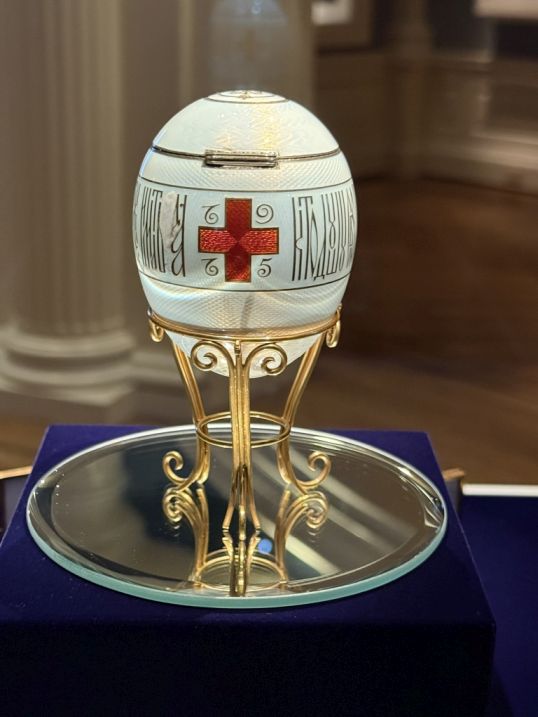 |
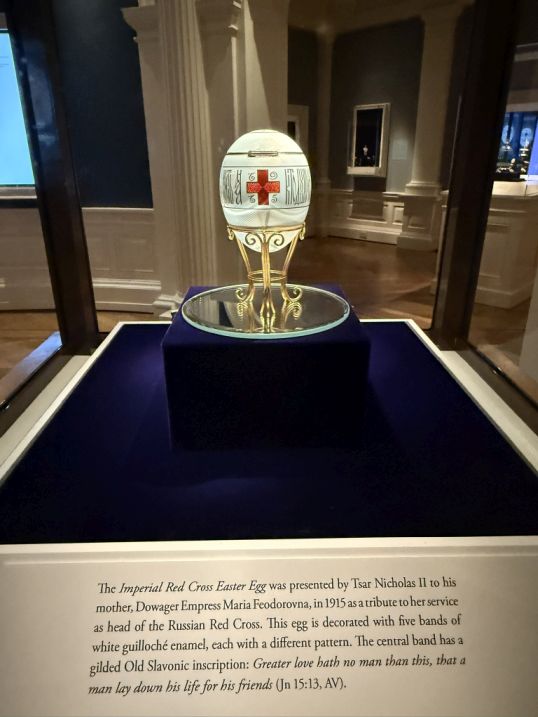
The imperial Red Cross Easter Egg was presented by Tsar Nicholas II to his mother, Dowager Empress Maria Feodorovna, in 1915 as a tribute to her service as head of Russian Red Cross. This egg is decorated with five bands of white guilloche enamel, each with a different pattern. The central band has a gilded Old Slavonic inscription: Greater love bath no man than this, that a man lay down his life for this friends.
 |
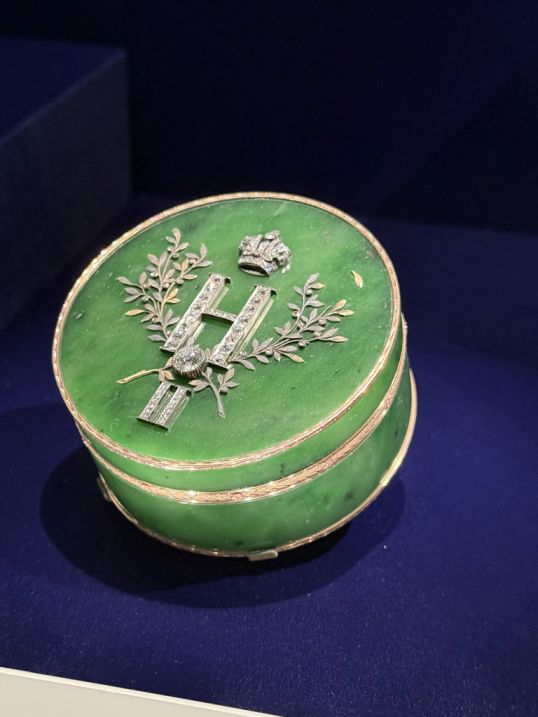 |
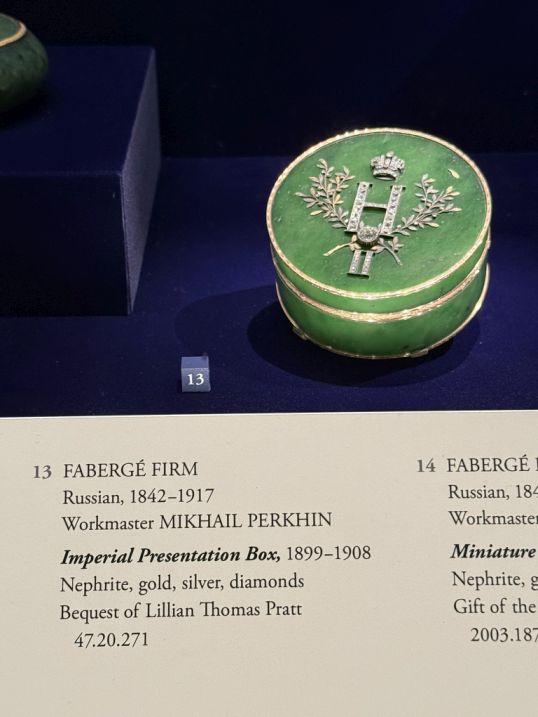
Imperial Presentation box,1899-1908-Nephrite, gold, silver, diamonds- Fabergé Firm.
The box itself was a powerful symbol of grace and imperial favor. The quality of the materials (nephrite, gold, silver, diamonds) and the artistry of Fabergé visually underscored the immense importance of both the gift and the recipient's standing. These boxes were created for one primary purpose: to hold and present awards, decorations, or significant diplomatic gifts on behalf of the Russian Emperor (Tsar) or Empress.
 |
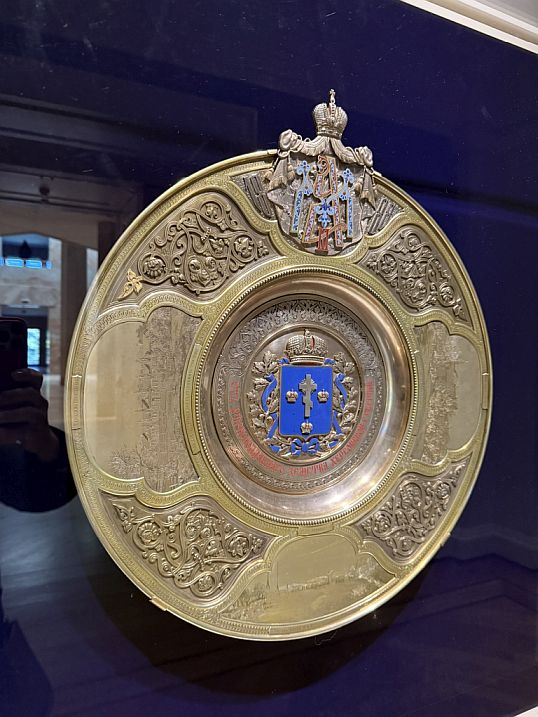 |
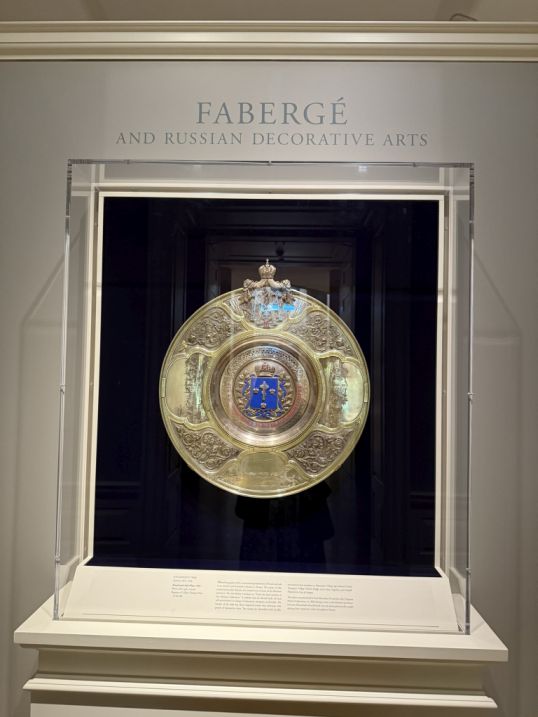
Faberge and Russian Decorative Arts
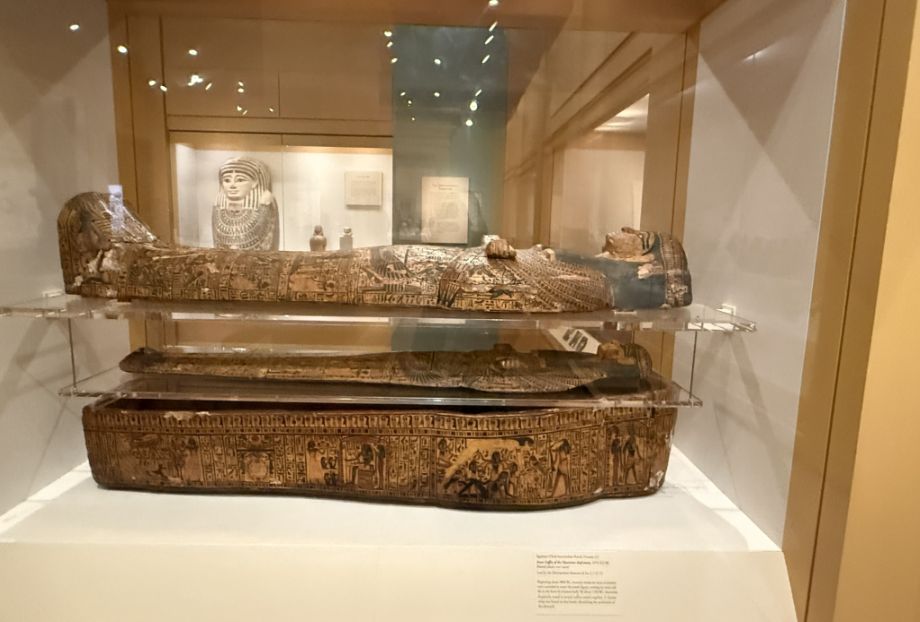
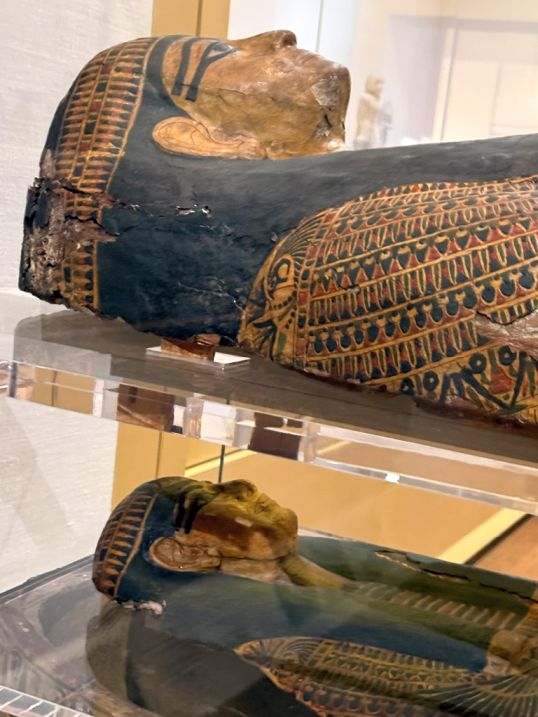
Inner Coffin of the Charioteer Atef-amon, 1070-945 BC, Painted plaster over wood.
Beginning about 2000BC, funerary mask on some mummies were extended to cover the entire figure, creating an inner-coffin in the form of a human body. By about 12000 BC mummies frequently rested in several coffins nested together. A chariot whip was found in this burial, identifying the profession of the deceased.
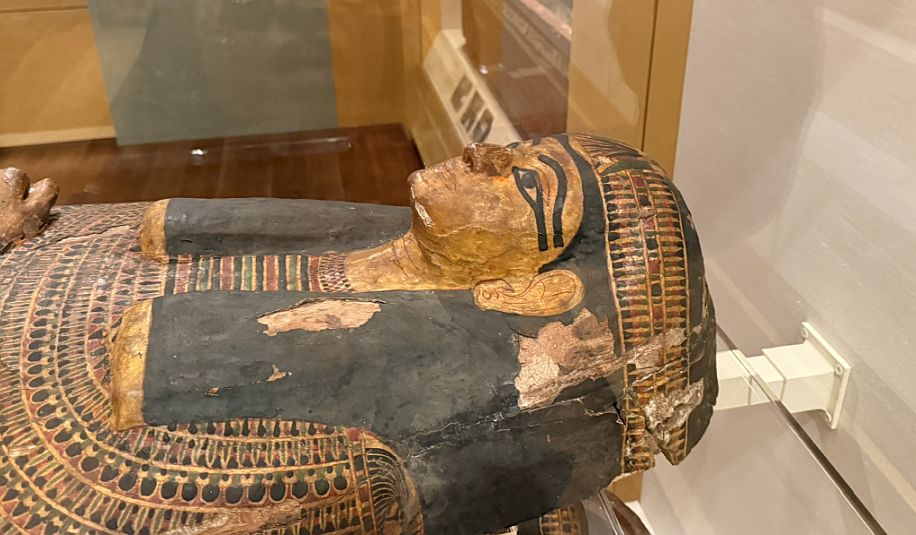
We are into one of the ancient art sections, specifically Egyptian. The Inner Coffin of the Charioteer Atef-amon, dating from 1070-945 BC, is a fascinating and historically rich object. This period is significant in ancient Egyptian history, and the coffin offers many insights. dates to the Third Intermediate Period, specifically the Late New Kingdom to early 21st Dynasty. This was a time of significant change and decreased centralized power in Egypt. The empire was fragmenting, with different rulers controlling different regions (e.g., pharaohs in the north, high priests of Amun in the south).
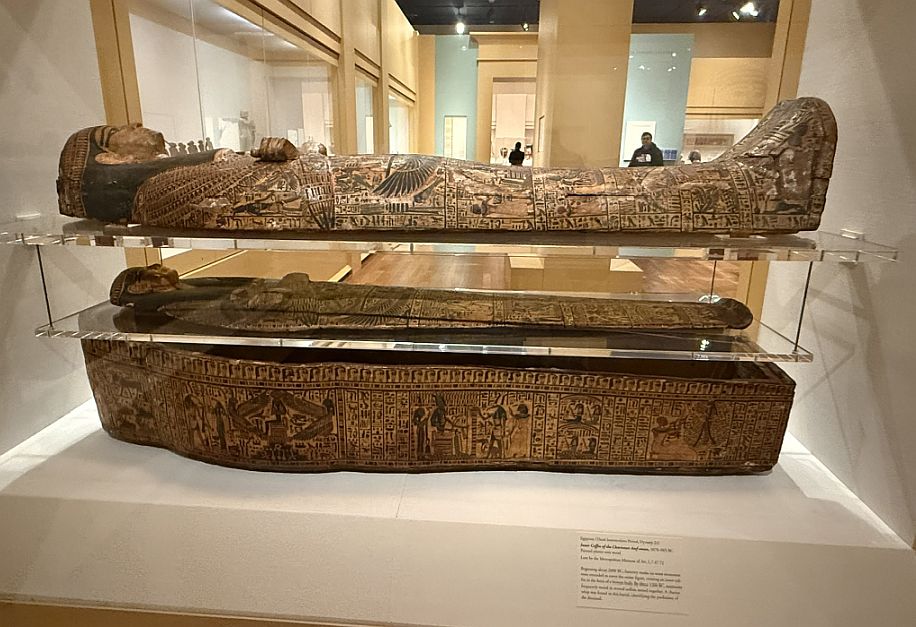
This title tells us about Atef-amon's profession. Chariots were a crucial part of the Egyptian military, especially during the New Kingdom. A charioteer would have been a skilled and respected individual, likely part of an elite military unit or a personal retinue. His name, "Atef-amon," indicates his devotion to the god Amun (or Amen-Re), who was the preeminent deity of the New Kingdom. "Atef" generally means "Opet-festival" or could be related to "crown." Thus, his name associates him directly with the great god of Thebes.
 |
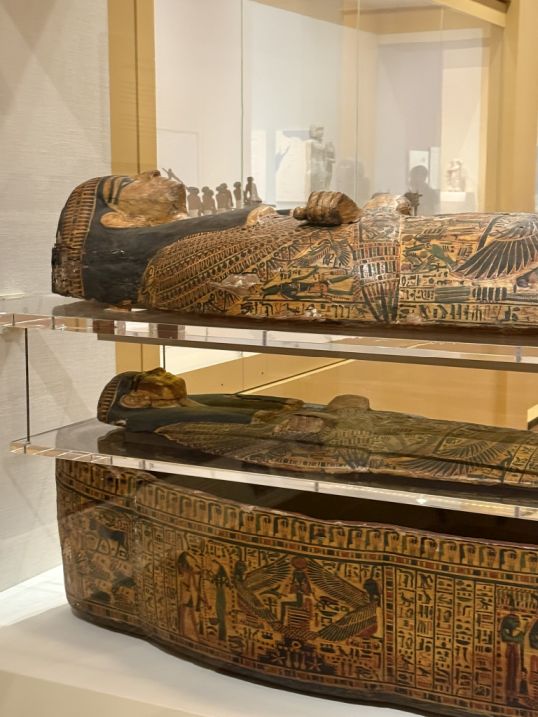 |
The coffin is designed in the shape of a human body, or "anthropoid," to hold the mummified remains of Atef-amon. This was believed to provide a recognizable form for the soul (ba) to return to.
Painted plaster over wood was a common and effective method for creating coffins in ancient Egypt. Wood (often imported, as good timber was scarce in Egypt) formed the core structure, shaped to mimic the human form. Layers of gesso (a mixture of plaster and glue) were applied over the wood, providing a smooth surface for painting. This allowed for intricate details and vibrant colors.
 |
 |
We are now in the impressive collection of late 19th-century European art, focusing on Impressionist and Post-Impressionist masters! These are truly iconic artists, and each piece offers a distinct perspective on art history.
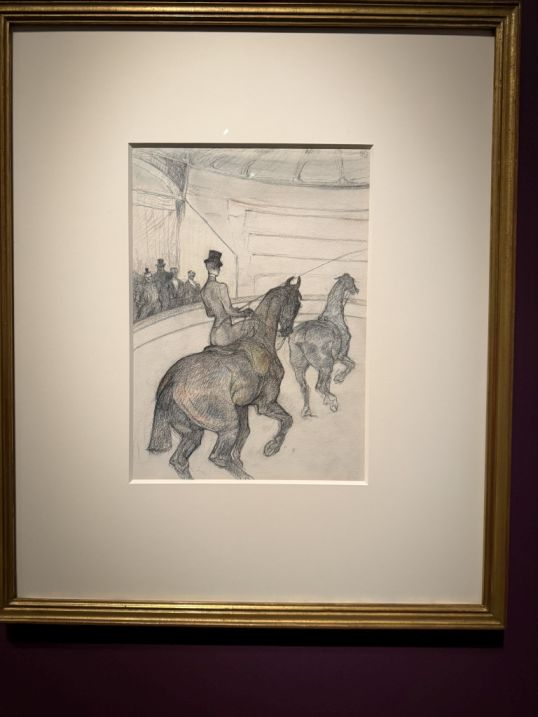
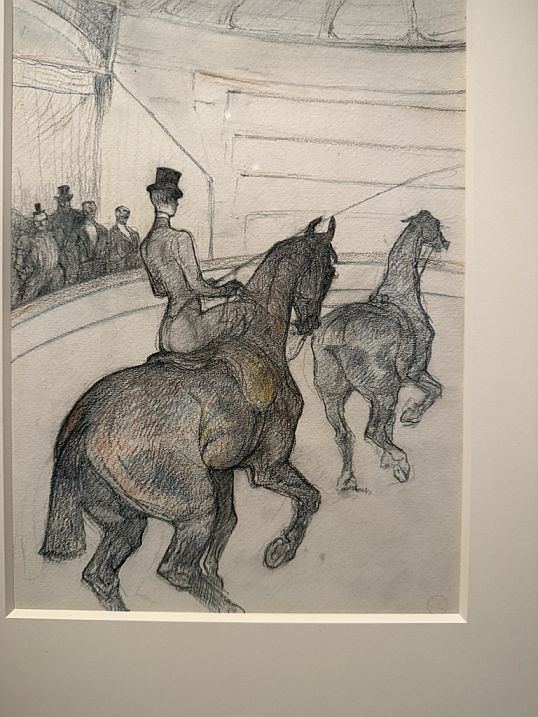
Le Tandem, 1899-Graphite and crayon on wove paper by Henri de Toulouse-Lautrec-French, 1864-1901
The circus grew popularity at the end of the 19th century. Alongside other forms of spectacular entertainment like the cabaret. Toulouse-Laurtrec frequented these venues, where he felt a sense of camaraderie with the performers. This drawing is one from a series he made while a patient a sanatorium outside Paris. Toulouse-Lautrec hoped that the drawings would convince his doctors that he was well enough for release.
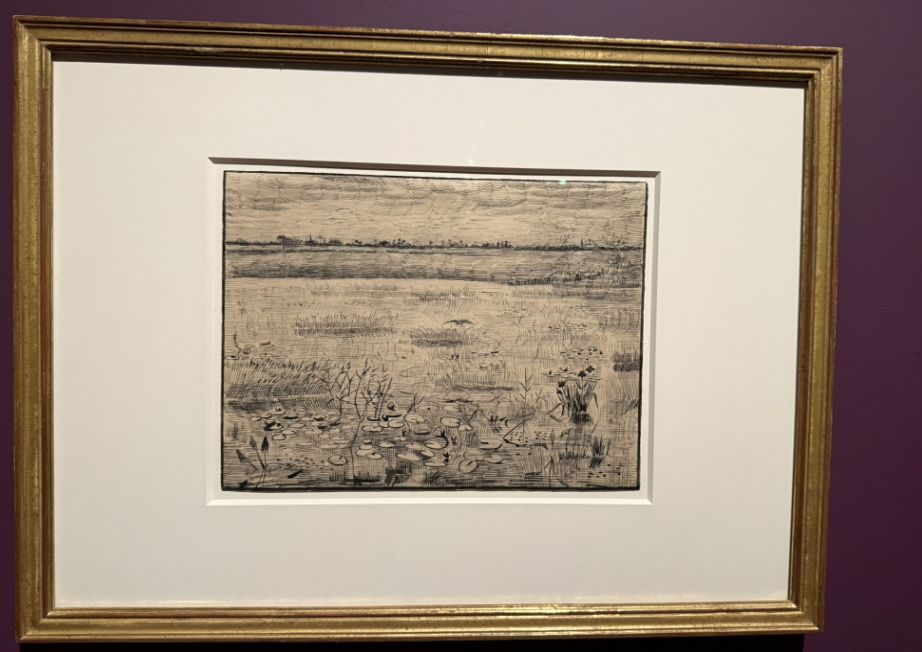
Marsh with Water Lilies, Etten, 1881-Pen an India ink on wove paper with graphite under drawing by Vincent Van Gogh, Dutch, 1953-1990
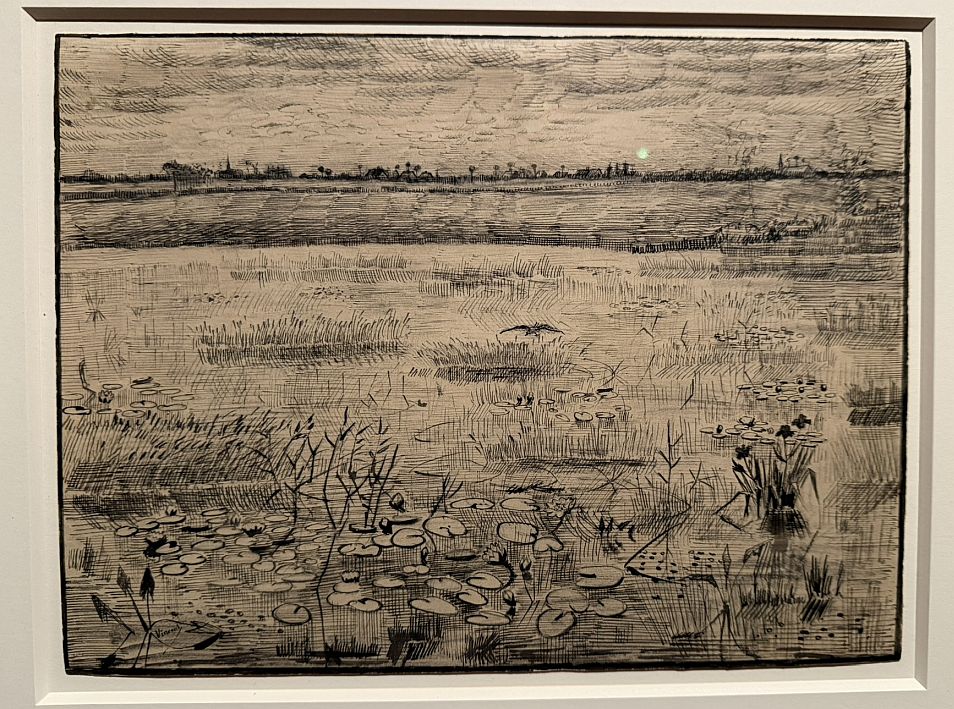
Van Gogh spent some of the summer of 1881 with his family in the Dutch village of Etten. IN this early drawing, the skyline of the town, including church spires, are visible along the horizon, distinct from the repetitive marks that suggest the sky above and field in the mid-ground. Van Gogh employed this pattern application of line and crosshatching throughout the sheet to convey different surfaces, including reds and water lilies emerging through the surface a still pond. Yet even with this systematic approach to the composition, hints of the exuberant expressionism of his later work are clear, most notably in the dynamism of the sky
 |
 |
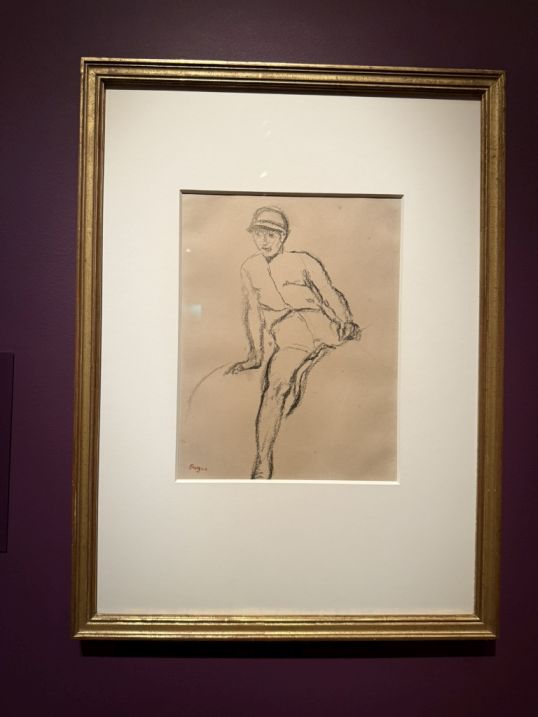
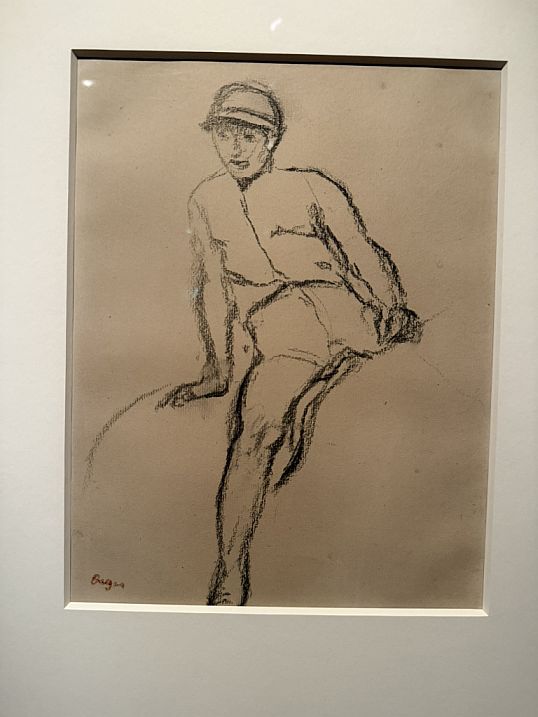
Seated Jockey, 1880, Black chalk on laid paper-Edgar Degas, French, 1834-1917
Degas was a frequent visitor to the racetracks at Longchamp in Paris an repeatedly depicted both riders an spectators. His immersion into the space gave him ample opportunities to study horses and jockeys both in motion and at rest. The Impressionist, especially Degas and Monet, became known for their seriality-returning to the same motif again and again. Throughout his career, Degas created works related to horses and racing in painting, sculpture, prints, and drawings. Drawings enables him to work on-site at the track, where it would not have been feasible to set up a easel.
 |
 |
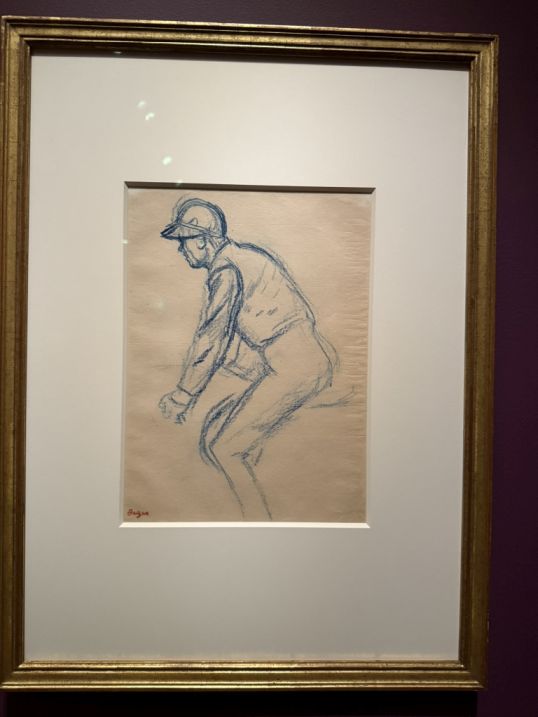
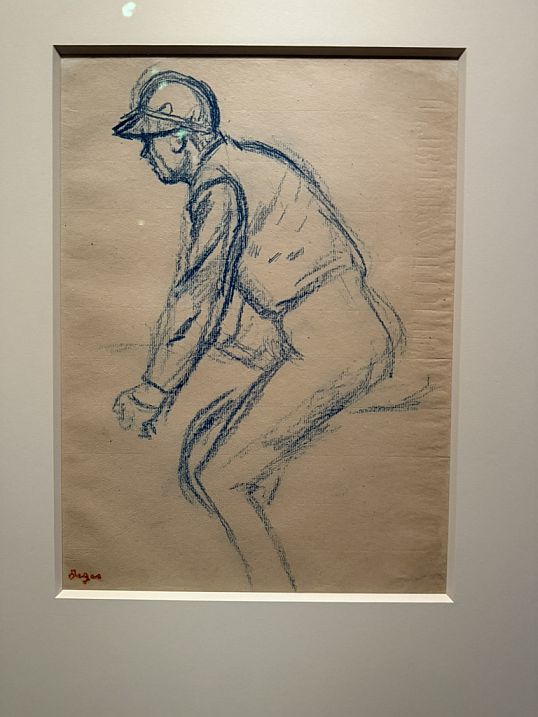
Jockey Facing Left, 1870-80, Blue pastel on laid paper-Edga Degas, French, 1834-1917
Degas was among the most prolific draughtsman of the impressionist group. As a young artist, he stated the work on Ingres and absorbed his linear approach. Though he worked in a range of drawings materials throughout his career, he was initially drawn to pastel because the matte qualities of the medium recalled the frescoes he had admired during a formative trip to Italy.
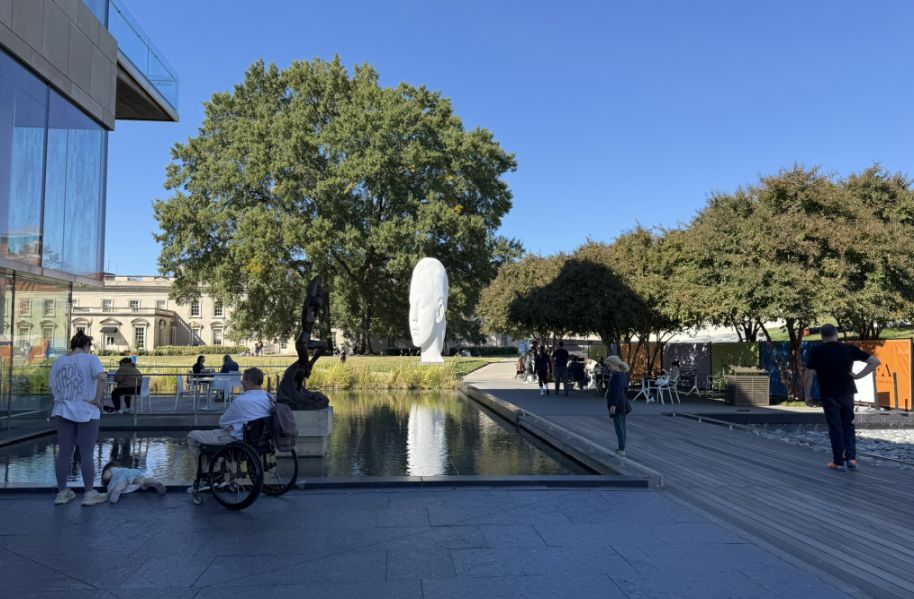
We are now at the E. Claiborne and Lora Robins Sculpture Garden.
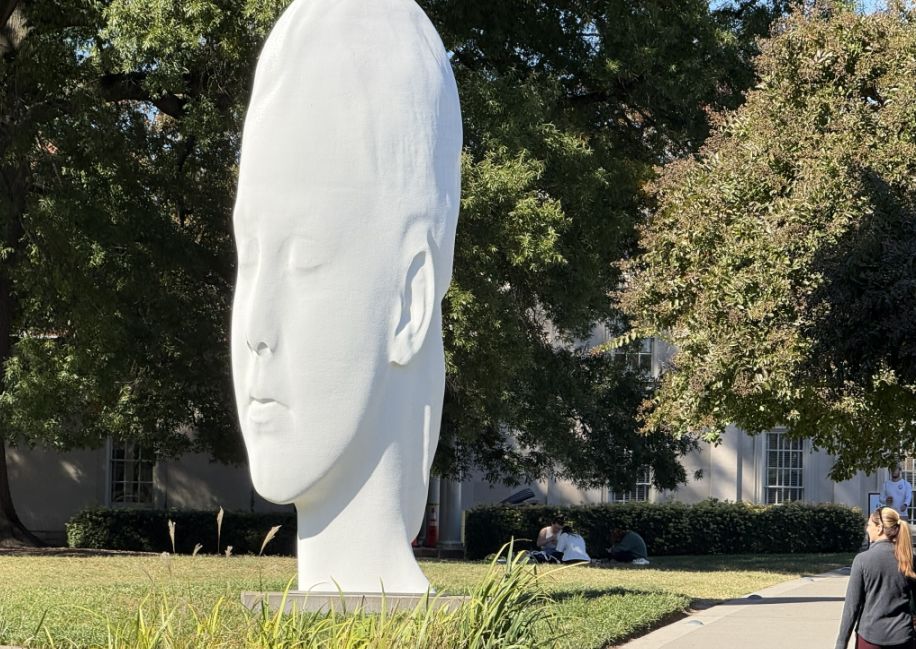
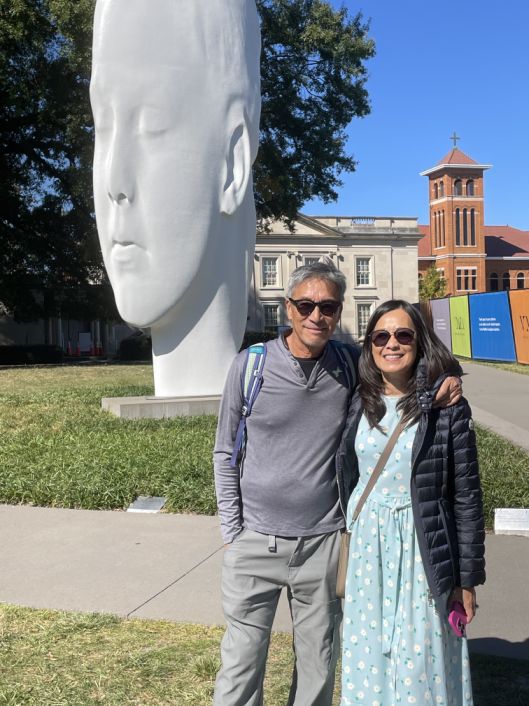
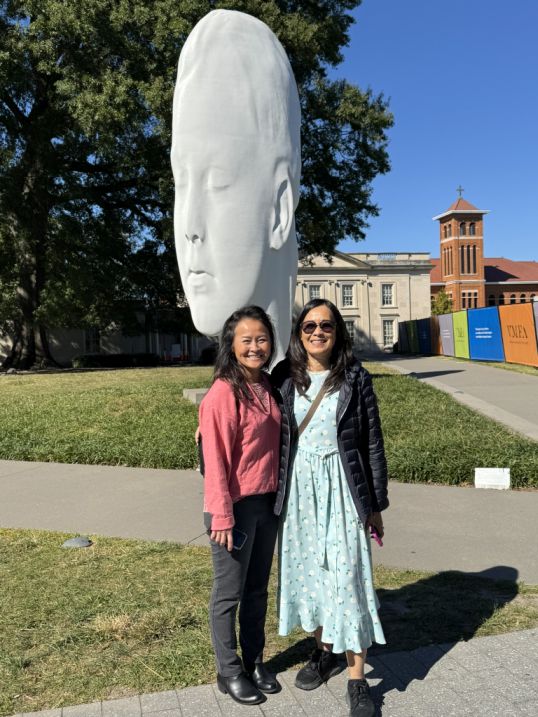
Awilda" by Jaume Plensa. "Awilda" is a monumental, elongated, serene female head, crafted from white marble or a white-coated synthetic material (often, Plensa uses marble dust and resin for these large outdoor pieces). The eyes are closed, suggesting meditation, introspection, or a dream-like state. The surface is smooth and often appears luminous, especially in sunlight.
 |
 |
We had a great visit at the Museum and we are now leaving the area for lunch.
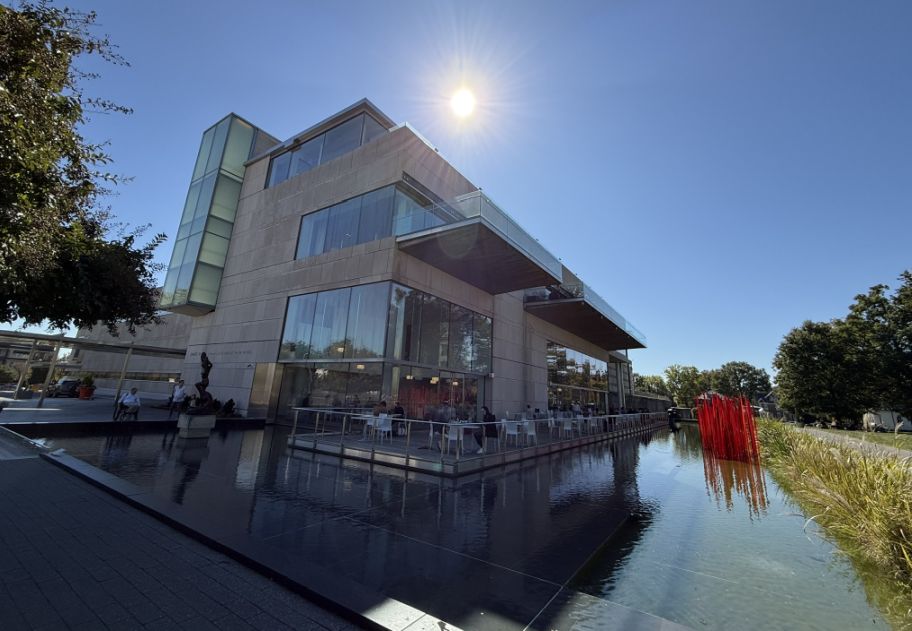
The E. Claiborne and Lora Robins Sculpture Garden is a beautiful outdoor art environment right on the grounds of the Virginia Museum of Fine Arts. It is located on a 3½-acre outdoor space designed as a calm, landscaped setting where art and nature meet. It opened as part of the museum’s 2010 expansion and blends sculpture, gardens, terraces, water features, and winding paths to create a restful place to explore art outside the museum walls. There’s a reflecting pool and waterfall that help set a serene tone for viewing the sculptures.
 |
 |
Inside there is a really nice coffee shop.

Afterwards we went downtown for Lunch but I didn't take any pictures, and then afterwards we had coffee and pastries an really friendly shop.
We spend like 4-5 hours together to reminisce about our time in Tasmania, and it was really nice to see Lisa again.
NEXT... Day 3- Dinner at petite Cerise