6 days in Washington DC- 10/18- 10/23/2024
Day 4-The U.S. Holocaust Memorial -10/21/2024
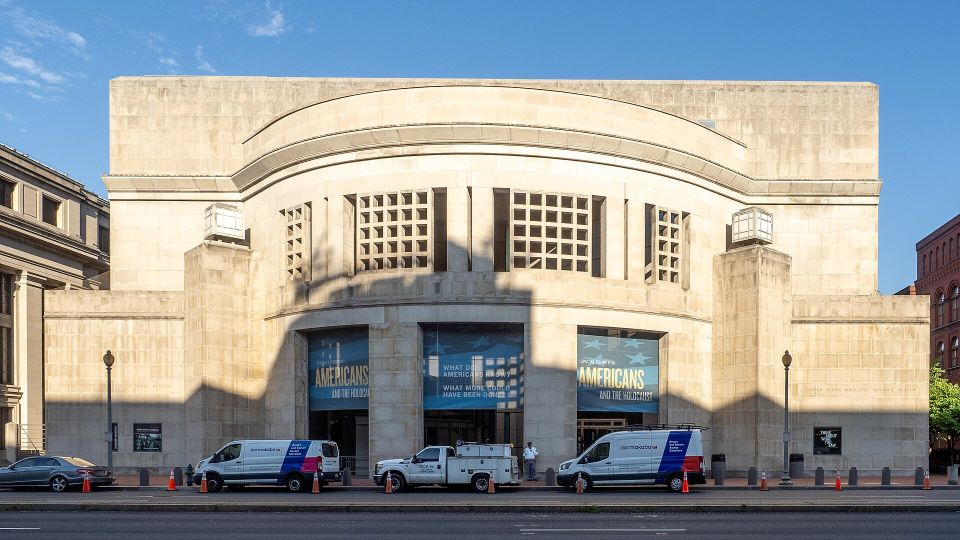
The United States Holocaust Memorial Museum in Washington D.C. is an intensely moving and significant institution. Its exterior, history, and what lies within are all designed to convey the gravity of the Holocaust and ensure its lessons are never forgotten.
The museum's architecture is deeply symbolic and intentionally stark, designed to evoke the grim realities of the Holocaust. It was designed by architect James Ingo Freed, a Jewish refugee from Nazi Germany, who sought to create a building that would prepare visitors emotionally for the horrors they would encounter. The building has a somber, almost industrial appearance, resembling a fortress. It is constructed primarily of brick, stone, steel, and concrete, materials that contribute to its somber and imposing presence.
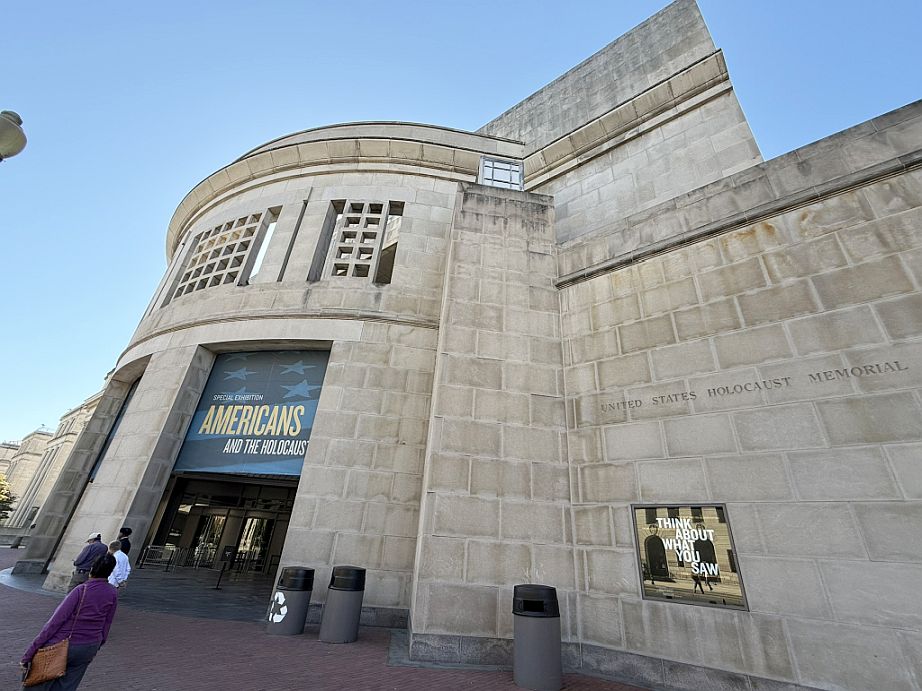
The idea for a national Holocaust memorial in the United States originated with President Jimmy Carter. In 1978, President Carter established the President's Commission on the Holocaust, chaired by Elie Wiesel, a Holocaust survivor and Nobel laureate. The commission recommended the establishment of a national museum and educational center. The site chosen was adjacent to the National Mall, near the Washington Monument, signifying its importance within the nation's capital. Construction began in 1989, and the museum officially opened to the public on April 26, 1993, during a dedication ceremony attended by President Bill Clinton, Israeli President Chaim Herzog, and numerous heads of state and Holocaust survivors.
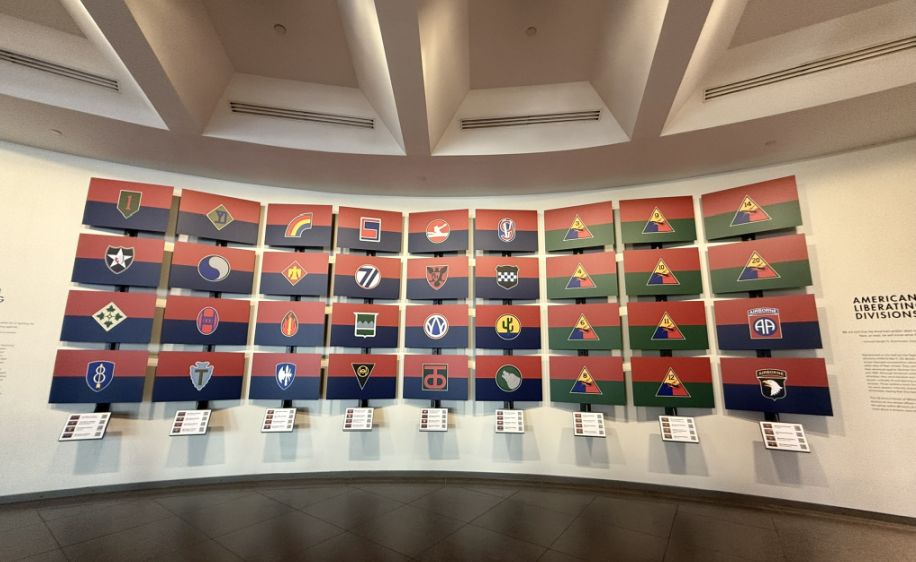
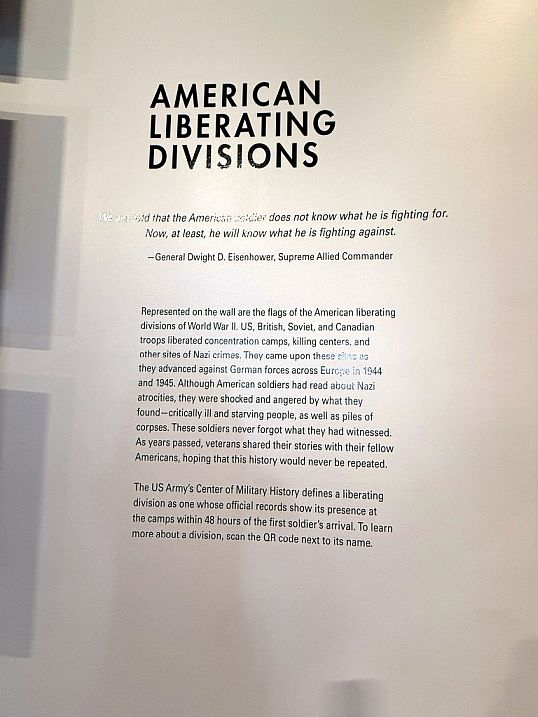
As you enter the museum, before even delving into the chronological horrors of the Holocaust, you encounter this display, which serves several crucial purposes: This wall is dedicated to "The American Liberators," and it's a powerful tribute that immediately connects American visitors to their nation's role in ending the Holocaust. It's a direct and profound acknowledgment of the American military divisions that fought in World War II and ultimately liberated concentration camps in Western Europe. Each plaque or inscription on the wall typically lists the names or numbers of these specific U.S. Army divisions.
 |
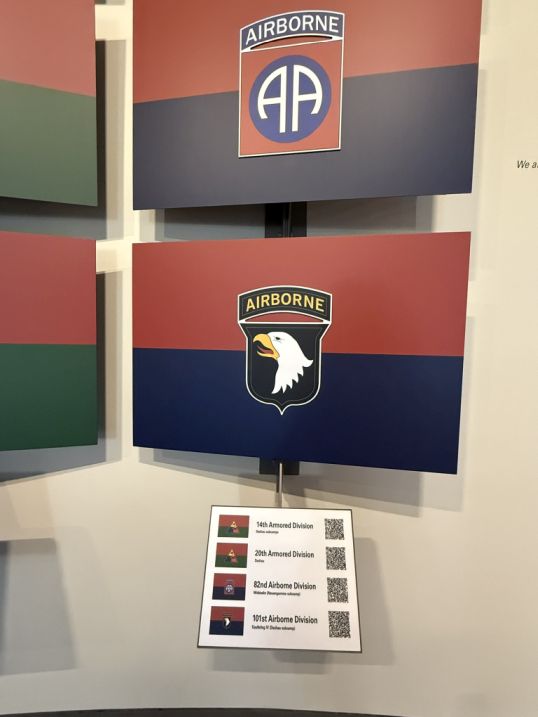 |
For many American visitors, especially veterans or their families, this wall is a point of deep connection. It allows them to see their loved ones, or themselves, represented in the fight against pure evil. It highlights the often-unfathomable courage and sacrifice of these soldiers.
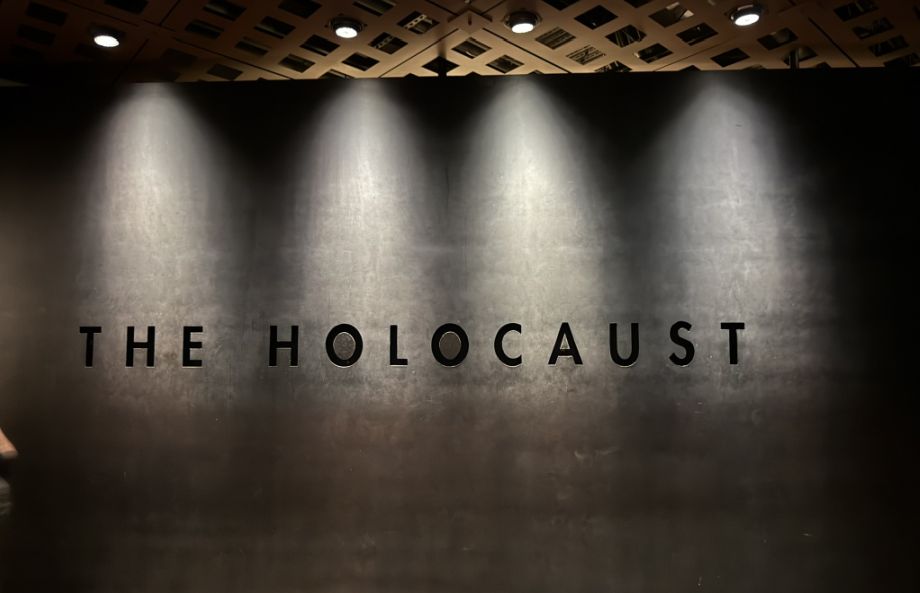
The museum's interior is meticulously designed to guide visitors through the narrative of the Holocaust, from its origins to its aftermath. The permanent exhibition is structured chronologically and thematically across three floors.
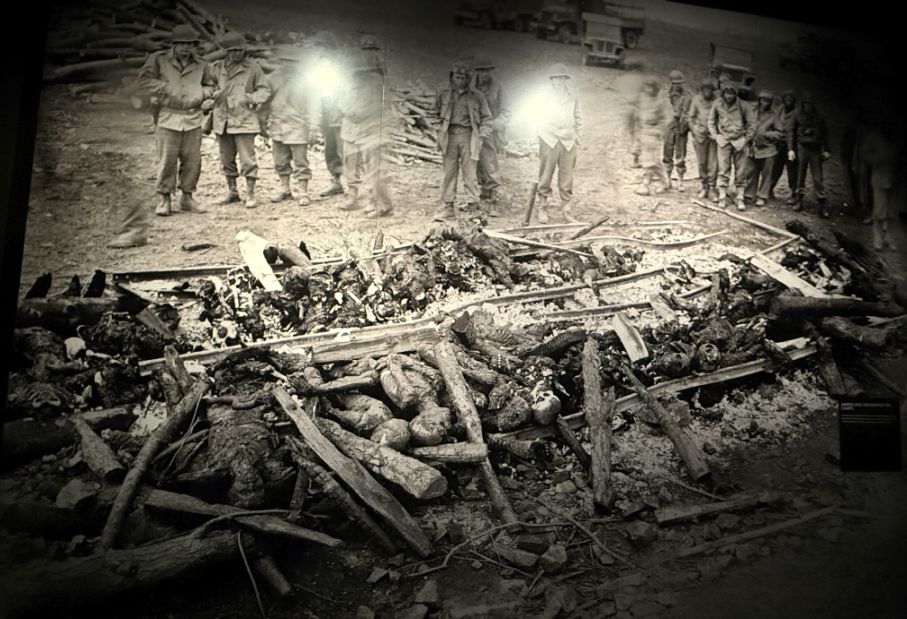
This picture represents the horrific reality that American soldiers confronted when they liberated the concentration camps. American soldiers in front of a large area with burned corpses , very strongly suggests a camp like Dachau, Buchenwald, Nordhausen, or Ohrdruf.
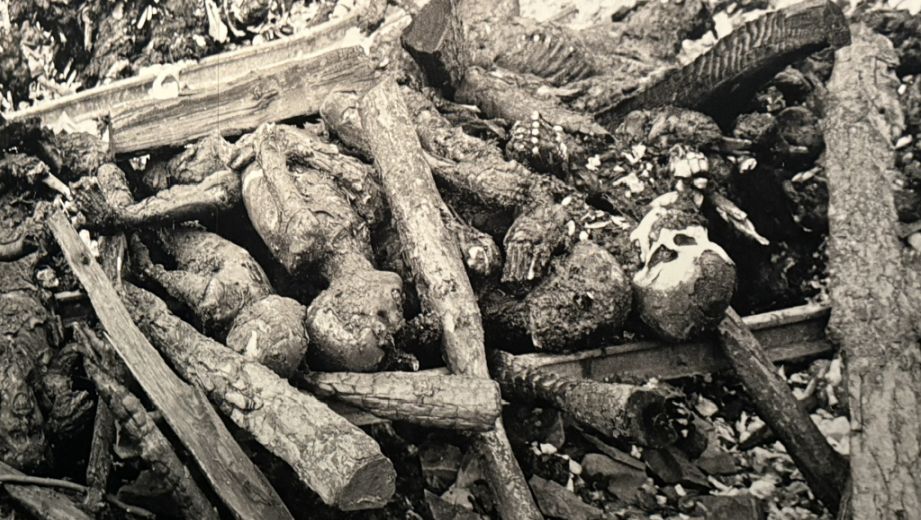
Upon the liberation of concentration and extermination camps. These images served as immediate, undeniable evidence of Nazi atrocities. Before liberation, many in the outside world had dismissed reports of genocide as exaggerations or propaganda. These photographs, taken by official military photographers and individual soldiers, provided irrefutable proof of the systematic murder and dehumanization committed by the Nazis.
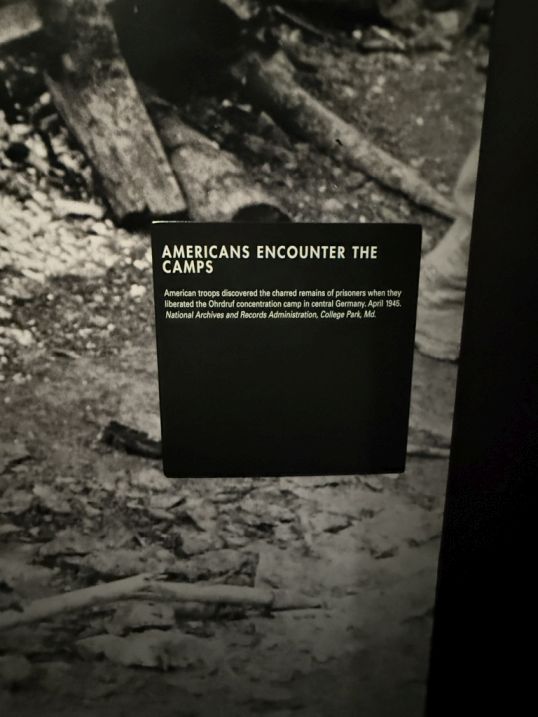 |
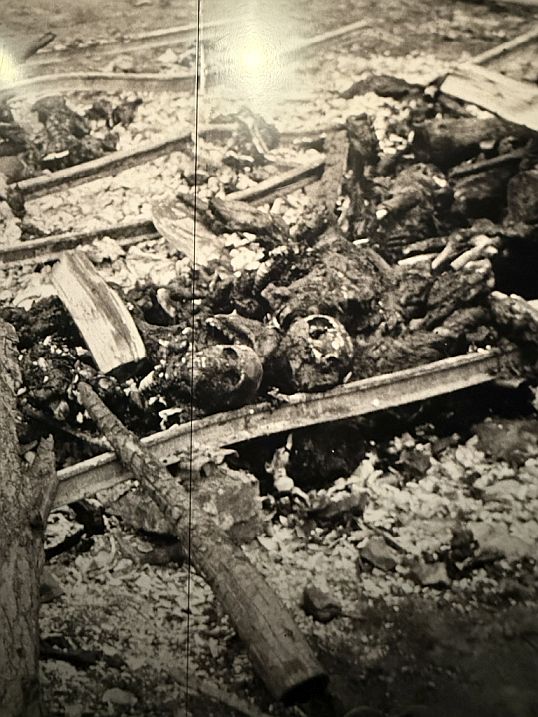 |
The sight of "large areas with burned corpses" points to the methods used by the SS to dispose of the overwhelming number of bodies, often in open-air pits or on massive pyres, especially in the final chaotic days of the camps as Allied forces approached. The sheer volume of dead bodies horrified the liberators and demonstrated the industrial scale of murder. The American soldiers, who had been fighting a conventional war, were utterly unprepared for the sights, sounds, and smells of the concentration camps. Many were young men who had never witnessed such depravity.
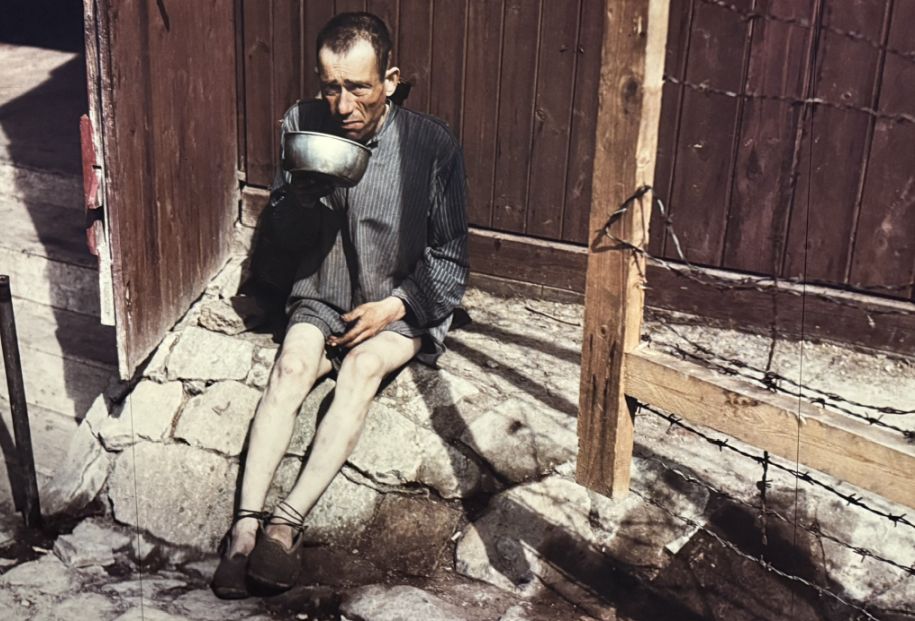
Emotional Trauma: The experience profoundly traumatized many liberators, leading to lifelong psychological effects. They witnessed survivors on the brink of death, living skeletons, and the physical manifestations of starvation, torture, and disease.
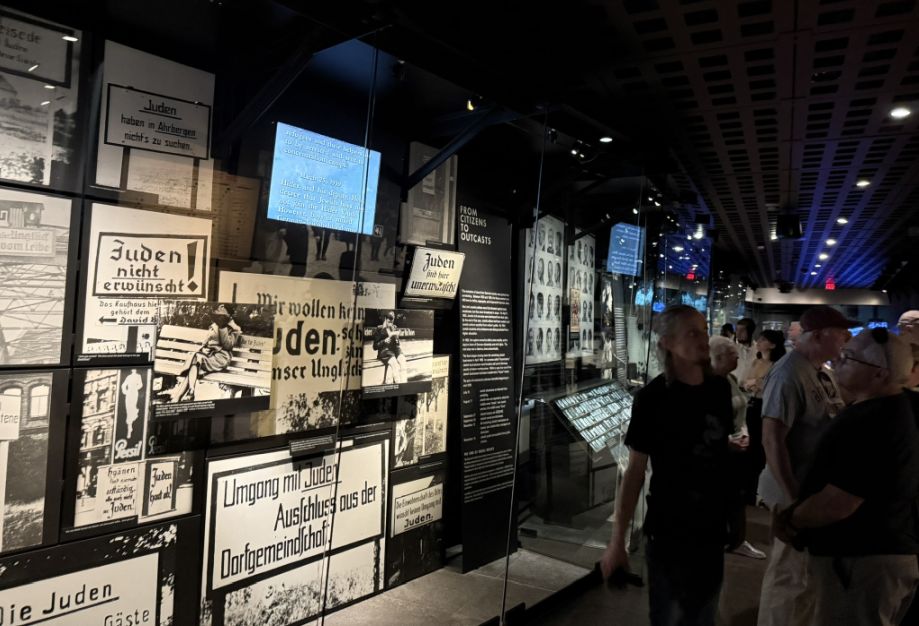
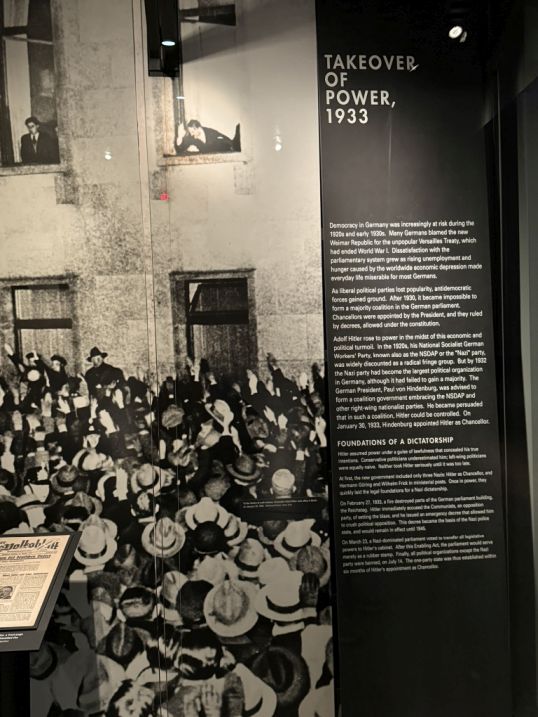
We are now in the he section of the United States Holocaust Memorial Museum's permanent exhibition that details the initial stages of Nazi persecution and the systematic dismantling of Jewish life in Germany.
 |
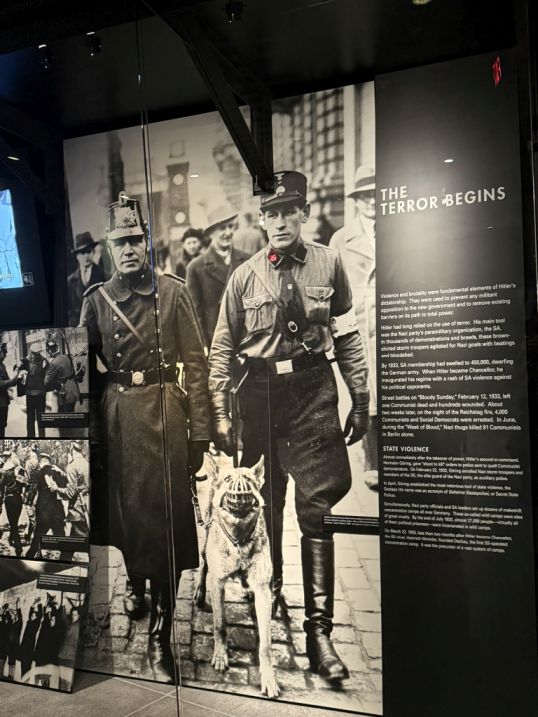 |
This period, roughly from 1933 to 1938, marks the transition from democratic governance to an increasingly totalitarian and anti-Semitic regime. This period saw the Reichstag Fire (February 1933), which the Nazis blamed on communists, leading to the suspension of civil liberties. The Enabling Act (March 1933) then effectively dissolved parliamentary democracy, granting Hitler dictatorial powers. This wasn't an overnight coup but a legal, albeit manipulated, seizure of control. Once in power, the Nazis immediately began suppressing dissent and targeting political opponents, trade unionists, and, crucially, Jews.
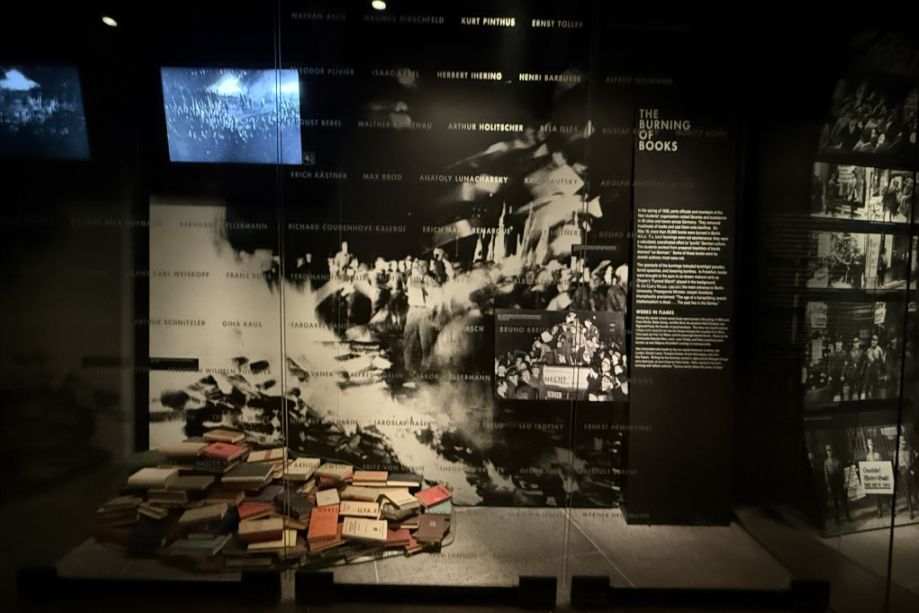
On May 10, 1933, Nazi students and professors across Germany orchestrated the public burning of books deemed "un-German." This wasn't just censorship; it was a symbolic act of intellectual cleansing and an attack on freedom of thought. Books by Jewish authors, pacifists, communists, and those considered morally "degenerate" were incinerated. It showcased the regime's contempt for liberal and democratic values and signaled its totalitarian intent.
 |
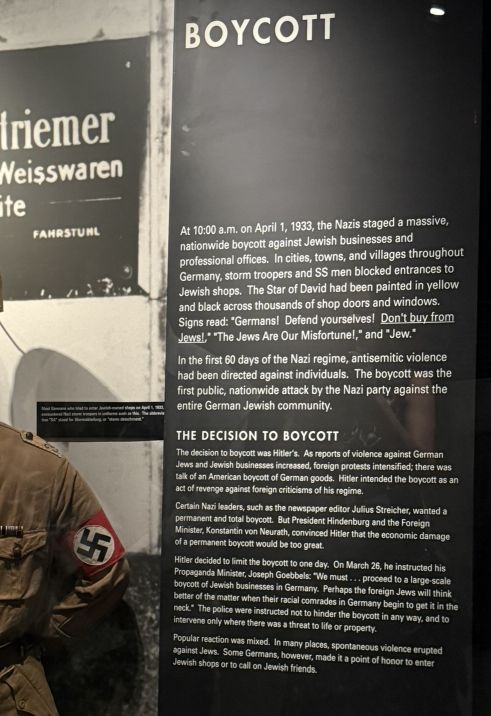 |
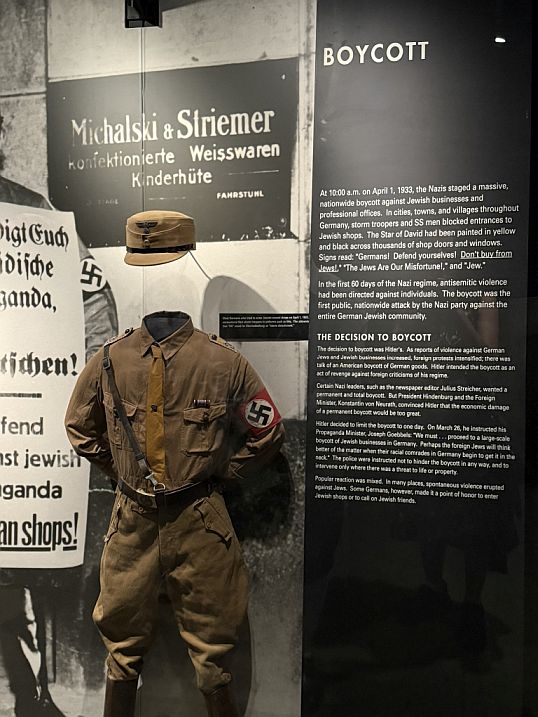
The 1933 Anti-Jewish Boycott. It was one of the first major, official, nationwide actions taken by the Nazi government against Jewish people, setting a chilling precedent for the years that followed. Immediately after Hitler came to power in January 1933, there was significant international outcry and press coverage about the Nazi regime's anti-Semitic policies and actions, including violence against Jews. Jewish organizations abroad called for counter-boycotts of German goods. The Nazis framed their boycott as retaliation against this "atrocity propaganda." The primary goal was to cripple Jewish businesses and professionals, forcing Jews out of Germany's economic life. This was a crucial step in the Nazi strategy to marginalize and ultimately eliminate Jews from German society. It was an act of intimidation, aimed at both Jews and non-Jewish Germans. It pressured Germans to conform to Nazi ideology and openly participate in the persecution of their Jewish neighbors.
 |
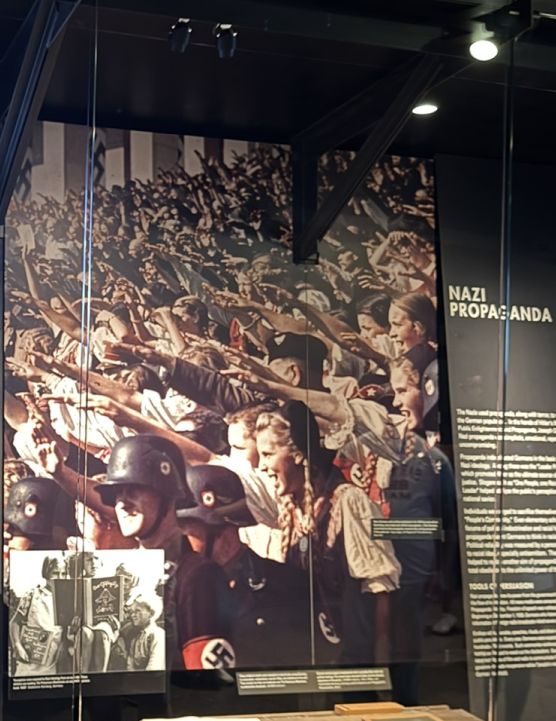 |
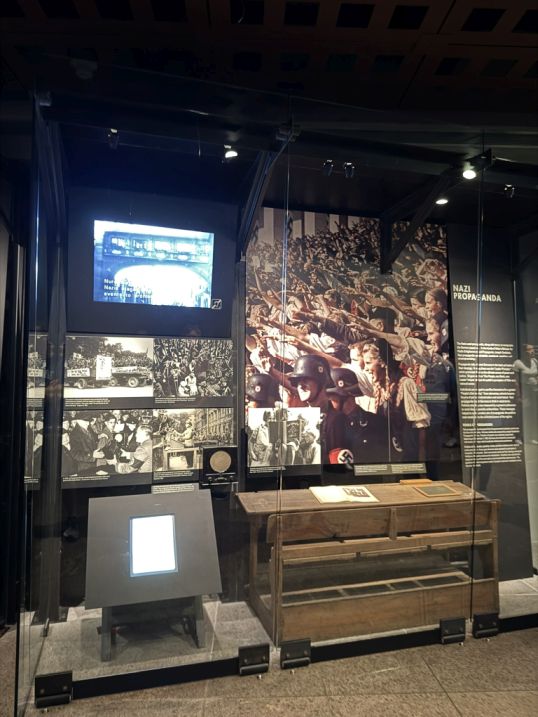
Nazi Propaganda. Joseph Goebbels, Hitler's Minister of Propaganda, orchestrated a relentless campaign to indoctrinate the German population and demonize Jews. This included control of newspapers, radio, films (like The Eternal Jew), posters, and school curricula. Propaganda skillfully blended nationalism, racial superiority, and virulent anti-Semitism, portraying Jews as an existential threat to Germany.
 |
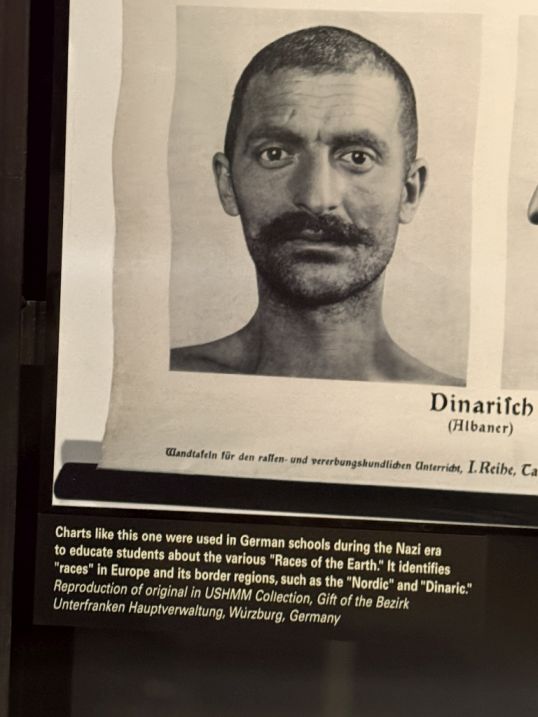 |
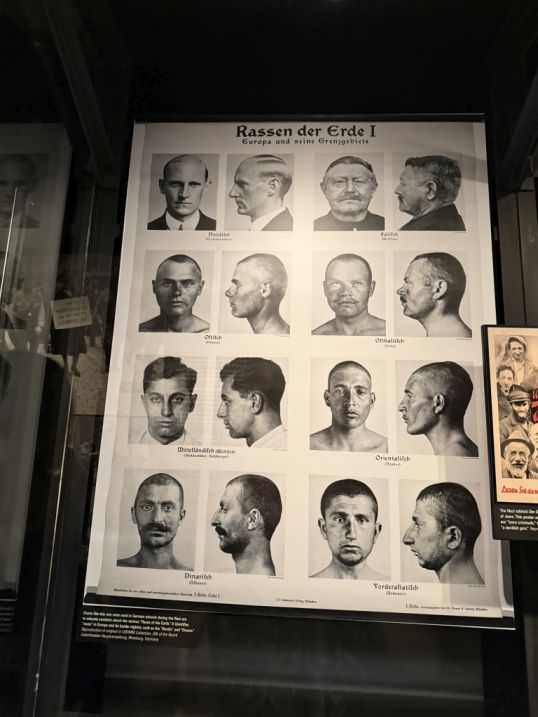
The "Science of Race" / Chart with Photos of Different Races of the Earth. The Nazis falsely promoted a pseudoscientific doctrine of "racial hygiene" and "racial purity." They believed in an Aryan "master race" and sought to justify their persecution of Jews, Roma, and other groups by falsely labeling them as "inferior" races. These charts you've seen are chilling examples of how the Nazis attempted to legitimize their prejudices. They often displayed "racial types" with measurements and classifications, presenting prejudice as scientific fact. The inclusion of "photos of different races of the earth" was part of an attempt to impose a hierarchical and rigid racial classification system, with "Aryans" at the top and Jews, Roma, and Black people at the bottom. This was used to strip non-Aryans of their rights and ultimately their lives.
 |
 |
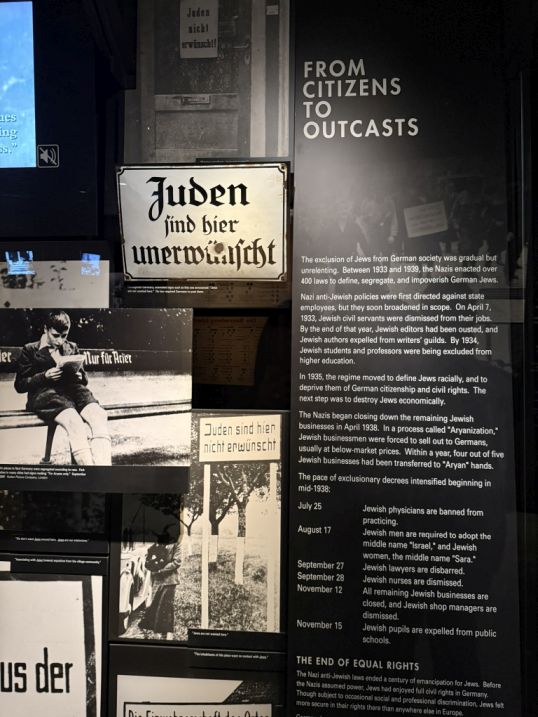
From Citizens to Outcast, this phrase encapsulates the systematic process by which Jewish citizens of Germany were legally and socially marginalized, stripped of their rights, and pushed to the fringes of society. This involved boycotts of Jewish businesses, banning Jews from civil service, professions, and public life. It was a gradual but relentless process of exclusion.
 |
 |
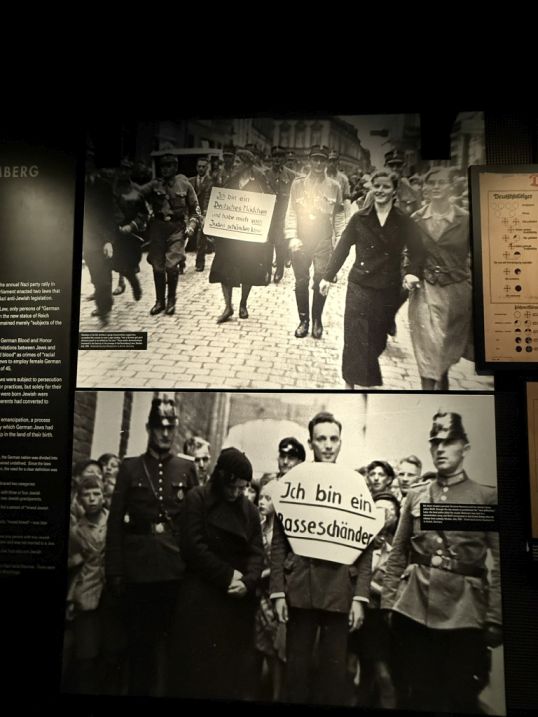
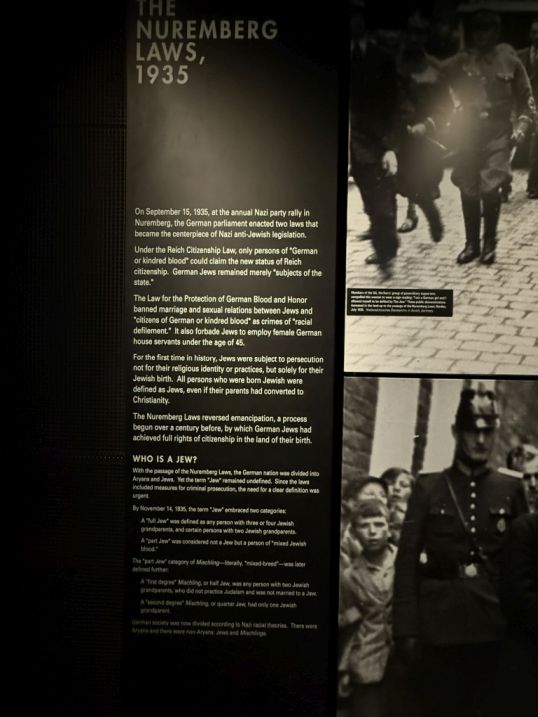
On the left Nuremberg Laws were two infamous laws passed at the annual Nazi Party rally in Nuremberg in September 1935. Reich Citizenship Law: Defined who was a "citizen" of the Reich based purely on "German or related blood," effectively making Jews non-citizens. Law for the Protection of German Blood and German Honor: Prohibited marriages and extramarital relations between Jews and Germans, and forbade German women under 45 from employing Jewish household help. These laws provided the legal framework for racial segregation and persecution. They formalized Nazi anti-Semitism into state policy, clearly defining Jews as a separate, inferior, and dangerous race.
 |
 |
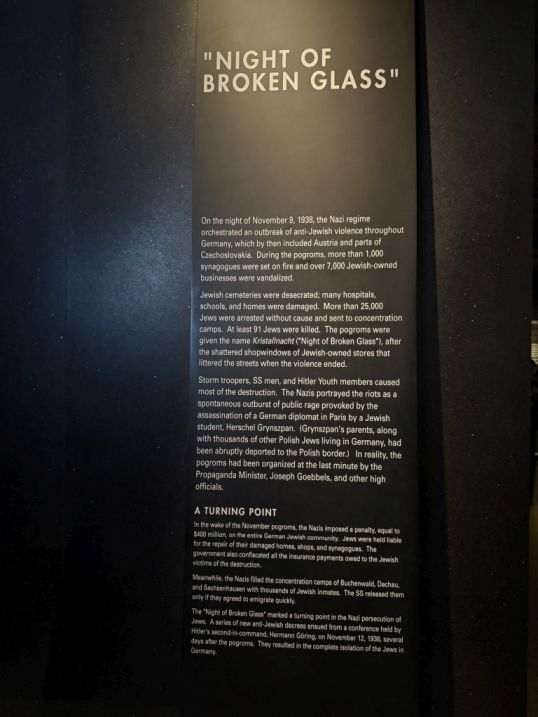
Night of the Broken Glass (Kristallnacht - November 9-10, 1938)-. This was a coordinated, nationwide pogrom (a violent attack sanctioned by the authorities) against Jews throughout Nazi Germany and annexed Austria. Orchestrated by the Nazi regime, SA Stormtroopers and Hitler Youth, aided by civilians, destroyed thousands of synagogues, ransacked Jewish businesses and homes, and brutally attacked Jewish people. Hundreds were killed, and approximately 30,000 Jewish men were arrested and sent to concentration camps. Kristallnacht marked a dramatic escalation in Nazi persecution. It was a turning point, moving from systematic discrimination to open, violent state-sponsored terror. It showed the world the true violent nature of the regime and foreshadowed the mass murder that would follow.
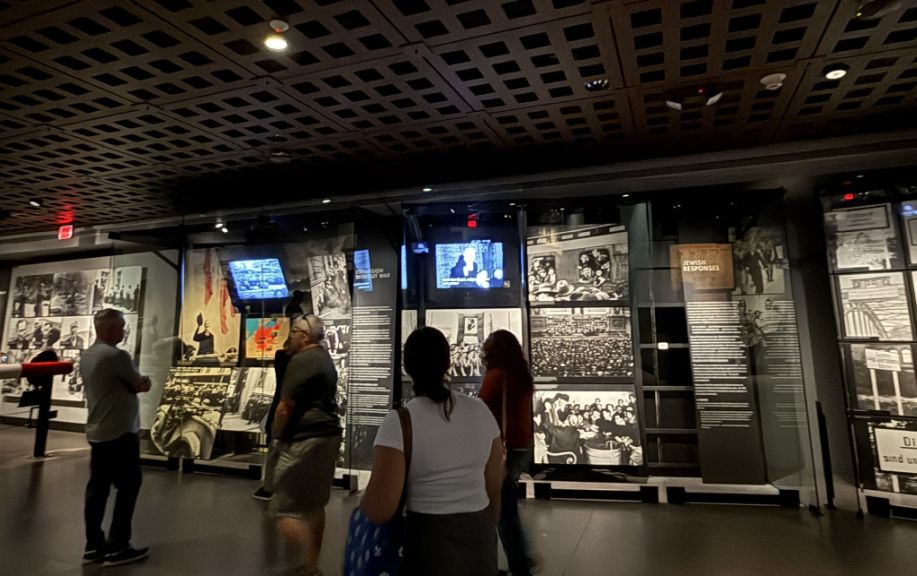
Walking along the Permanent Exhibits.
s
 |
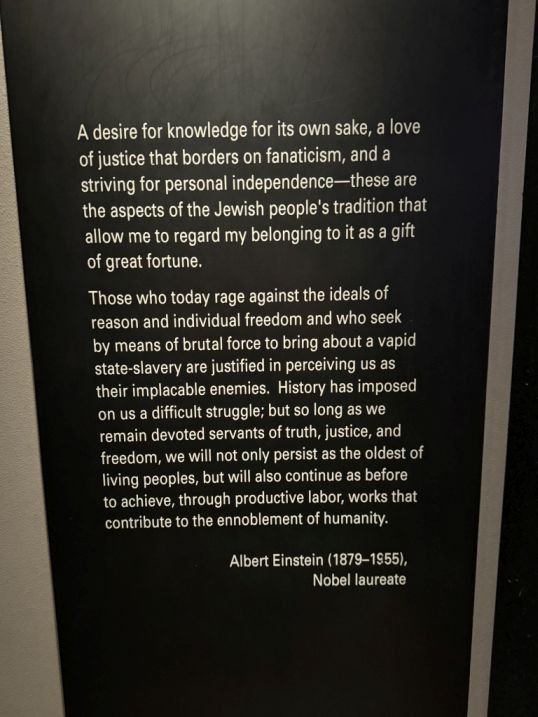 |
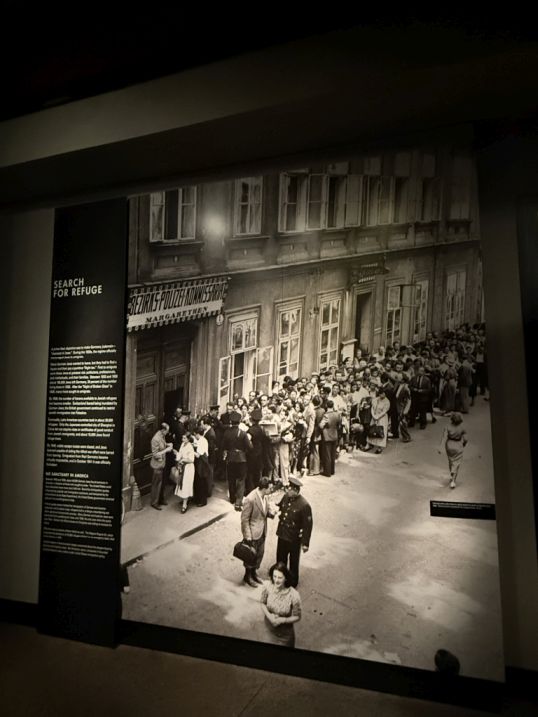
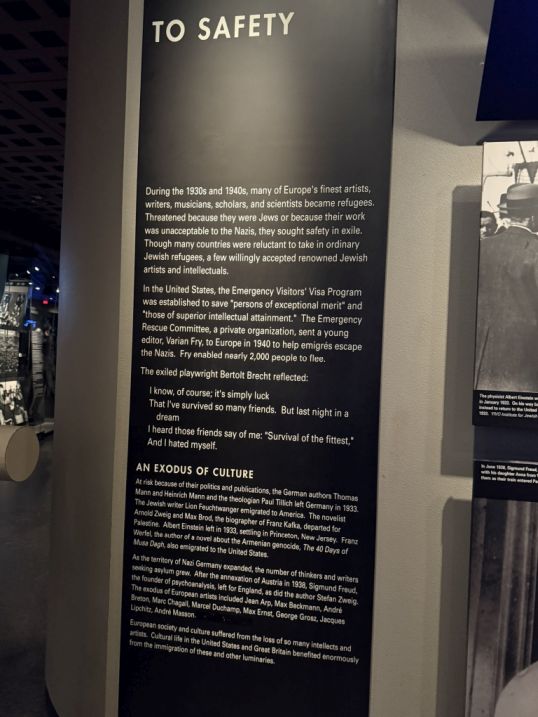
We are now moving through a section of the museum that covers the critical period of Jewish people trying to escape Nazi persecution, as well as the immediate onset of the war and its devastating impact. This part of the exhibition vividly portrays the escalating danger and the desperate efforts to find refuge. The theme of emigration and the desperate attempts of prominent (and ordinary) Jewish individuals to flee Nazi Germany and Austria before the borders closed and systematic mass murder began.
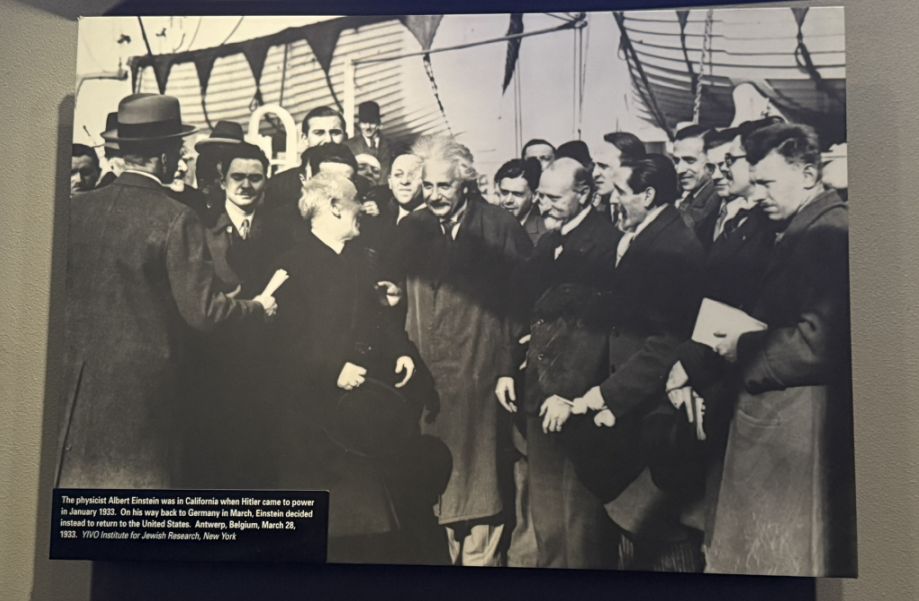
As one of the most famous Jews in the world, Einstein was a prime target for Nazi propaganda and persecution immediately after 1933. He wisely left Germany permanently after Hitler came to power and eventually settled in the United States. The picture of him "surrounded by a lot of men" might show him at an arrival port, a press conference, or with colleagues in his new home, symbolizing the welcome (or at least the ability to find refuge) that some prominent individuals received.
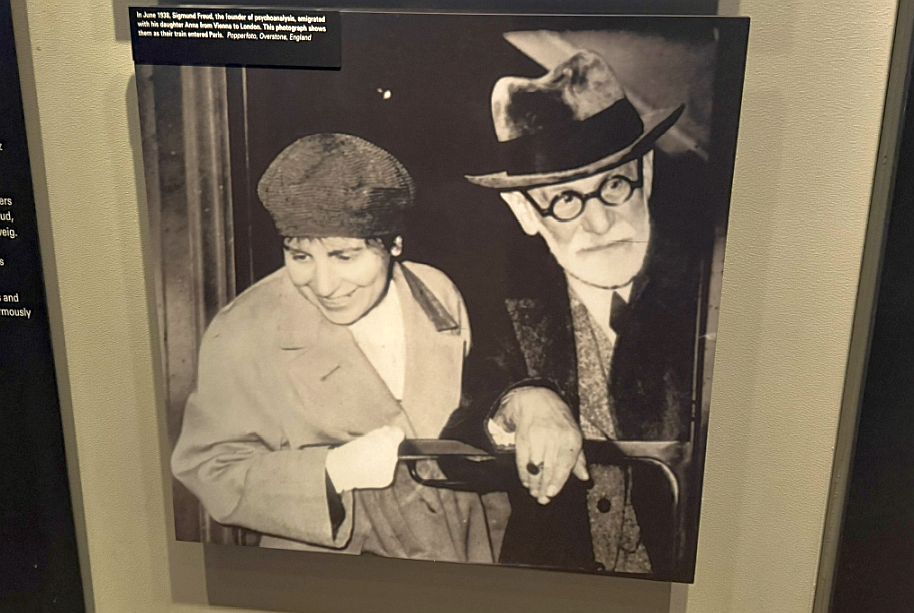
Sigmund Freud on a Train: The renowned founder of psychoanalysis, Sigmund Freud, was an Austrian Jew. After the Nazi annexation of Austria (the Anschluss) in March 1938, his life was in grave danger. With the help of friends and international intervention (including from his former patient Princess Marie Bonaparte, a great-grandniece of Napoleon), he was able to escape Vienna by train to London in June 1938, just a year before his death. This image is a poignant symbol of an intellectual giant, forced to flee his homeland.
These images highlight the desperate choices faced by millions. Even for figures of immense international stature, escape was a harrowing ordeal, often requiring significant influence and resources. For most ordinary Jews, finding a safe haven became increasingly difficult as country after country closed its doors.
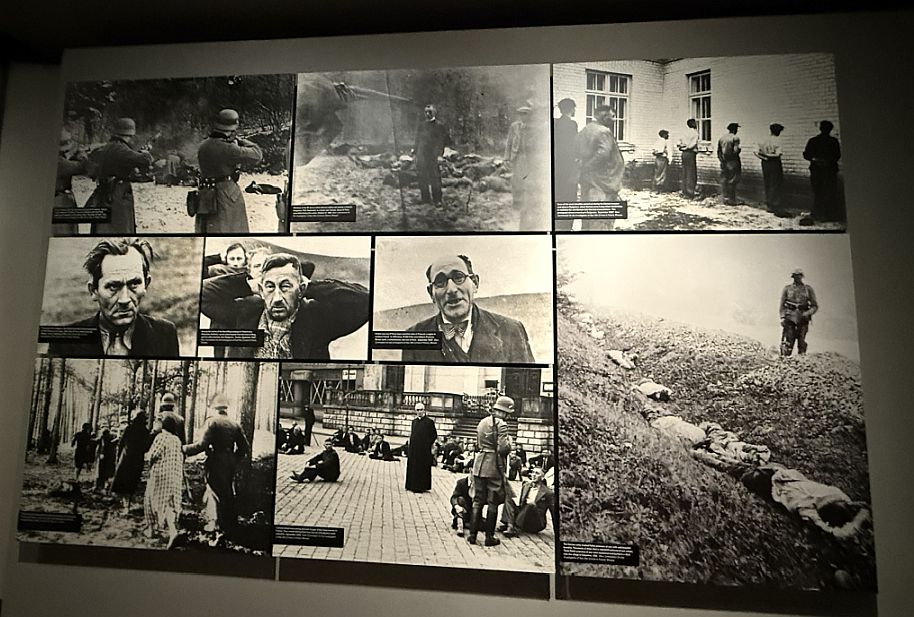
These images mark the dramatic shift from persecution and forced emigration to the outbreak of World War II and the immediate, brutal implementation of Nazi terror, especially in Poland. Bydgoszcz (German: Bromberg): This city was part of the Polish territory invaded by Germany on September 1, 1939, marking the beginning of WWII. Bydgoszcz was the scene of horrific atrocities committed by German forces. This was a series of events in September 1939 where significant numbers of ethnic Germans were killed, likely by retreating Polish forces and civilians, who feared that the Germans were preparing to collaborate with the invading German army. The Nazis then used this incident as a pretext for horrific reprisals against the Polish population, particularly Polish intellectuals, clergy, and Jews. They wildly exaggerated the number of German casualties to justify their brutality.
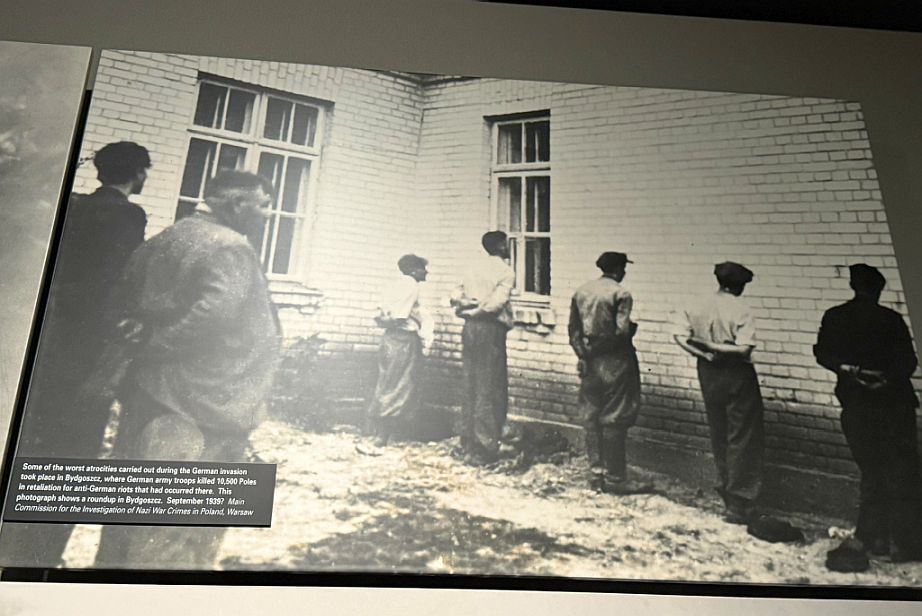
This is a classic depiction of a war crime, an execution. In places like Bydgoszcz, the German invasion immediately led to mass arrests and executions of Polish citizens, including Jews, often without trial. These were part of the Intelligenzaktion, a campaign to eliminate the Polish intellectual and leadership class, and the broader terror aimed at subjugating the Polish population.
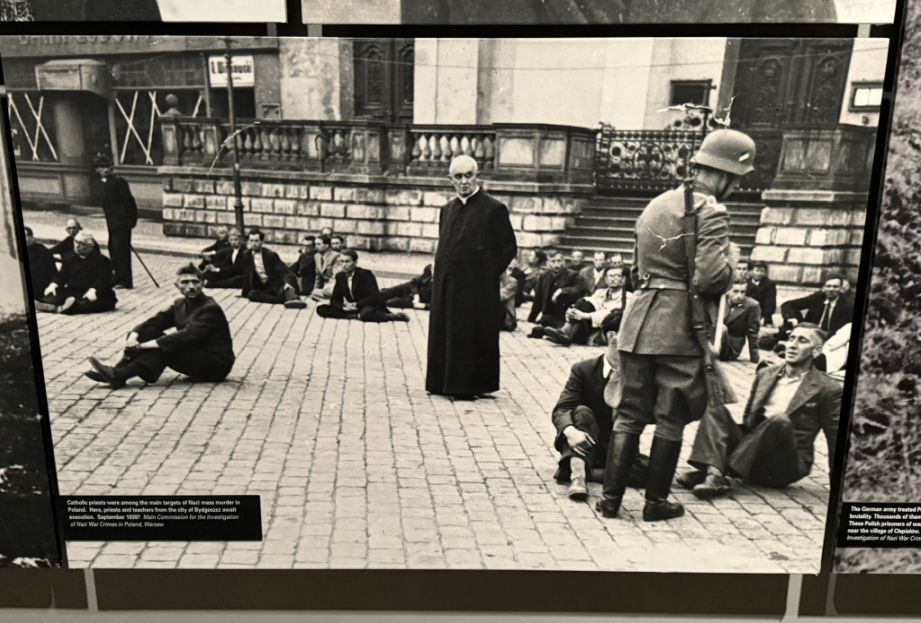
The Nazis viewed the Polish Catholic Church as a powerful symbol of Polish national identity and a potential source of resistance. Priests, along with teachers, doctors, lawyers, landowners, and other educated professionals, formed the backbone of Polish society and its leadership. This was a specific Nazi genocidal plan implemented immediately after the invasion of Poland. Its goal was to eliminate Polish elites (the intelligentsia) to prevent any organized resistance, destroy Polish culture, and prepare the way for Germanization of the Polish lands. Priests and teachers were high on the Gestapo's pre-prepared "Special Prosecution Book-Poland" list of those to be arrested and executed.
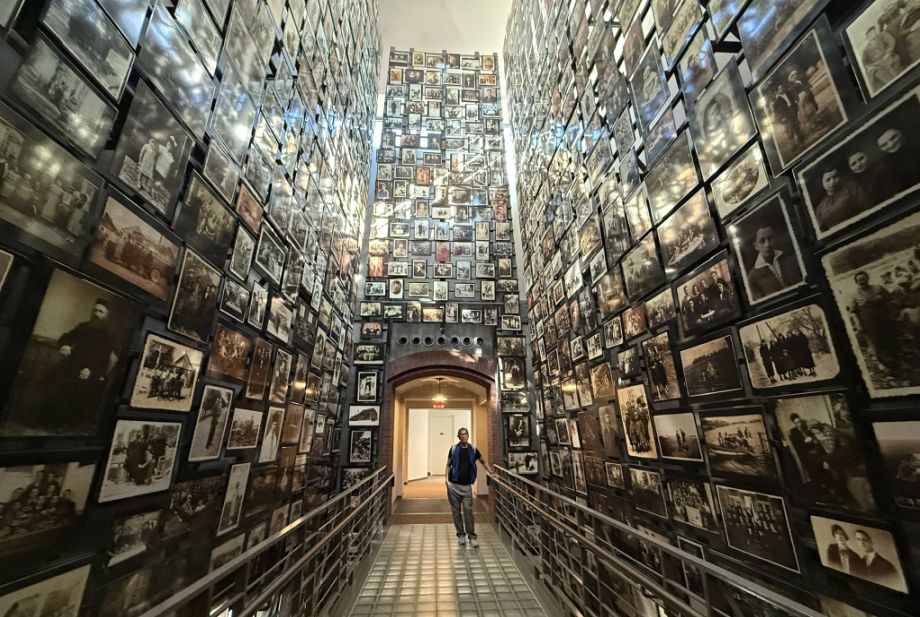
This is the "Hall of Remembrance", often associated with the "Tower of Faces" (which contains thousands of actual family photos) or a dedicated space, is intended to humanize the victims of the Holocaust. After witnessing the statistics and the horrors of mass murder, this room reminds visitors that each victim was an individual, with a name, a family, a life, hopes, and dreams. This room serves as a memorial, ensuring that those who were murdered are remembered not just as victims, but as people who lived full lives.
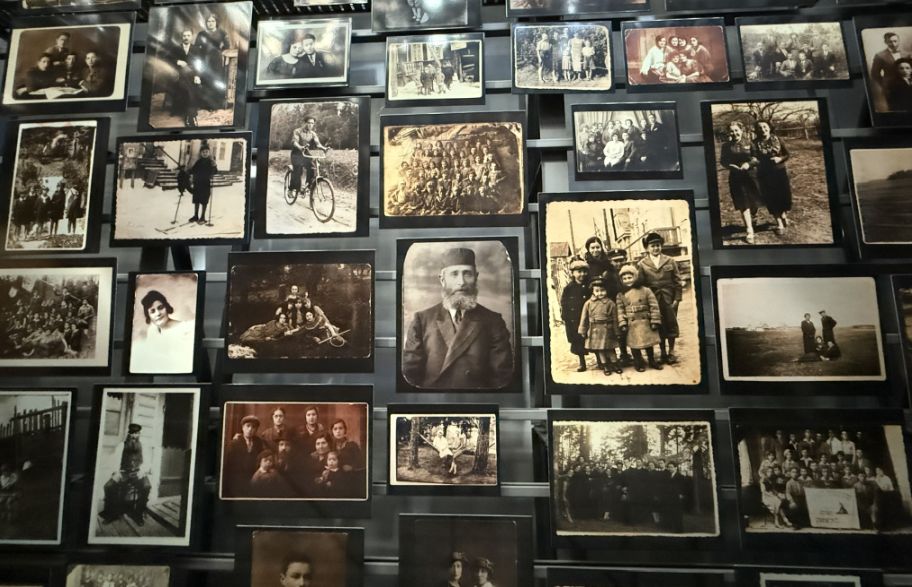
These are often pre-war photographs, showing vibrant Jewish communities, celebrations, daily life, and the faces of people who would ultimately be murdered. They represent the six million lives that were extinguished. The Nazis systematically dehumanized their victims. This display is a powerful counter-narrative, re-establishing their humanity and dignity. Walking through such a room, seeing countless faces, is often one of the most emotionally impactful moments in the museum. It transforms abstract numbers into concrete, heartbreaking losses.
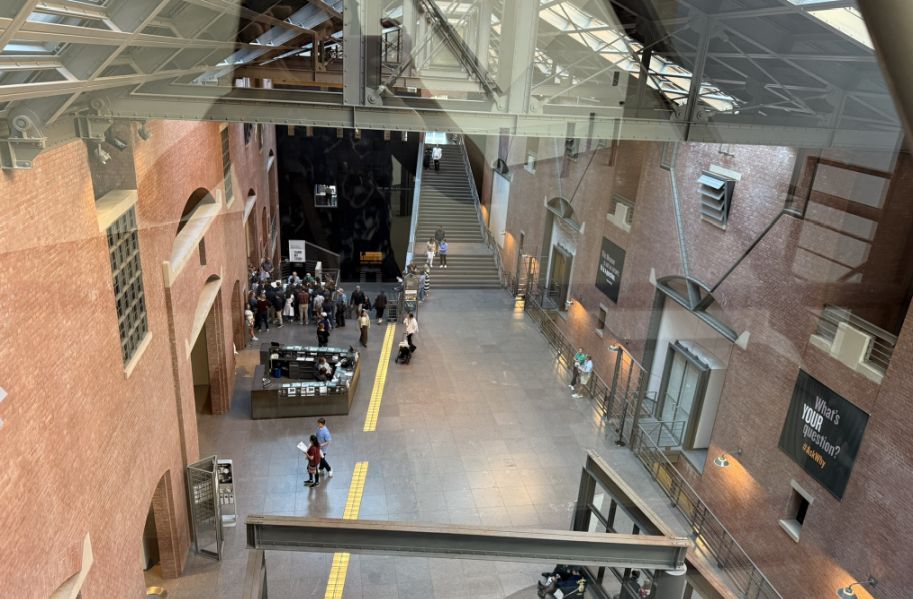
We are now on the second floor looking down below.
 |
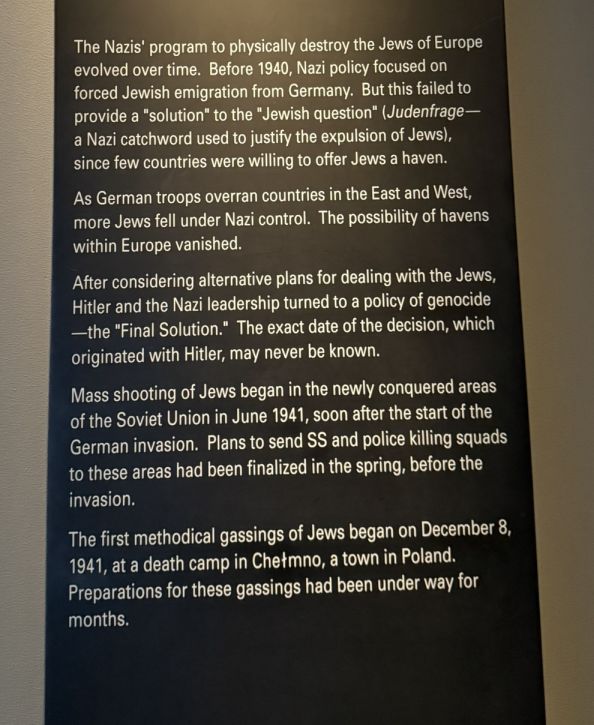 |
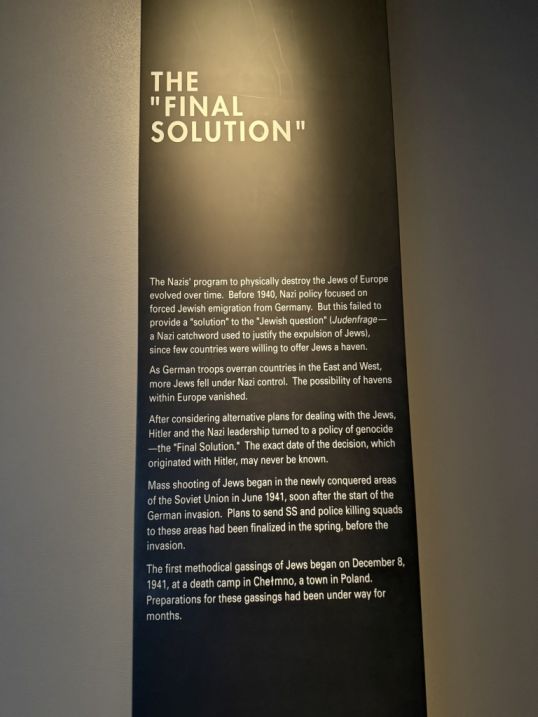
The Final Solution" and its Implementation (1940-1944). this phrase, Die Endlösung der Judenfrage (The Final Solution to the Jewish Question), was the Nazi plan for the genocide of the Jewish people. It evolved from policies of persecution, forced emigration, and ghettoization to outright extermination. This panel introduces the systematic nature of the genocide, signaling that visitors are now entering the phase of the Holocaust dealing with mass killings.
 |
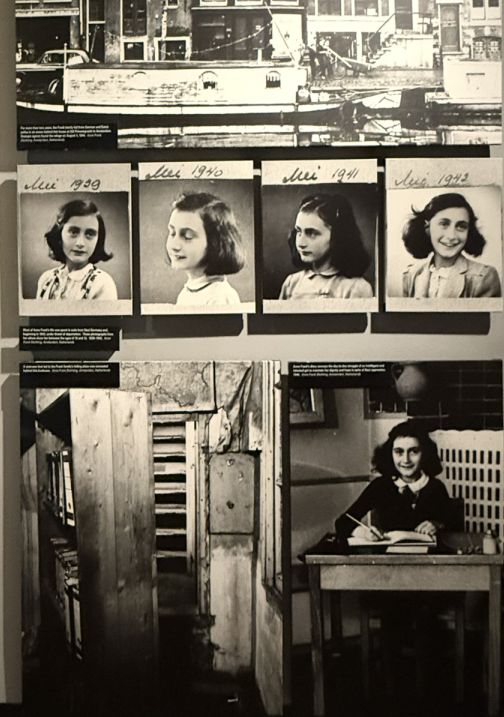 |
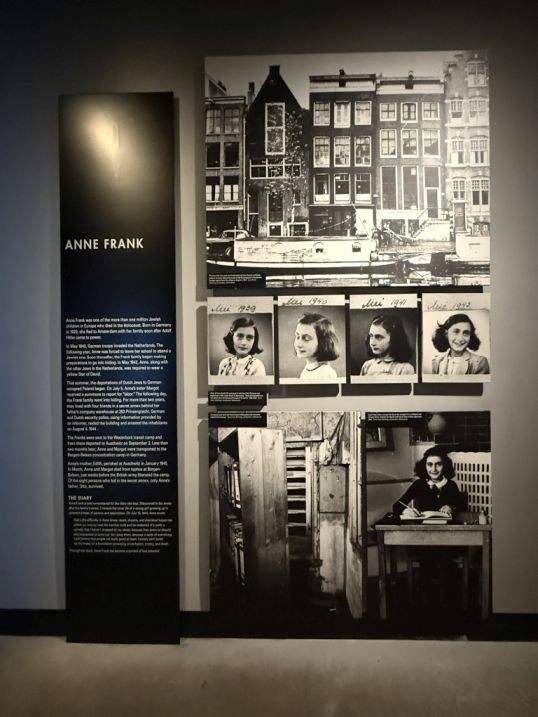
Anne Frank is one of the most famous and poignant victims of the Holocaust. Her Diary of a Young Girl provides a deeply personal and humanizing perspective on Jewish life in hiding during the Nazi occupation of the Netherlands. "The House" or the "Secret Annex" (Achterhuis) in Amsterdam, where Anne, her family, and four others hid from July 1942 until their betrayal and arrest in August 1944. Reproductions or models of the hiding place highlight the claustrophobia, constant fear, and isolation of life in hiding.
Anne Frank's story personalizes the abstract numbers of the Holocaust. Visitors relate to her dreams, fears, and frustrations, making the tragedy of her death (at Bergen-Belsen in early 1945) profoundly impactful. She represents the millions of children and youth whose lives were brutally cut short.
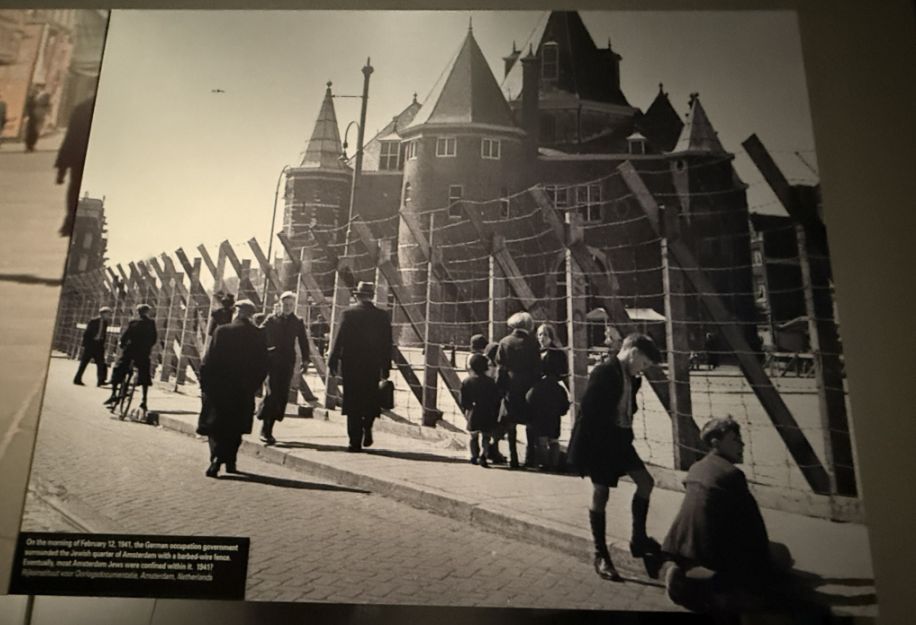
On the morning of February 12. 1941, the German occupation government surrounded the Jewish quarter of Amsterdam with a barbed wire fence. This marks a crucial step in the isolation and eventual deportation of the Jewish population in Western Europe, mirroring events in Eastern Europe.
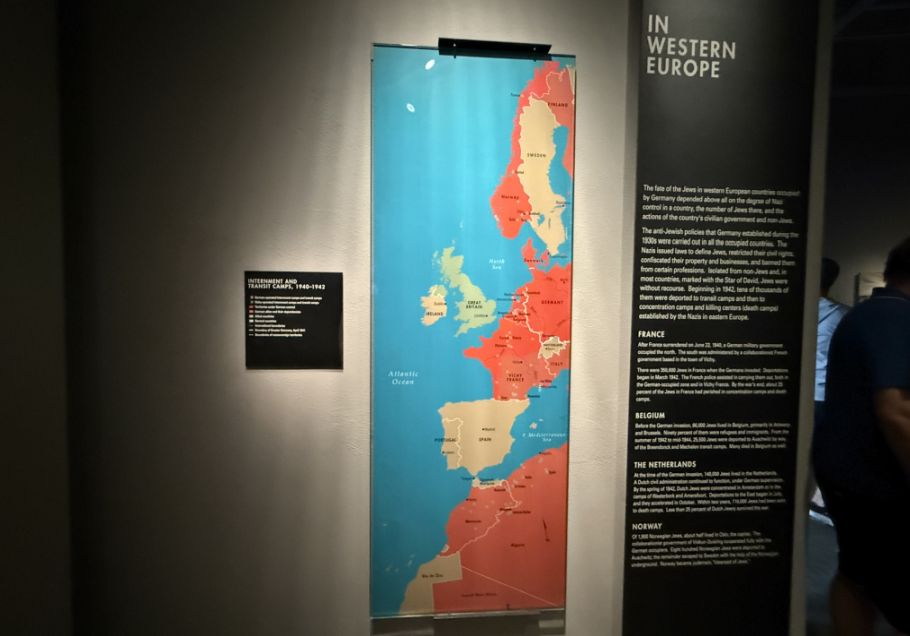
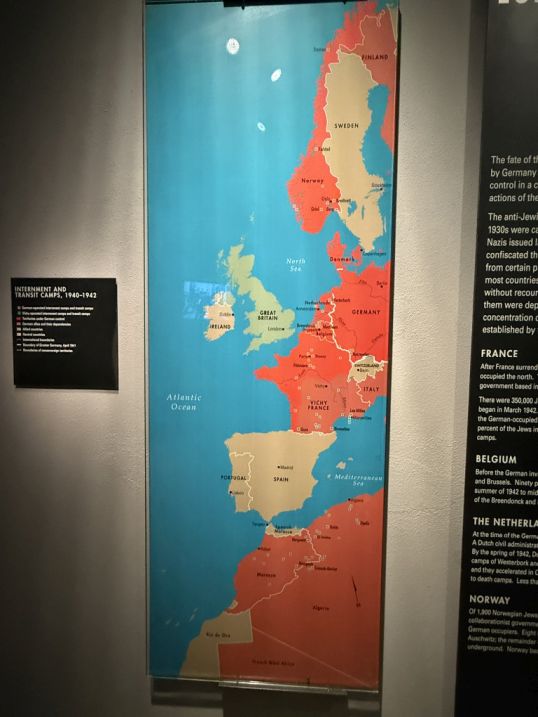
This powerful visual depicts the vast network of camps that the Nazis established across occupied Europe. The "red" indicates the pervasive presence and reach of the Nazi regime's machinery of terror.
 |
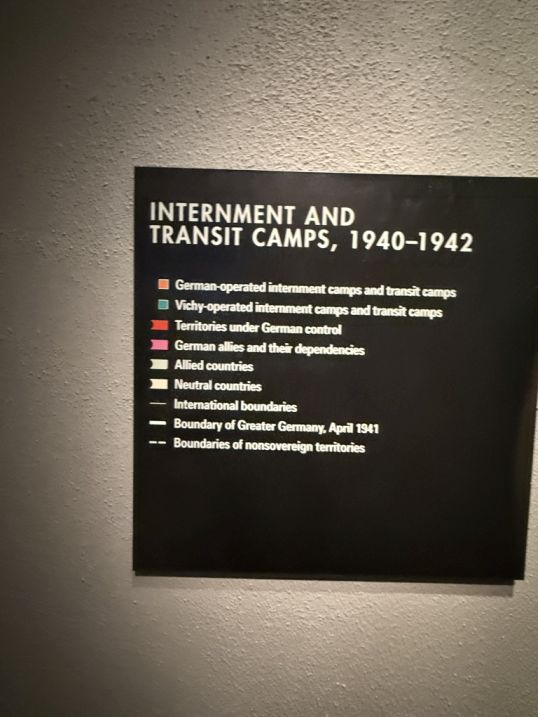 |
Camps where people were imprisoned and held without trial, often for political reasons, or as a prelude to further persecution.
 |
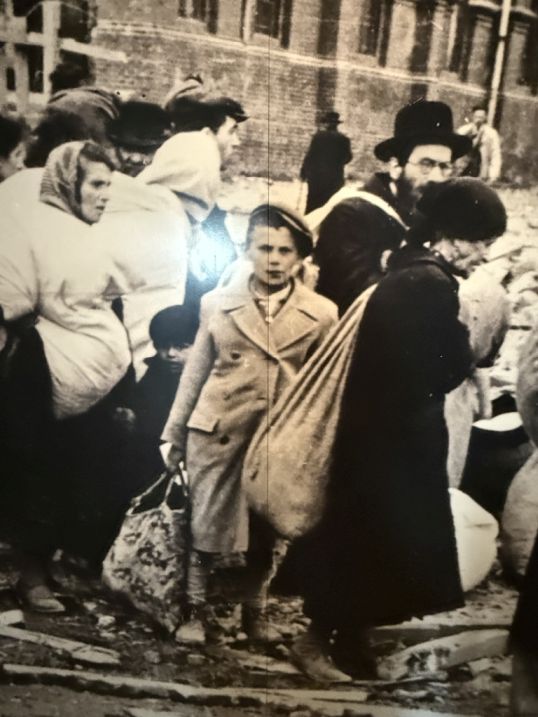 |
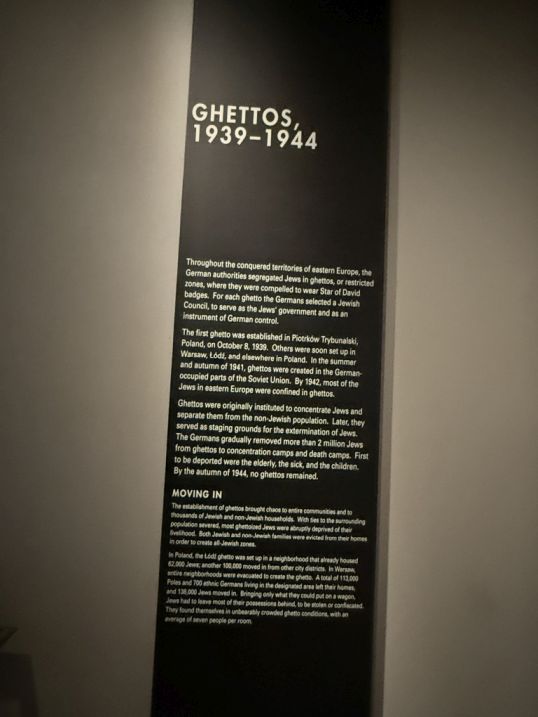
Ghettos were established in hundred of cities and town throughout Poland and the German-occupied parts of the Soviet Union. On October 1, 1942, German authorities set up a ghetto in Drogobych, a town south of Lvov, in the Ukraine. They confined about 10,000 Jews inside it.
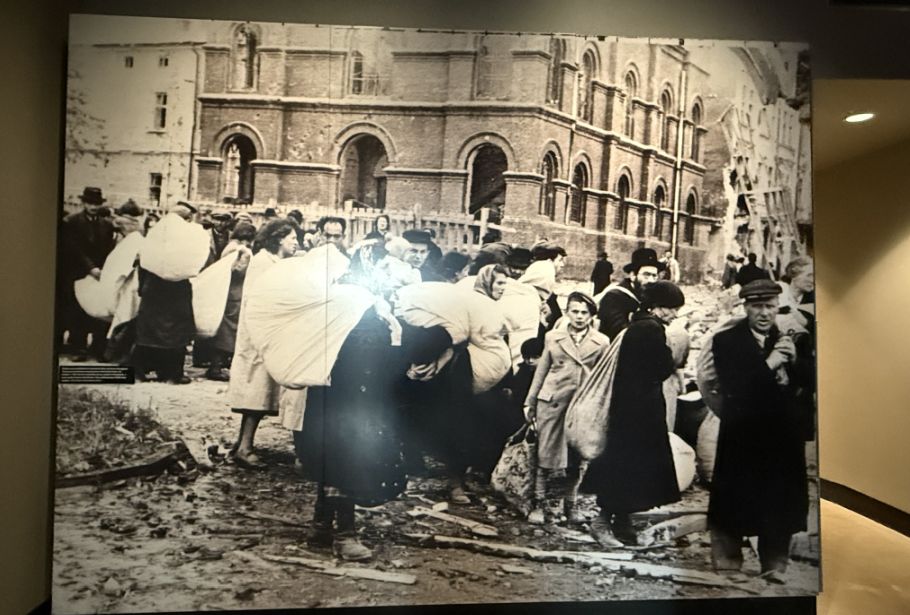
While ghettos in Eastern Europe were often open-air prisons for entire Jewish populations, in Western Europe, the process was more often through forced relocation to specific "Jewish quarters" or "concentration areas," which were then sealed off. Amsterdam's Jewish quarter was one such example.
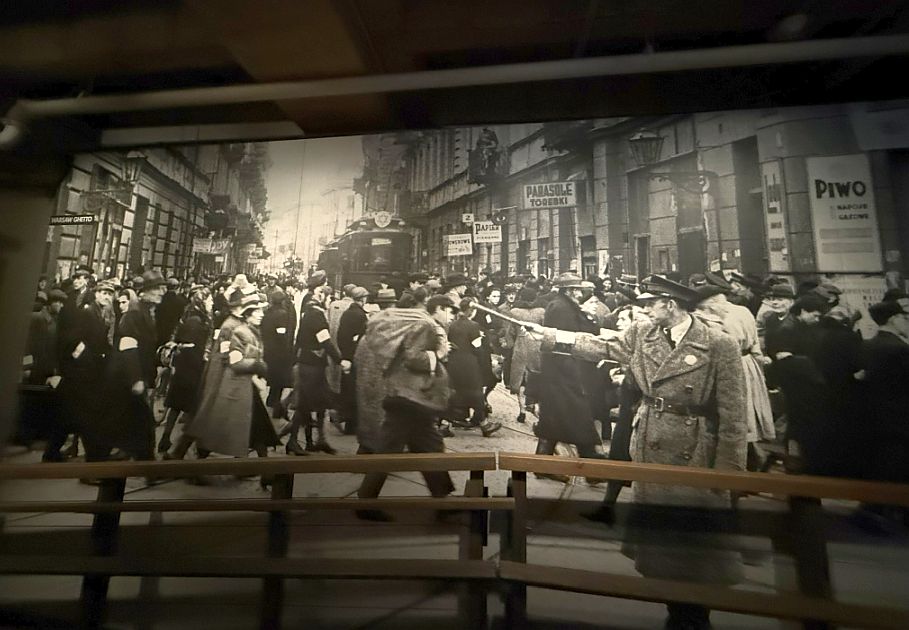
Ghettos were established by the Nazis, primarily in Eastern Europe (most notably Poland), to segregate and confine Jewish populations. They served multiple purposes: to isolate Jews from the non-Jewish population, to exploit their labor, to facilitate starvation and disease, and to make their eventual mass deportation to extermination camps easier.
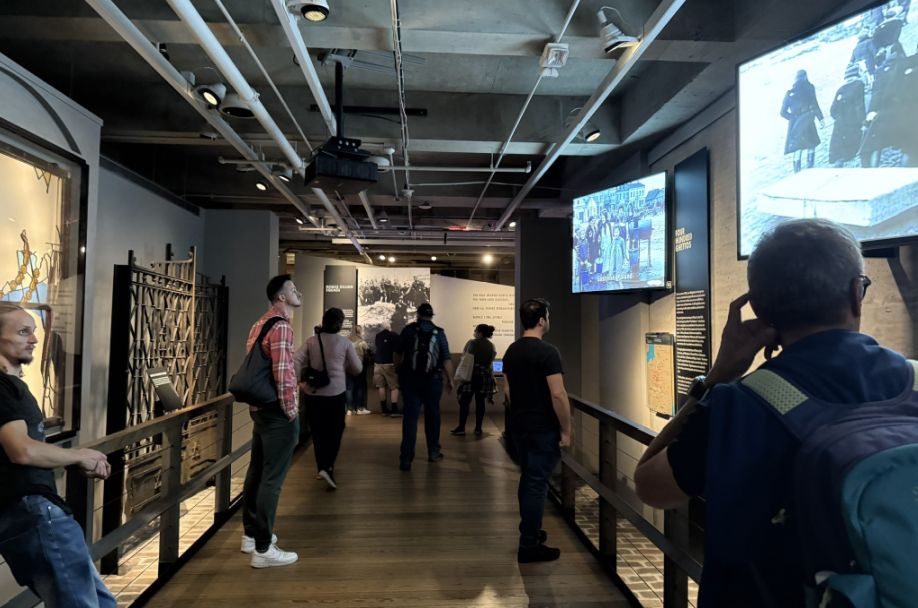
We are now squarely in the section illustrating the grim realities of the ghettos, the horrific process of mass deportations, and the beginnings of life (or rather, existence) in the concentration and extermination camps. This part of the museum is designed to be deeply immersive and visceral, using actual artifacts and stark imagery to convey the inhumanity.
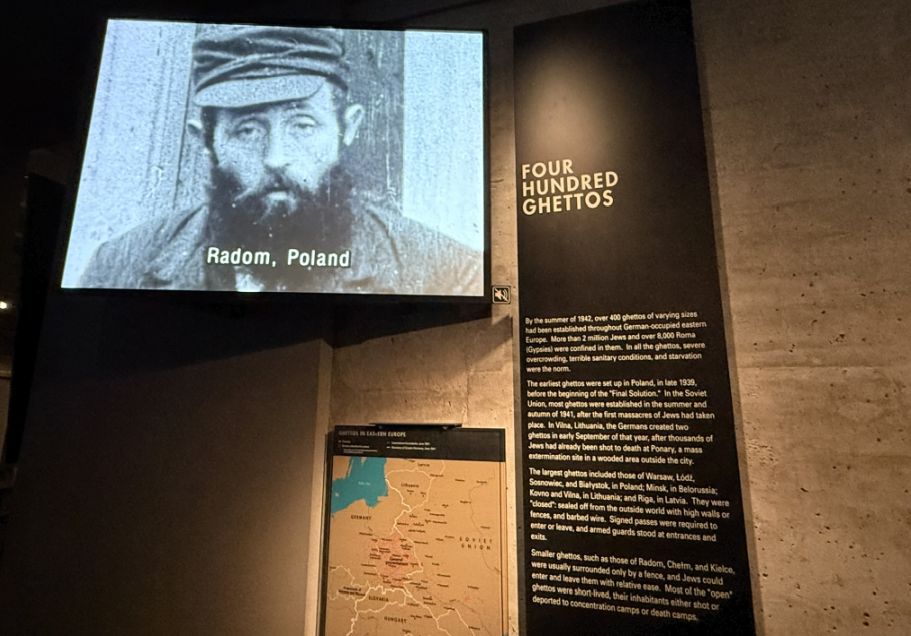
Ghetto Life, Deportation, and Early Camp Existence. This emphasizes the sheer scale of the Nazi policy of ghettoization. The "four hundred" refers to the roughly 400 ghettos established by the Nazis and their collaborators, primarily in occupied Eastern Europe (Poland, Soviet Union, Baltic States). It underscores that ghetto creation was not an isolated phenomenon but a deliberate, widespread, and systematic policy across vast territories, designed to segregate, exploit, and ultimately destroy Jewish communities.
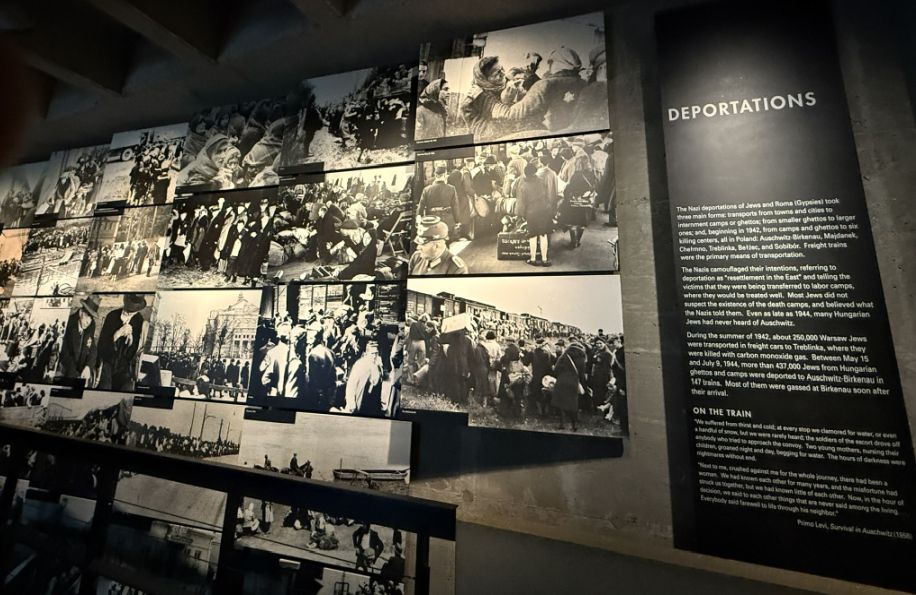
Mass Deportation, refers to the forced transport of millions of Jews from ghettos, towns, and cities across Nazi-occupied Europe to concentration camps, forced labor camps, and, most horrifically, to extermination camps.
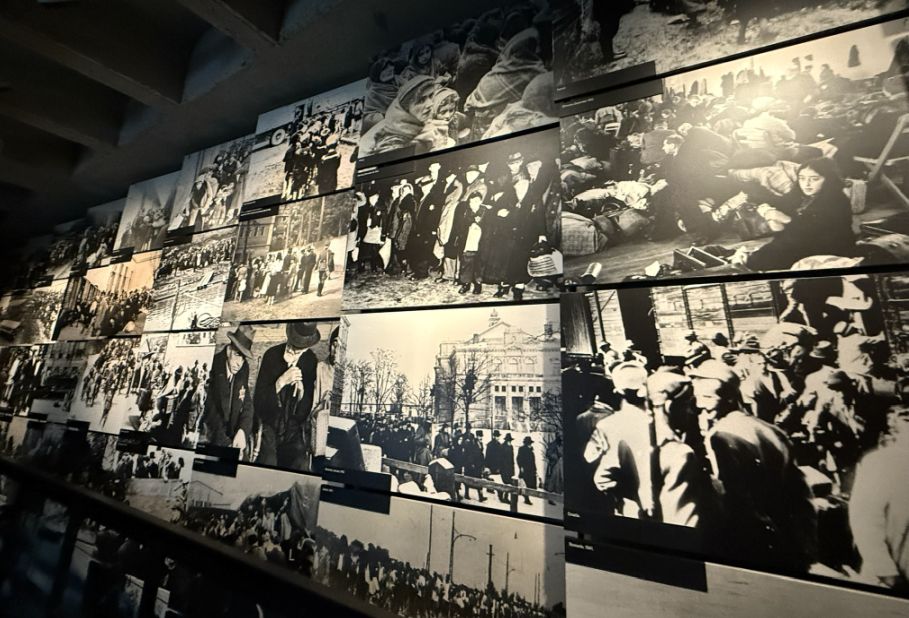
These deportations were typically carried out by train, often in crowded, unsanitary freight cars. The journey itself was brutal, with many dying en route from suffocation, starvation, thirst, or disease.
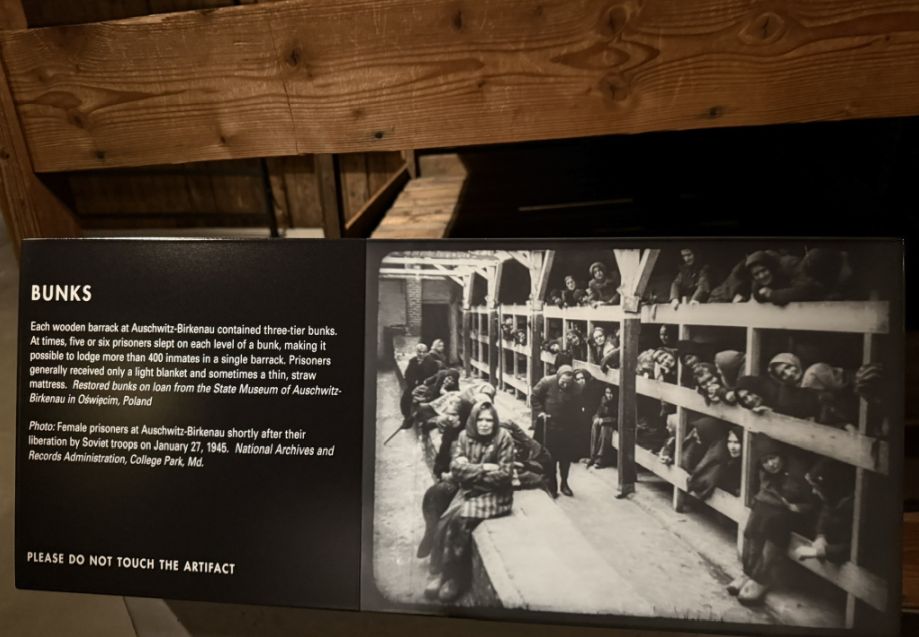
This image would depict the horrific overcrowding and squalor. Multiple individuals would be crammed onto single, narrow wooden bunks, sometimes three or four tiers high. There was little to no personal space, and the bunks often lacked mattresses, blankets, or even enough room for individuals to lie down fully.
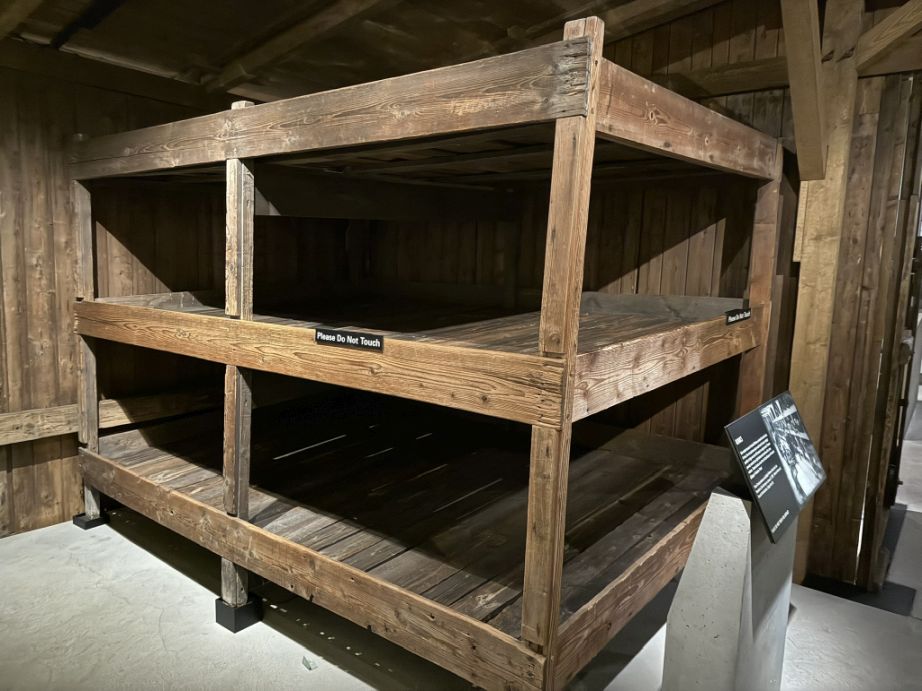
The presence of an authentic wooden bunk on the exhibit floor is a powerful artifact.
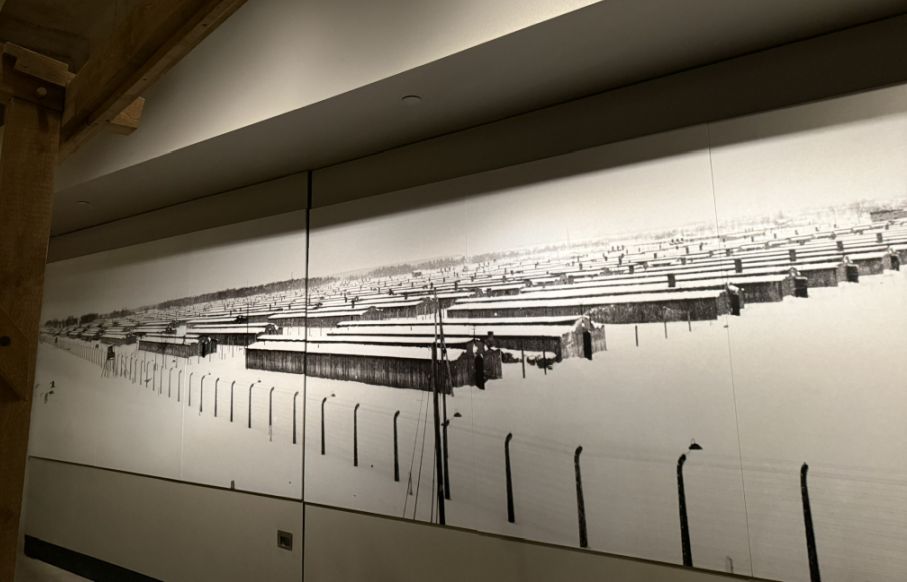
Approximately half of Birkenau camp is visible in this photograph. taken after liberation from the watchtower over the camp's ,main entrance. At the lower right is the railway platform where incoming Jewish prisoners were selected fro slave labor of for immediate gassing. Picture taken on February 1945 by Sovfot, New York.
 |
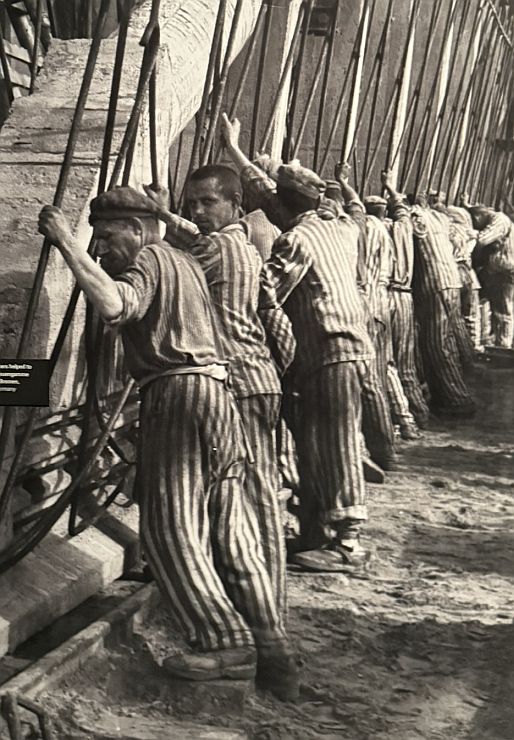 |
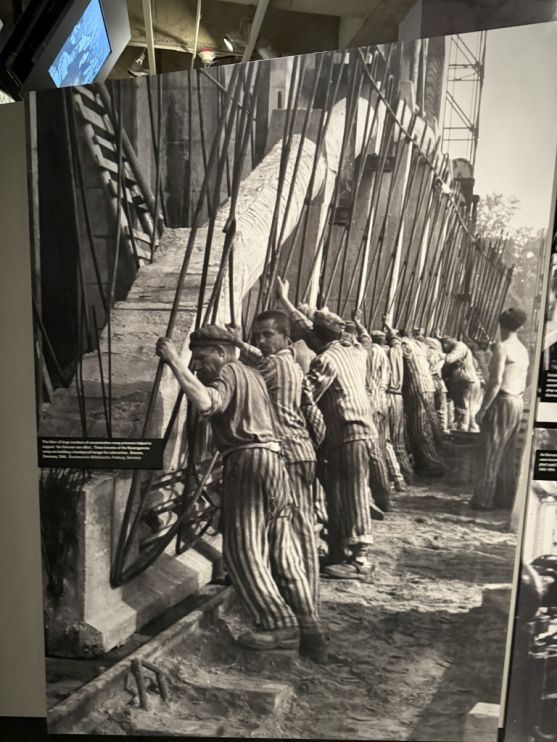
For hundred of German Firms, concentration camps were a source of cheap labor. The assembly line at the Bavarian Motor works (BMW) aircraft engine factory in Allach was manned almost entirely by prisoners. 1940-1044 Archives, Munich, Germany.
The iconic striped uniform (often blue and white or gray and white) was a common issue for prisoners, particularly in concentration camps. It stripped individuals of their personal identity, reducing them to interchangeable numbers.
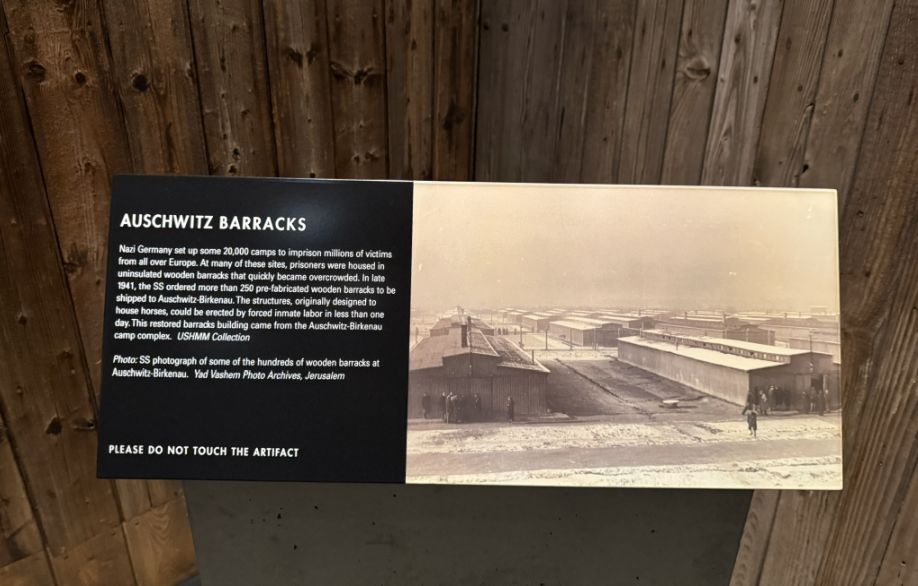
Nazi Germany set up some 20,000 camps to imprison millions of victims from all over Europe. At many of these site, prisoners were house in un-insulated wooden barracks that quickly became overcrowded. In late 1941, the SS ordered more than 250 pre-fabricated wooded barracks to be shipped to Auschwitz-Birkeneau. The structures, originally designed to house horses, could be erected by forced inmate labor in less than one day.
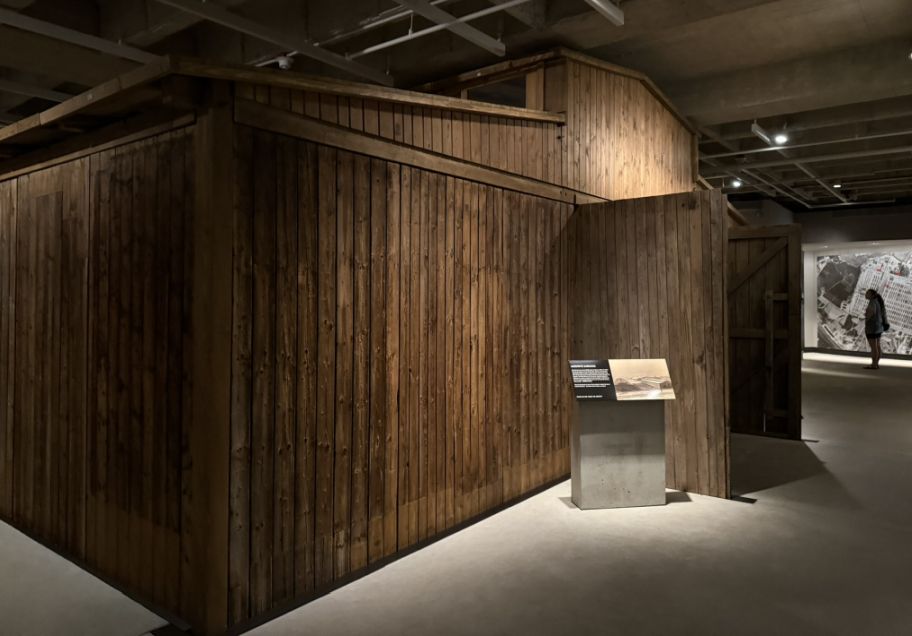
This restored barracks building came from the Auschwitz-Birkeneau camp complex.
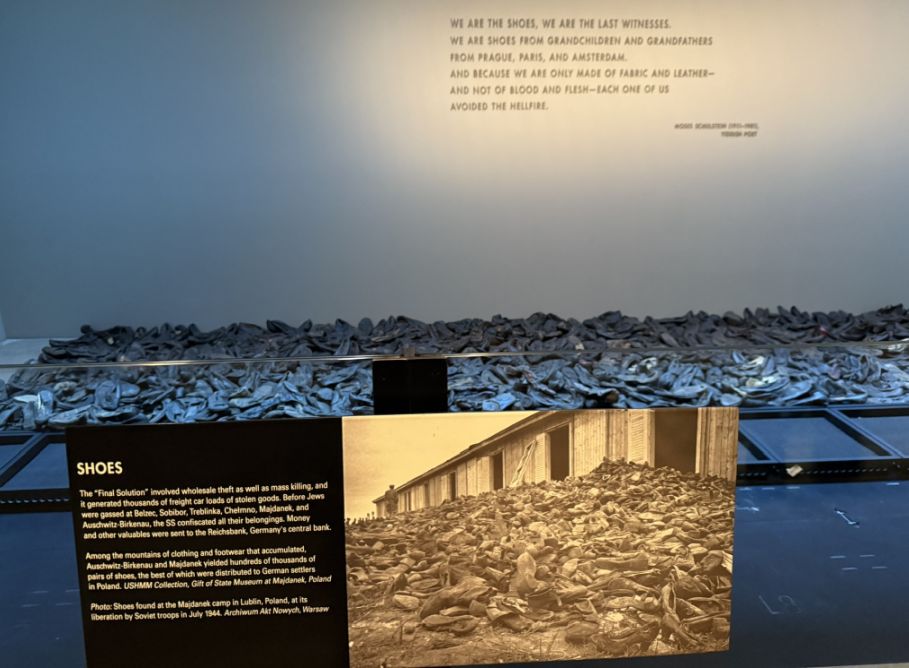
A "Mountain" or Piles of Shoes: The exhibit typically displays a large chest-high, pile of shoes, sometimes contained within a clear enclosure. These are not replicas but actual shoes taken from Holocaust victims. The stripping of personal belongings was a crucial step in the dehumanization process. It robbed victims of their dignity, their identity, and their humanity before they were killed. The shoes are what remained of their earthly possessions.
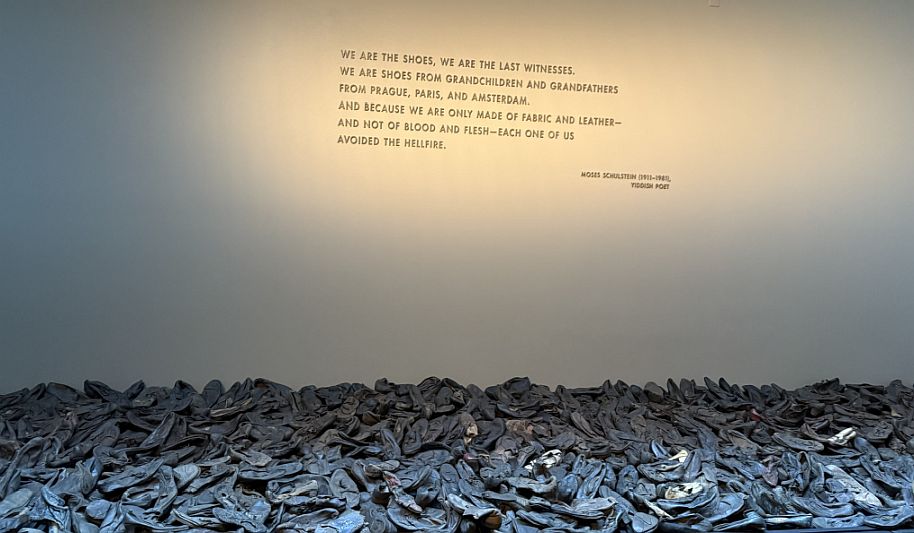
The Quote: "We are the shoes, we are the last witnesses...", this powerful inscription speaks volumes. These shoes were taken from the victims before they were murdered, primarily in the extermination camps like Auschwitz-Birkenau. Upon arrival, prisoners were forced to undress, and their belongings, including their shoes, were confiscated. The sheer volume of shoes, ranging from tiny baby shoes to worn-out adult boots, instantly conveys the unimaginable scale of human lives that were extinguished. It's an overwhelming visual that turns an abstract number into a concrete, physical reality.
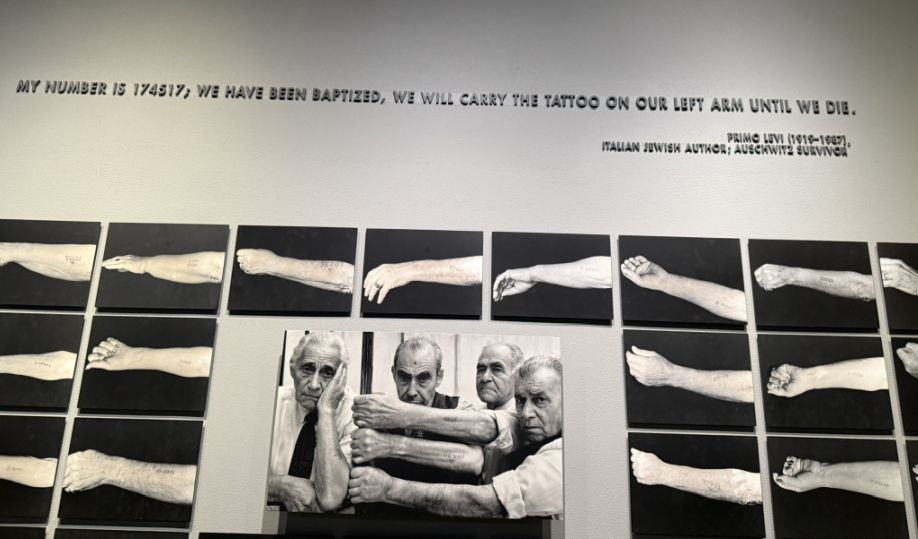
This exhibit is another incredibly powerful and iconic feature of Holocaust museums, focusing on the ultimate act of dehumanization in the concentration and extermination camps: the tattooing of prisoners. A Central Image of Four Men with Tattooed Arms: This is a prominent and often reproduced photograph. It shows four men, possibly survivors, displaying their forearm tattoos. This exhibit captures the essence of the systematic attempt to obliterate individuality and the enduring strength of those who bore this mark, choosing to live and tell their stories despite the trauma. It's a profoundly affecting part of the museum's narrative.
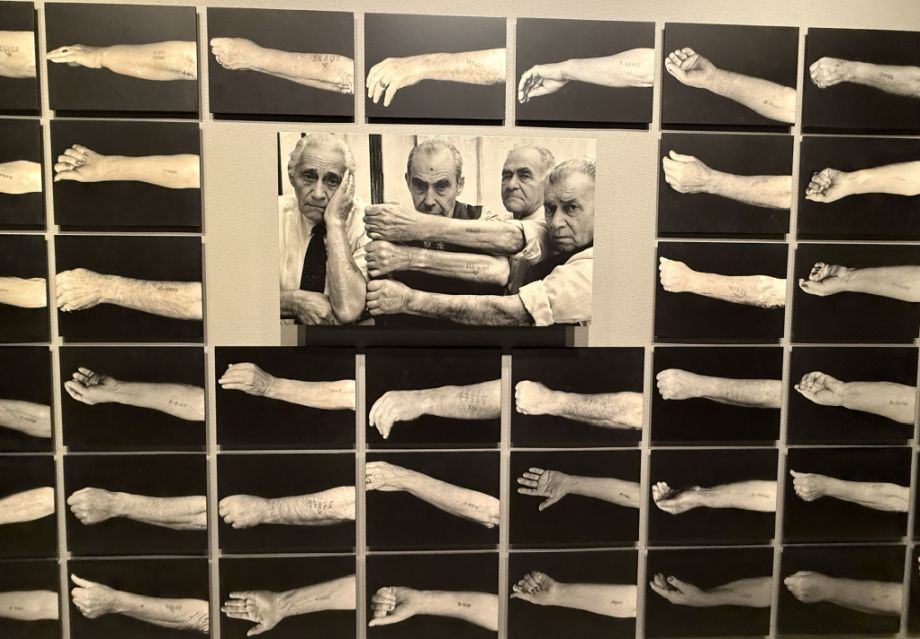
The gallery around this central image further emphasizes the widespread nature of this practice, showcasing many different tattooed arms, belonging to both men and women, often revealing the variety of number sequences and sometimes faint traces of the prisoner's identity beyond the number.
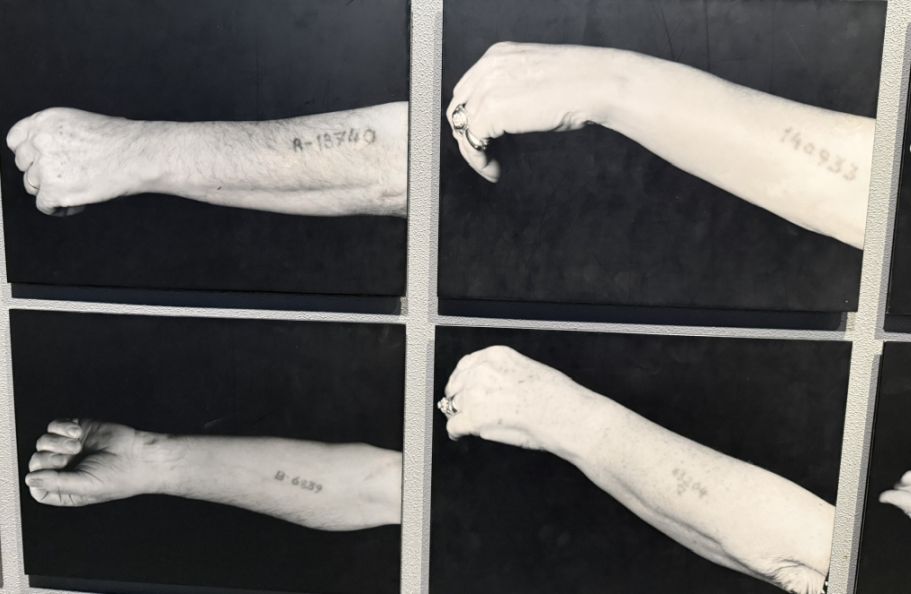
It's crucial to understand that systematic tattooing of prisoner numbers was almost exclusively practiced at the Auschwitz concentration and extermination camp complex (Auschwitz I, Auschwitz II-Birkenau, Auschwitz III-Monowitz, and its sub-camps). Other camps used different methods of identification, such as cloth patches sewn onto uniforms. This means the individuals in these photos were prisoners of Auschwitz. Unlike a uniform patch, the tattoo was permanent, a brand upon the flesh that could not be removed, symbolizing the total subjugation and loss of freedom.
 |
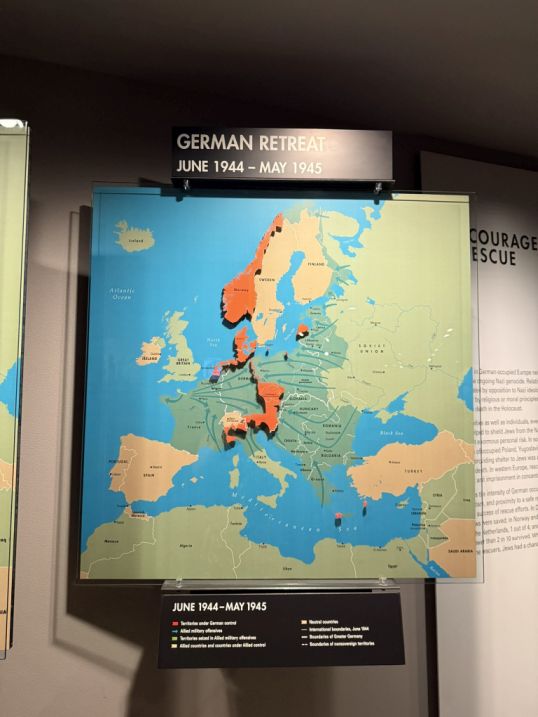 |
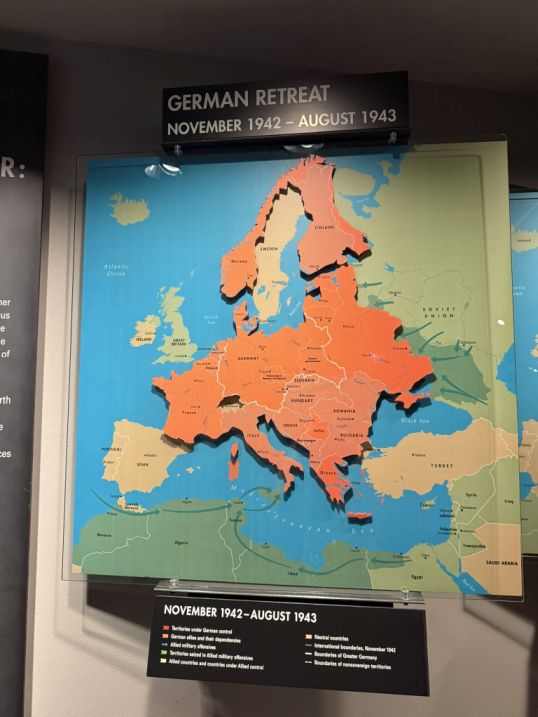
We are now looking at a critical set of maps that visually represent the rise and fall of Nazi Germany's territorial control across Europe during World War II, a dramatic shift that directly impacted the course of the Holocaust.
The Ebb and Flow of Nazi Domination (1942-1943)-This map depicts the absolute zenith of Nazi Germany's territorial control and influence. By 1942, Hitler's forces, with their allies, dominated almost all of continental Europe, stretching from the Atlantic coast of France to deep into the Soviet Union. With so much of Europe under their control, the Nazis had access to millions of Jews who were then rounded up, deported, and systematically murdered in extermination camps, primarily in occupied Poland. The efficiency of the deportations was a direct consequence of this broad territorial control. The map shows the logistical nightmare for anyone trying to escape and the pervasive threat to Jewish communities everywhere.
The map of the right is The Beginning of the End: June 1944 is a pivotal date, marked by the D-Day landings (Operation Overlord) in Normandy, initiating the liberation of Western Europe. This map visually represents the Allies' relentless advance from the West and the Soviet Union's powerful counter-offensives from the East. Territories like France, Belgium, and much of Eastern Europe being liberated from Nazi occupation. The Red Army's continuous westward drive, liberating vast sections of Eastern Europe and eventually reaching Berlin.
 |
 |
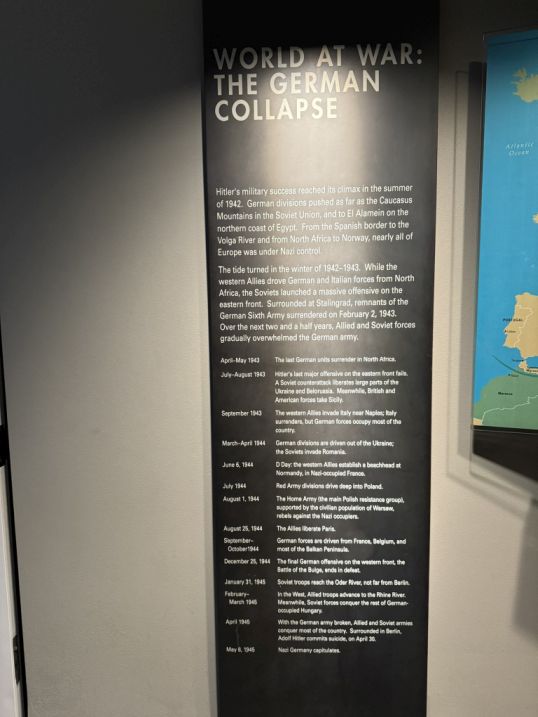
The final collapse in May 1945 (Victory in Europe Day) marked the end of the war and the end of the Nazi regime's ability to carry out its genocidal policies.
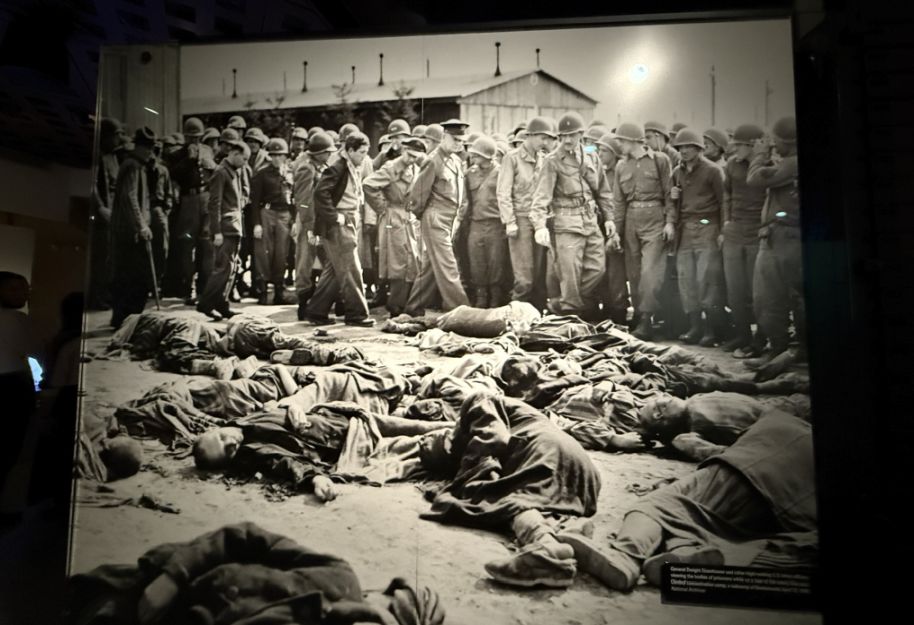
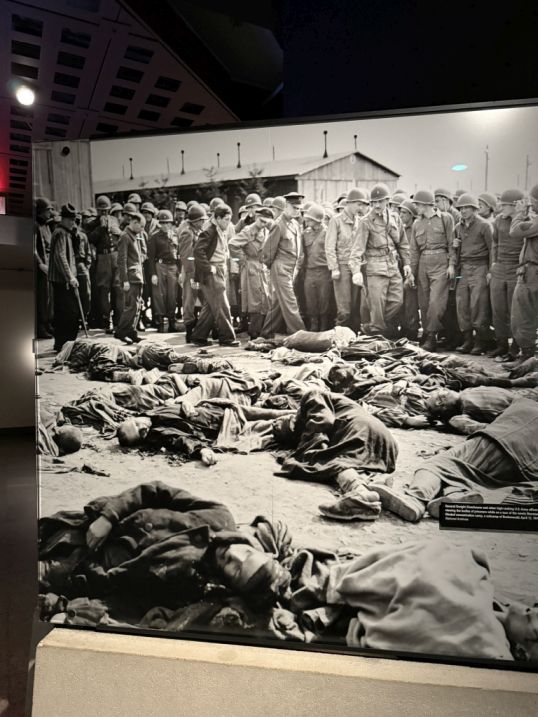
General Dwight Eisenhower and other high-ranking U.S. Army officers viewing the bodies of prisoners while on a tour of the newly liberated Ohrdurf concentration camp, a sub camp of Buchenwalk, April 12. 1945-National Archives. This photograph is one of the most historically significant and chilling images you will encounter at the United States Holocaust Memorial Museum. It captures a pivotal moment when the highest echelons of the Allied command were confronted with the undeniable, horrific reality of the Nazi concentration camp system.
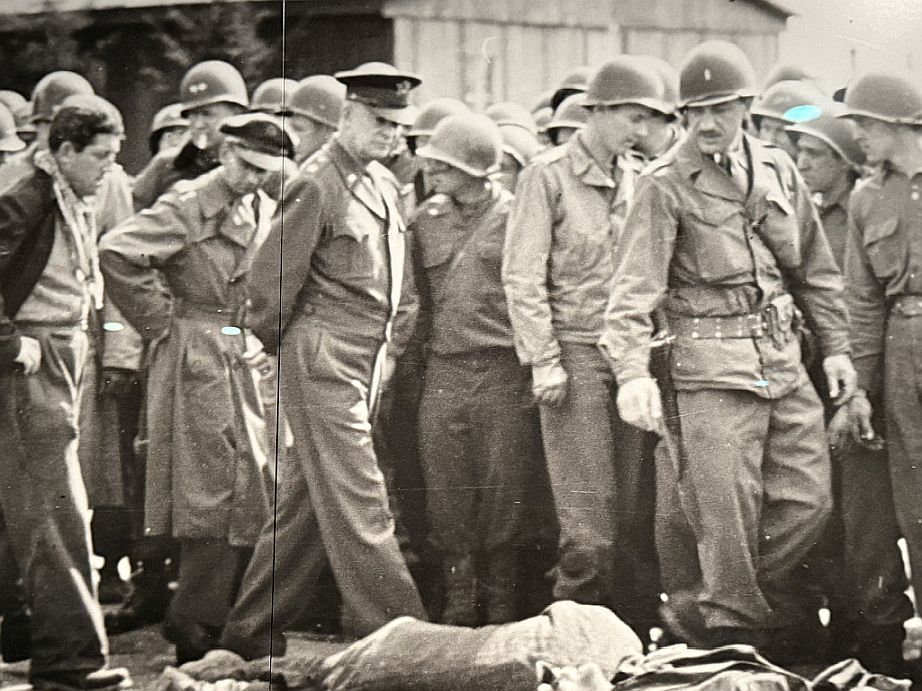
Eisenhower at Ohrdruf: The Confrontation with Unspeakable Evil. The Date: April 12, 1945: This date is crucial. It's just weeks before Germany's unconditional surrender (May 8, 1945) and tragically, also the day President Franklin D. Roosevelt died.
The Place: Ohrdruf Concentration Camp: Ohrdruf was a sub camp of the larger Buchenwald concentration camp system in Germany. It was the first Nazi concentration camp liberated by U.S. troops, specifically by elements of the 4th Armored Division, 89th Infantry Division, and the 80th Infantry Division,
A visit to the Holocaust Museum is educational, emotionally moving, and deeply reflective. It offers a chronological narrative that helps visitors understand how prejudice and hate can escalate into genocide, and why remembering these events matters today.
NEXT... Day 4- Dinner at Blueduck Tavern